If you run a defense contracting firm right now, the environment has gotten objectively harder in the past twelve months. Compliance demands have multiplied; the talent you need is either unavailable or stuck in a clearance backlog, and the AI tools your team adopted to save time may have quietly created a new class of regulatory exposure.
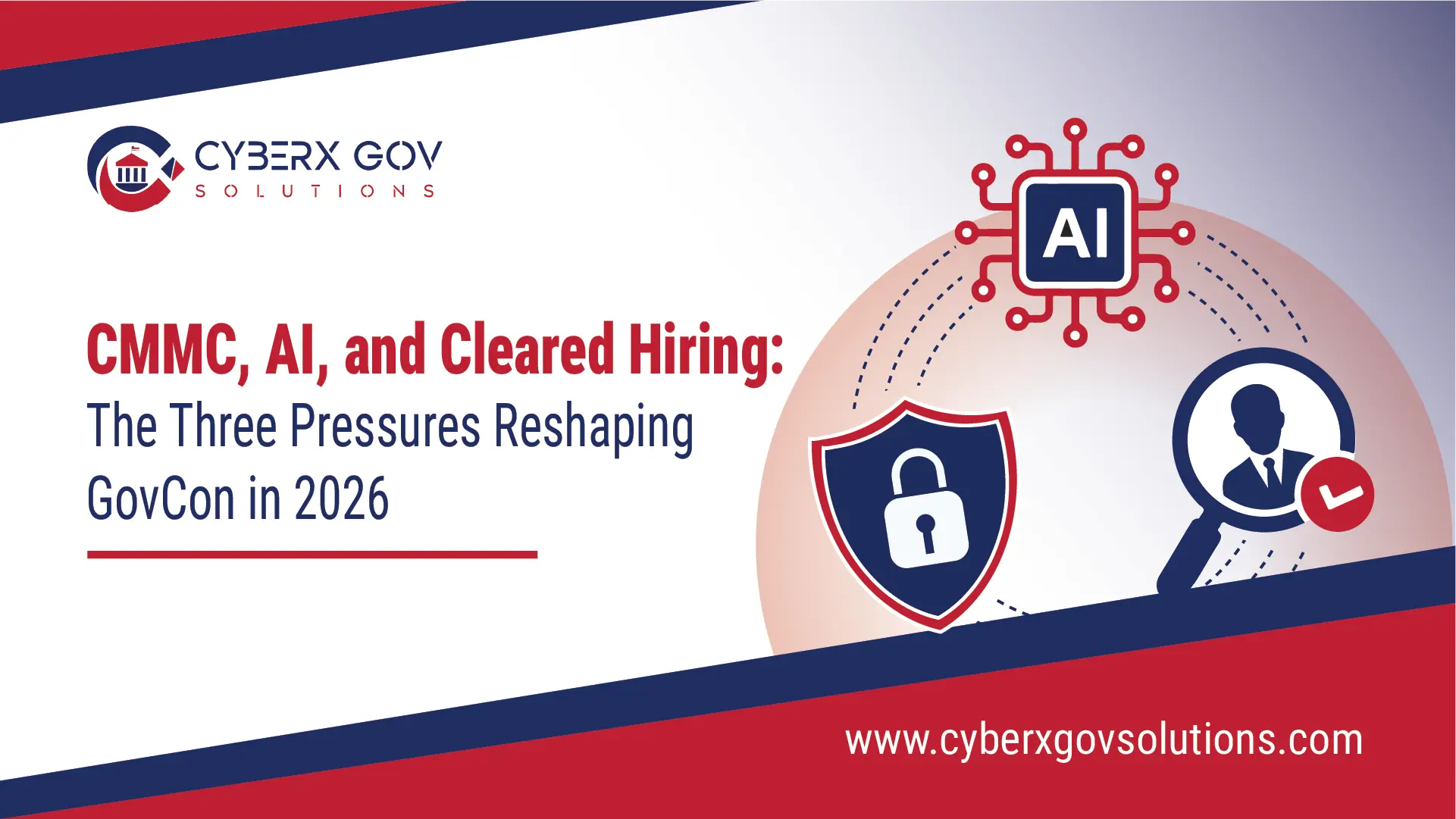
Three forces are driving the most serious government contracting challenges in 2026: CMMC Phase 1 enforcement, AI compliance risk, and a cleared workforce that cannot keep pace with contract demand. None of these is new. All three are intensifying simultaneously. That convergence is the actual problem, and it is why contractors who treat each issue in isolation are consistently underprepared.
This post breaks down what each pressure looks like on the ground, why they interact, and what you need to address before Phase 2 enforcement begins.
Pressure 1: CMMC Phase 1 Is Active, and the Primes Aren’t Waiting
CMMC Phase 1 launched on November 10, 2025. The Department of Defense estimates it will affect approximately 65% of the Defense Industrial Base during this initial phase, which runs through November 9, 2026.
Phase 1 focuses on self-assessment rather than mandatory third-party certification. That framing has led some contractors to treat it as a grace period. It is not.
Lockheed Martin, Boeing, and Northrop Grumman have all issued supply chain directives, making CMMC compliance a condition of continued work. Lockheed is requiring suppliers to document their CMMC status in SPRS and is actively encouraging C3PAO certification now, noting that some FY2026 contracts may already carry out that requirement. Boeing has stated explicitly that suppliers handling FCI or CUI will be required to have the CMMC level specified in solicitations as a condition of contract award.
If your firm depends on any major prime for a meaningful share of defense revenue, Phase 2, which begins November 10, 2026, is not your real deadline. In practice, you have already passed it.
There is a longer regulatory timeline in motion, too. The FY2026 National Defense Authorization Act, under Section 1513, directs DoD to build an AI/ML cybersecurity framework as a direct extension of the CMMC program. The DoD must deliver a status update to Congress by June 16, 2026. Contractors who develop, deploy, store, or host AI/ML systems for the Pentagon are defined as covered entities under this provision and will face additional requirements once the framework is incorporated into DFARS.
For context: CMMC began as a provision in the FY2020 NDAA and took years to finalize. Many contractors were caught unprepared. The same pattern is repeating, just faster.
Pressure 2: Your AI Tools Are Already a CMMC Problem
Most defense contractors are not building AI systems for the DoD. But most are using AI tools internally, writing proposals, summarizing performance reports, drafting Statements of Work, and cleaning up technical documentation.
That day-to-day usage is where compliance exposure lives.
Under CMMC Level 2 scoping rules, any system that processes, stores, or transmits Controlled Unclassified Information is a CUI asset. When an employee pastes CUI into a commercial AI tool like ChatGPT, Gemini, GitHub Copilot, or Grammarly, that service becomes an External Service Provider within your assessment boundary. Under DFARS 252.204-7012, any cloud service that handles CUI must meet FedRAMP Moderate authorization at a minimum. None of those consumer-grade tools currently carries that authorization for CUI.
The practical consequence: if your organization submits a CMMC self-attestation while employees are sending CUI to non-FedRAMP-authorized AI services, you are asserting compliance you do not have. Legal analysts at OSIbeyond have noted that this scenario puts contractors directly in False Claims Act territory.
Compliant options do exist. Microsoft 365 GCC High, Azure Government, and AWS GovCloud meet the authorization thresholds. But the gap between “we have Microsoft Copilot” and “our Copilot deployment is operating within a compliant FedRAMP boundary” is significant, and most small and mid-sized GovCon teams have not evaluated which side of that gap they occupy.
AI spillage into unvetted tools also rarely looks like a dramatic incident. It looks like a program manager using an AI assistant to draft meeting notes that reference contract deliverables. It looks like a proposal writer feeding a prior government contract into a chatbot to build a new bid structure. These are normal workflow behaviors, and they create compliance exposure that an assessor will find.
The Section 1513 framework coming in 2026 will make this more explicit, not less. The DoD framework will specifically address data poisoning, adversarial tampering, and unintentional data exposure as AI-specific risk categories. Contractors who have not already audited their AI tool usage are building compliance debt that compounds over time.
Pressure 3: Cleared Talent Is Not Getting Easier to Find
The defense contractor’s workforce has a structural supply problem, and compliance deadlines make it worse.
Deltek’s Clarity report, based on 917 contractor responses collected in early 2026, found that talent attraction and retention are the primary concerns for the year ahead. Labor costs ranked as the biggest cost driver, ahead of overhead and subcontractor expenses. The GovCon market grew 15% on average in 2025, but growth without the workforce to execute it creates its own compounding risk.
Security clearances remain in the core bottleneck. Background investigations are thorough, slow, and sequential. Interim clearances have accelerated some positions, but sensitive roles still require full adjudication. The practical implication: hiring timelines need to be set well ahead of contract start dates, not triggered by them.
Cleared talent is also geographically concentrated. Washington D.C., Huntsville, and Colorado Springs account for a disproportionate share of available, cleared professionals. Contractors outside those markets or competing within them are working from a thinner bench than their pipeline would suggest.
Some firms are addressing this by sponsoring clearances for qualified candidates who lack government access. Others prioritize hiring veterans with active clearances to reduce onboarding delays. Both require a structured pipeline, not reactive recruiting after a task order is already in hand.
AI is being positioned as a partial solution here. Deltek found that 98% of human capital management respondents expect to use AI to streamline onboarding and automate administrative hiring tasks. That adoption is reasonable given the volume of pressure contractors face. But the AI tools handling those processes still need to sit within a compliant boundary, which brings you directly back to Pressure 2.
Why These Three Forces Compound Each Other
Each of these government contracting challenges in 2026 is manageable in isolation. Together, they compete for the same internal bandwidth.
A contractor pursuing CMMC Level 2 needs a documented System Security Plan. Writing an SSP is time-consuming. AI tools can accelerate it, but only when deployed within an authorized boundary. A contractor using commercial AI to draft SSP content while handling CUI is creating exactly the kind of exposure CMMC exists to prevent.
Cleared hiring timelines are long. Contractors managing active CMMC preparation simultaneously find that compliance work competes with business development, program execution, and recruiting. Firms that avoid major disruption usually get outside help with at least one function, typically cleared staffing or compliance readiness, so internal teams are not stretched across all three.
What Defense Contractors Should Address Before Phase 2
On CMMC:
- Conduct a gap assessment against NIST SP 800-171 now, not after your next solicitation arrives
- Document your System Security Plan with accurate technical descriptions, not AI-generated placeholders
- If you handle CUI and depend on prime contractors, treat compliance as a current condition of business, not a future regulatory requirement
- Book your C3PAO assessment early; schedules are filling ahead of Phase 2
On AI:
- Audit every AI tool your team currently uses and map each one against your CMMC assessment boundary
- Determine which tools are FedRAMP-authorized for CUI and which are not
- Publish an acceptable use policy that explicitly covers AI tools and data classification levels
- Train your staff on the specific workflows where exposure is highest: proposal writing, document drafting, meeting summaries, and SSP development
On Cleared Hiring:
- Start recruiting six to twelve months before the projected contract need, not when the task order is awarded
- Sponsor clearances for strong candidates who lack current government access
- Prioritize hiring veterans with active clearances to cut onboarding delays
- Work with a cleared staffing partner who maintains an active pipeline rather than responding to postings reactively
These are not strategic recommendations. They are the operational baselines that Phase 2 enforcement and prime contractor directives are already requiring.
Frequently Asked Questions
What is CMMC Phase 2, and when does it take effect?
Phase 2 begins November 10, 2026. Contracting officers will start requiring C3PAO-assessed Level 2 for CMMC status in applicable defense solicitations. Phase 3, which begins November 10, 2027, extends Level 2 certification requirements to existing contracts through option exercises. Contractors who have not begun preparation are unlikely to be assessment-ready before Phase 2 is active.
Are commercial AI tools like ChatGPT a CMMC compliance risk?
Yes, if they are used to process Controlled Unclassified Information. ChatGPT, Gemini, GitHub Copilot, and Grammarly do not carry FedRAMP Moderate authorization for CUI. Under DFARS 252.204-7012, any cloud service handling CUI must meet that standard. Using non-compliant tools with CUI while submitting CMMC self-attestations creates False Claims Act exposure. FedRAMP-authorized alternatives include Microsoft 365 GCC High, Azure Government, and AWS GovCloud.
What does Section 1513 of the FY2026 NDAA require from defense contractors?
Section 1513 directs DoD to develop a cybersecurity framework for AI and machine learning systems as an extension of CMMC. It covers contractors who develop, deploy, store, or host AI/ML for the Pentagon, and it defines covered AI/ML to include source code, model weights, training data, algorithms, and evaluation software. DoD must deliver a status update to Congress by June 16, 2026. No implementation deadline has been set yet, but contractors building AI systems for DoD should monitor this framework closely.
How do I find cleared talent faster in a tight market?
The most reliable approaches involve starting earlier than the contract timeline requires. Sponsor clearances for qualified candidates who lack current access. Prioritize hiring veterans with active clearances to reduce wait times. Work with specialized, cleared staffing partners who maintain active pipelines rather than posting on general job boards. Washington D.C., Huntsville, and Colorado Springs are the strongest cleared talent markets; contractors outside these areas typically need longer lead times.
Ready to Handle All Three?
CyberX Gov Solutions works with defense contractors to navigate cleared recruitment, CMMC, and compliance readiness, and to develop a federal growth strategy through our Get Fed Ready™ program. If you are managing any combination of these pressures right now, a strategy conversation is the right first step.