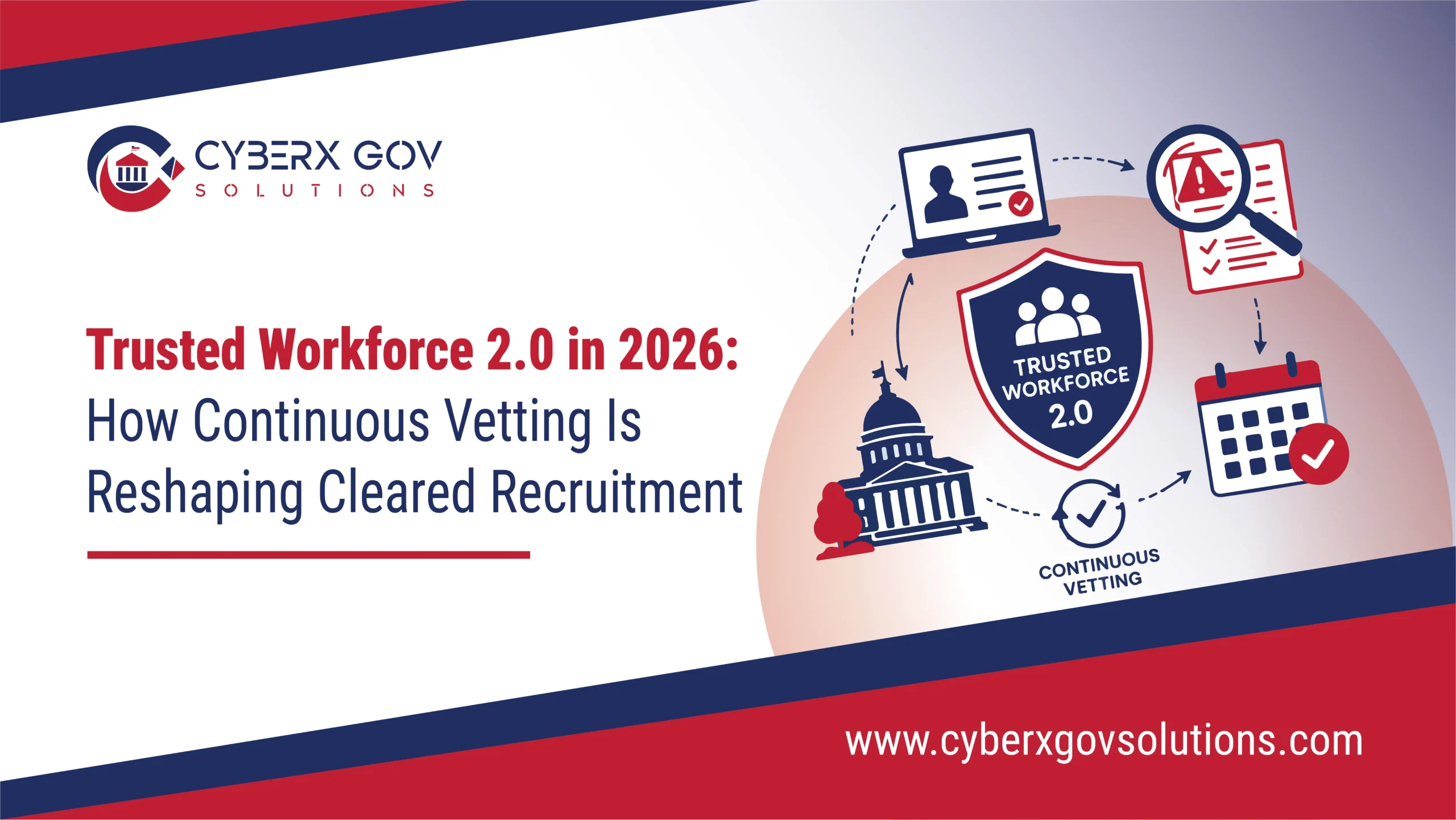
For decades, security clearance was a snapshot. The government investigated you, granted access, then waited five or ten years to look again. Trusted Workforce 2.0 ended that model. Now the government checks cleared people continuously, all year, every year.
This shift matters for anyone who hires cleared talent. By September 2024, the Defense Counterintelligence and Security Agency (DCSA) reported that more than 3.8 million people in the national security population were enrolled in continuous vetting. By early 2026, reporting put that figure above 4 million. The old reinvestigation cycle is gone.
So, what does this mean for your hiring pipeline? Faster onboarding in some cases, new compliance duties in others, and a few traps that can stall a contract award. This guide breaks down Trusted Workforce 2.0 for federal contractors and shows how continuous vetting reshapes cleared recruitment in 2026.
What Is Trusted Workforce 2.0?
Trusted Workforce 2.0 (TW 2.0) is a government-wide reform of how the United States vets people for trusted roles. It launched in 2018 after the personnel security system buckled under a backlog that peaked at 725,000 cases in June 2018, according to government reporting at the time.
A council of agencies runs the reform together. The Office of the Director of National Intelligence (ODNI) serves as the Security Executive Agent. The Office of Personnel Management (OPM) handles suitability and credentialing. DCSA does most of the investigative work. In fact, DCSA conducts about 95% of all initial federal background investigations, serving more than 140 federal agencies.
The reform rests on a simple idea often called the “1-3-5” framework: one shared vetting model, three investigative tiers instead of five, and five vetting scenarios. Those scenarios cover initial vetting, continuous vetting, transfer of trust (reciprocity), upgrades, and re-establishing trust.
How Continuous Vetting Replaces the Old Reinvestigation Model
Continuous vetting (CV) is the engine of TW 2.0. Instead of scheduling a fresh investigation every five years, CV runs automated record checks on an ongoing basis. The Government Accountability Office (GAO) describes it as replacing periodic reinvestigations with automated checks of public and government data, plus alerts that prompt a closer look when something surfaces.
DCSA enrolled all Department of Defense clearance holders in continuous vetting by October 2021. The agency monitors several categories of records, including:
- Criminal and arrest activity
- Financial issues, such as new debt or bankruptcies
- Terrorism and violent extremism indicators
- Foreign travel and foreign associations
- Public records and eligibility data
The payoff is the speed of detection. The government reported that under continuous vetting, concerning information now surfaces about 3 years faster for Top Secret holders and 7 years faster for Secret holders compared with the old cycle. For contractors, that means a cleared worker stays current the whole time they hold the clearance.
Why Continuous Vetting Changes Cleared Recruitment
Here is the part most policy articles skip: what TW 2.0 actually does to your hiring pipeline.
When clearances stay continuously current, your cleared candidates stay deployable. A person who holds an active, monitored clearance can often move to a new contract without waiting for a fresh investigation. That turns recruitment from a slow, reactive scramble into a pipeline you can plan around.
The timelines back this up. DCSA industry data for the first quarter of fiscal year 2026 showed end-to-end processing, at the fastest 90% of cases, of about 156 days for Secret and 227 days for Top Secret. The investigations inventory also fell sharply, dropping roughly 65% since the start of 2025. Things are moving faster than they did during the backlog years.
But faster is not instant. A GAO survey of contractors in 2025 found that 40% saw at least some improvement in requesting clearances, and 45% reported quicker interim determinations. At the same time, 52% still struggled to get information about ongoing investigations. The lesson: plan for progress, but do not assume the system is frictionless.
The Reciprocity Question: Will a Clearance Transfer?
One of the biggest recruitment variables is reciprocity, the transfer of a clearance from one agency or contract to another. In theory, a clearance that is good for one agency should be good for all. Security Executive Agent Directive 7 (SEAD 7) sets a target of roughly five business days for these determinations.
Reality is messier. Transfers between Defense Department contracts can move quickly. Moves into the intelligence community can take far longer because of extra suitability checks or polygraph requirements. The cost of these delays is real. An industry analysis estimated that reciprocity problems cost the federal government billions of dollars in lost productivity each year.
For recruiters, the rule is simple. Confirm that a candidate’s clearance is both active and current in the system before you promise a start date. Then build a buffer into your timeline.
Self-Reporting Did Not Go Away
A common myth is that continuous vetting replaced self-reporting. It did not. Under Security Executive Agent Directive 3 (SEAD 3), cleared employees, including contractor staff, must still report certain events themselves. That includes foreign travel, foreign contacts, significant financial changes, and arrests.
Automated checks catch a lot, but no database catches everything. A cleared hire who does not understand their reporting duties is a compliance risk waiting to happen. Smart contractors brief every cleared employee on SEAD 3 at onboarding and keep reminding them.
What Changed in 2026
Two 2026 developments deserve your attention.
First, in April 2026, DCSA updated the continuous vetting process for cleared contractor personnel under the National Industrial Security Program. Periodic reinvestigations for these workers are no longer required. Instead, each person must submit an updated personnel vetting questionnaire every five years, tracked from a recorded date in the system. Facility security officers need to build this five-year checkpoint into their routine.
Second, modernization is not finished. The National Background Investigation Services (NBIS) system, meant to be the backbone of TW 2.0, has run years behind schedule. In February 2026, GAO testified that the Defense Department now projects spending an additional $2.2 billion on NBIS through fiscal year 2031, on top of $2.4 billion already spent through fiscal year 2024. Full deployment is targeted for fiscal year 2027, with legacy systems retiring no later than fiscal year 2028.
Why does this matter for hiring? Because of the promise of seamlessness, instant reciprocity depends on systems that are still being built. Plan around what works today, not what is promised for tomorrow.
Common Cleared Recruitment Mistakes to Avoid
Contractors who hire cleared talent tend to repeat the same errors. Here are the ones worth fixing first.
- Requiring more clearance than the role needs. Asking for Top Secret/Sensitive Compartmented Information (TS/SCI) on a job that only needs Secret shrinks your candidate pool and slows the fill. Scope clearances to real need.
- Assuming reciprocity is automatic. A held clearance does not guarantee an instant transfer. Verify status first.
- Pricing proposals to meet wishful timelines. If you bid as though every candidate clears within 60 days, a single adjudication delay can put a contract at risk. Use current DCSA timelines.
- Skipping SEAD 3 briefings. Untrained, cleared staff create reporting gaps that surface at the worst moment.
- Treating the pipeline as reactive. The best cleared recruiters build relationships with candidates long before an opportunity drops.
How CyberX Gov Solutions Can Help
Hiring cleared talent in this environment takes more than posting a job. It takes a pipeline strategy that accounts for clearance levels, reciprocity timing, and compliance from day one.
CyberX Gov Solutions supports federal contractors through its Cleared Recruitment service. That includes matching candidates to the right clearance level (Secret, Top Secret, or TS/SCI), screening for role and contract fit, and supporting urgent or time-sensitive hiring. CyberX also helps with proposal and pre-award recruitment planning, so your staffing plan is credible before you bid, and with building an ongoing pipeline of cleared talent as your business grows.
The goal is straightforward: get qualified, currently cleared people onto your contracts without the last-minute scramble.
The Bottom Line for 2026
Trusted Workforce 2.0 turned the security clearance from a periodic snapshot into a continuous signal. For federal contractors, that is mostly good news. Cleared workers stay current; detection is faster, and the worst of the backlog is behind us.
Yet the reform is still a work in progress. Reciprocity remains uneven; self-reporting duties continue, and the systems meant to tie it all together are not finished. The contractors who win cleared talent in 2026 will be the ones who plan their pipelines around how the system actually works, not how it is supposed to work.
Building a cleared workforce should not slow down your next contract. CyberX Gov Solutions helps federal contractors recruit pre-screened, security-cleared professionals through its Cleared Recruitment service.
Schedule a free consultation at cyberxgovsolutions.com/schedule-a-meeting/ to talk through your cleared hiring needs.
Frequently Asked Questions
What is the difference between continuous vetting and continuous evaluation?
The two terms are often used interchangeably. Continuous evaluation was the earlier name for the automated monitoring program. Continuous vetting is the broader, current term used under Trusted Workforce 2.0, and it now applies to the full cleared population.
Does a cleared employee still need periodic reinvestigation?
For most national security roles, no. Continuous vetting replaced the scheduled five- and ten-year reinvestigations. As of April 2026, cleared contractor personnel instead submit an updated vetting questionnaire every five years rather than undergoing a full periodic reinvestigation.
How long does it take to get a security clearance in 2026?
It depends on the level. DCSA data for the early fiscal year 2026 showed roughly 156 days for Secret and 227 days for Top Secret at the fastest 90% of cases. Interim clearances can sometimes let a candidate start sooner while the full process finishes.
Can a startup or small business hire cleared talent?
Yes. Small businesses and new entrants can hire cleared professionals, especially when they have a contract or a credible bid that justifies the need. A recruitment partner can help match cleared candidates to the right contract and clearance level.
What happens if a continuous vetting alert is triggered?
An alert flags information for review, such as a new arrest or financial issue. It does not automatically revoke clearance. The matter is reviewed, and the employee may be asked for more information before any decision is made.