More than 60% of government proposals get cut during the initial compliance review, before an evaluator reads a single line of your technical approach.
That’s not a ranking problem. It’s not a price problem. It’s an avoidable problem.
Here’s a scenario that plays out constantly: a mid-size contractor spends six weeks preparing a response to a $4.2M IDIQ opportunity. They have a past performance. They have technical capability. On submission day, someone forgets to include the subcontracting plan required under FAR 52.219-9. The proposal is rejected at intake. The team won’t be able to find out for three weeks.
Six weeks of effort. Gone.
In 2026, the margin for error is thinner than it’s ever been. CMMC 2.0 requirements are now embedded in DoD solicitations at scale. Agencies are using AI-assisted evaluation tools to flag non-compliant responses faster. Competition for OASIS+, SEWP V, and small-business set-asides has intensified. Evaluators don’t have the patience or obligation to fix your submission for you.
This post covers the 10 mistakes that consistently kill government contract proposals, why they happen, and what high-win-rate teams do differently.
Understanding the High Stakes of Federal Proposals in 2026
Why Small Errors Now Cost More Than Ever
Federal procurement has always been unforgiving of careless submissions. But the stakes in 2026 are higher for a few specific reasons.
First, agencies are moving faster. Compressed evaluation timelines mean compliance screening happens in hours, not days. If your proposal doesn’t pass the initial compliance check, it doesn’t get a second look.
Second, the competitive field is larger. Set-aside programs, particularly 8(a), HUBZone, and SDVOSB contracts, now attract more qualified bidders than they did five years ago. You’re not competing against less capable firms; you’re competing against firms that are just as capable and have better proposal infrastructure.
Third, the technical requirements have improved. CMMC Level 2 attestation, zero trust architecture requirements, and supply chain risk disclosures are now standard across a wide range of solicitations. Firms that don’t account for these in their proposals lose compliance before they lose merit.
The True Cost of Losing a Bid
The direct cost of a failed proposal isn’t just the hours logged by your team. It’s the indirect costs: the opportunity that funded nothing, the Bid/No-Bid investment that returned zero, the reputational signal sent to agency contracting officers who remember which vendors submit sloppy work.
Some proposal professionals estimate that a full and open competition response costs $15,000–$80,000 to develop properly, depending on scope. A single avoidable mistake at submission can wipe that out.
10 Fatal Mistakes That Destroy Government Contract Proposals
Mistake 1: Missing or Ignoring Proposal Deadlines
Why is even a minute-late submission fatal
The Federal Acquisition Regulation is not flexible about late proposals. FAR 15.208 is explicit: late submissions are not considered unless the contracting officer determines an exception applies, and those exceptions are narrow. Government portals like SAM.gov, beta.SAM and agency-specific submission systems don’t extend deadlines for technical issues on your end.
Agencies routinely reject late proposals, regardless of the reason. A crashed computer, a VPN failure, a misread time zone, none of these are the government’s problems.
How to build an ironclad deadline management system
High-win-rate firms don’t treat proposal deadlines as calendar reminders. They build reverse schedules from the submission date, assigning hard internal deadlines to every major deliverable: first draft, Red Team review, pricing sign-off, final formatting, and test submission.
Test submissions are particularly important. Many agencies use portals that require registration, file size checks, or specific upload formats. Discovering a portal issue at 4:55 PM on the day of a 5:00 PM deadline is not a recoverable situation.
Practical step: Build your internal deadline three business days before the actual submission deadline. Use the buffer for compliance checks and formatting review, not for last-minute writing.
Mistake 2: Failing to Follow RFP Instructions Precisely
The compliance trap, most companies underestimate
Section L of a federal solicitation contains the instructions for preparing your proposal. Most contractors read it once. Winning contractors treat it like a legal document.
Font size, margin requirements, page limits, volume structure, file naming conventions, attachment labeling; these are no suggestions. Evaluators are explicitly told to reject or downgrade proposals that deviate from Section L instructions. In some cases, a page count overrun of even one page is grounds for elimination.
The trap is that instructions evolve between the initial RFP and the final amendment. Firms that base their submission on an early draft miss the late-stage change.
Creating and using a bulletproof Compliance Matrix
A Compliance Matrix maps every RFP requirement to a specific location in your proposal. It’s one of the most practical tools in GovCon proposal writing and one of the most frequently skipped.
Build it at the start of the proposal process, not at the end. Assign a person who didn’t write the proposal to do the final compliance check against Section L. Writers are blind to their own omissions.
Real example: A logistics firm responding to a DLA solicitation submitted a technically strong proposal but used 11-point Arial instead of the required 12-point Times New Roman. The contracting officer noted the deviation and reduced the proposal score for non-compliance. They lost by a narrow margin.
Mistake 3: Submitting Generic, Boilerplate Content
Why evaluators spot copy-paste proposals instantly
Government evaluators read dozens of proposals for the same solicitation. After the first few, generic language becomes immediately obvious. Phrases like “our highly qualified team is committed to delivering exceptional results” tell an evaluator nothing. They’ve seen that sentence, or a version of it, twenty times today.
Boilerplate content signals something specific to evaluators: the contractor didn’t read the solicitation carefully enough to respond to it specifically. That’s a win-rate killer.
Techniques to fully customize every response
Before writing a single word, read the Statement of Work three times. Identify the agency’s specific operational context, the stated pain points, and the performance metrics they’ve built into the PWS. Then write about those specifics.
Replace generic claims with concrete evidence. Instead of “we have experience in logistics management,” write “we managed the distribution of 2.3M line items across six DLA depot locations under contract SP3300-21-C-0042, maintaining a 99.1% on-time delivery rate.”
Specificity is what separates proposals that score 7s from proposals that score 9s.
Mistake 4: Ignoring or Misreading Evaluation Criteria (Section M)
How to align your entire proposal with what really matters
Section M tells you how the agency will score your proposal. It lists the evaluation of factors, typically Technical Approach, Past Performance, Price, and their relative weights.
A surprisingly common mistake is writing a proposal that’s strong in areas the agency doesn’t weigh heavily, while being thin on the factors that actually drive award decisions. If Section M says Past Performance is more important than Technical Approach, your proposal should reflect that. If Cybersecurity Plan is a separately evaluated subfactor, it deserves its own dedicated volume, not a paragraph buried in Section 4.
Prioritizing win themes and discriminators
Win themes are the 3-5 core reasons the agency should choose you over your competitors. Discriminators are the specific capabilities or past performance instances that back those themes up.
High-win-rate firms use a “ghost analysis”, identifying likely competitors and their probable weaknesses, to sharpen their discriminators. If your closest competitor has past performance in the same domain but no CMMC Level 2 certification, that certification is a discriminator worth building a theme around.
Mistake 5: Weak or Irrelevant Past Performance Narratives
The difference between “we did something similar” and compelling evidence
Past performance is one of the most heavily weighted evaluation factors in federal proposals. Yet most contractors submit narratives that read more like project summaries than performance arguments.
A project summary describes what you did. A past performance narrative demonstrates that you did it well, under conditions similar to the current opportunity, and that the agency can verify it.
Evaluators want three things from a past performance submission: relevance (similar scope, complexity, and contract type), recency (generally within three to five years), and verifiable quality (CPARS ratings, customer POC contact information).
How to make past performance highly relevant and recent
Match your past performance examples to the specific requirements in the SOW, not to the contract vehicle or agency. If the solicitation is for IT managed services for a DoD agency, don’t lead a commercial IT project.
If your most relevant experience is older than five years, address it directly. Some agencies allow experience beyond the standard recency window if you explain why it’s uniquely applicable. Ignoring the recency issue and hoping evaluators don’t notice is not a strategy.
Practical step: Build a past performance library that pre-maps completed projects to common NAICS codes, SOW themes, and contract types. This cuts proposal development time and improves narrative quality.
Mistake 6: Poor Pricing Strategy; Unrealistic or Unjustified Costs
Balancing competitiveness with realism and profit
Government pricing is not just about being low. Under best-value procurements, which now account for the majority of competitive federal contracts, prices are evaluated in relation to technical merit. A proposal priced 20% below the next bidder doesn’t automatically win if evaluators can’t understand how you’ll deliver at that price.
Unrealistically low pricing raises red flags. Evaluators are trained to identify unbalanced bids, and a price that seems disconnected from the proposed staffing plan or labor categories invites scrutiny.
Supporting your price with a clear rationale
Your price volume should be traceable. Every major cost line, direct labor, subcontracting, ODCs, and overhead rates should be supported by clear assumptions and a narrative that connects costs to the work.
For cost-plus contracts, build your rates from auditable indirect rate history. For firm-fixed prices, document your basis of estimate (BOE) clearly enough that the COTR could verify your math.
Firms that win consistently don’t just price to win. They price to perform and document why their price is realistic.
Mistake 7: Incomplete Submissions or Missing Required Documents
Certifications, matrices, and attachments that get overlooked
This mistake is completely avoidable and completely common. Required attachments, subcontracting plans, small business utilization plans, key personnel resumes, representations and certifications, and Section 508 compliance statements get missed under deadline pressure.
Some solicitations require SAM.gov registration to be active and up to date at the time of submission. Others require specific cybersecurity documentation, like a System Security Plan summary or FIPS 140-2 attestation, as a separate volume. Missing any of these can result in disqualification at intake, before your technical proposal is read.
Final submission checklist every team should use
Build a master submission checklist at the beginning of every proposal effort. Populate it directly from Section L and Section K. Assign a dedicated “compliance owner” whose only job in the final 48 hours is to verify every item on the list.
This person should not be the proposal manager. The proposal manager is too close to the document to catch omissions reliably.
Mistake 8: Failing to Demonstrate True Understanding of Agency Needs
Moving beyond repeating the Statement of Work
Some proposals read like they were written by someone who copied and pasted the SOW and substituted “we will” for “the contractor shall.” Evaluators notice this immediately, and it signals one thing: the contractor didn’t do their homework.
Real understanding of agency needs comes from research done before the RFP drops. It means reading the agency’s Strategic Plan, reviewing FPDS contract history, attending industry days, and, when possible, doing pre-solicitation market research conversations with contracting officers.
Showing deep insight into the agency’s pain points and mission
Proposals that score high on “Understanding of Requirements” do more than acknowledge the task order. They describe the operational context, identify the constraints the agency is working under, and propose a technical approach that accounts for those constraints.
If you’re bidding on an IT modernization contract for a civilian agency, acknowledge that the agency is running legacy infrastructure with a mixed-tenure workforce and a limited change management budget. Then explain how your approach accounts for those realities. That’s what understanding looks like on paper.
Mistake 9: Weak Executive Summary That Fails to Sell Value
Why this section can make or break first impressions
Some evaluators read the Executive Summary first and use it to frame how they read the rest of the proposal. Others skip it and return to it after scoring. Either way, a weak Executive Summary is a missed opportunity.
Most Executive Summaries in government proposals are bland. They restate the solicitation number, introduce the company, and say something vague about commitment to quality. None of that sells anything.
Writing an executive summary that evaluators actually remember
Your Executive Summary should answer three questions before the evaluator hits page two: Why are you uniquely qualified for this work? What is your core technical approach? Why does your price represent good value?
Keep it to two pages. Lead with your strongest discriminator, not your company history. If you have a relevant CPARS rating of Exceptional, start there. If you’ve done this exact type of work for a sister agency with documented results, that’s your opening.
Don’t save your best argument for the Technical Volume. Evaluators who form a strong impression early tend to read everything that follows more favorably.
Mistake 10: Skipping Rigorous Internal Reviews and Quality Checks
The dangers of “hope-based” submissions
Hope-based submissions are proposals that go out the door because the deadline arrived, not because the team was confident in the product. They’re characterized by last-minute writing, no structured review process, and a general sense that “we’ll tighten it up on the resubmit if we don’t win.”
There is rarely a resubmit.
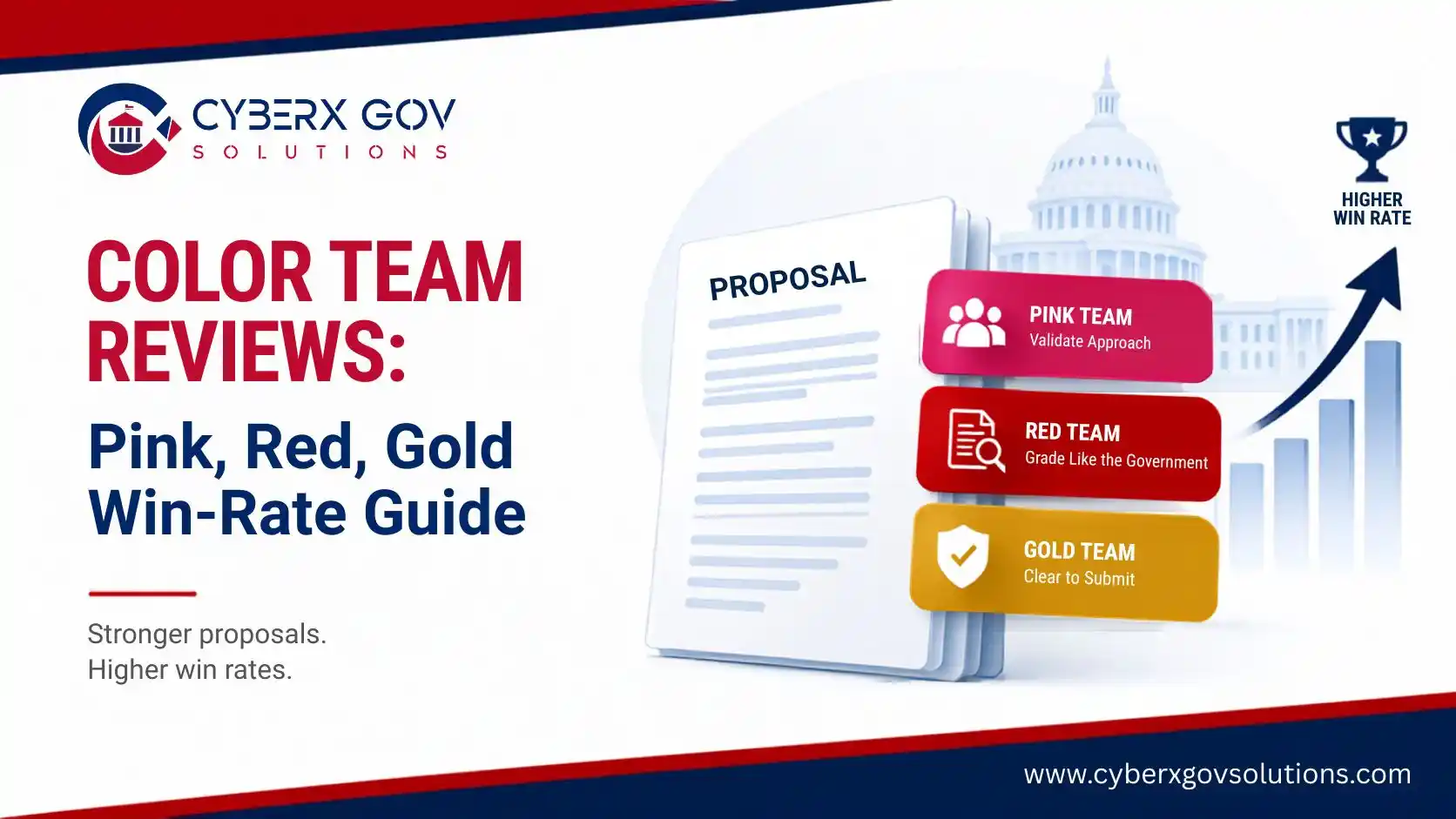
Implementing Pink, Red, and Gold Team reviews effectively
The color-team review process exists because writers can’t objectively evaluate their own work. Each review gate serves a different purpose:
Pink Team (early draft, typically 30-40% complete): Checks outline structure, compliance with Section L/M, and alignment of win themes with evaluation criteria. Catches structural problems before the team invests another two weeks of writing.
Red Team (near-complete draft, typically 70-80% complete): Simulates the evaluator’s perspective. Scores the proposal against Section M criteria as if they were the government. Identifies weak sections, unsupported claims, and missing discriminators.
Gold Team (final review, 95-100% complete): Checks for compliance, completeness, formatting, and submission readiness. This is not an editorial review; it’s a final quality gate.
Teams that skip these reviews consistently produce lower-scoring proposals. Teams that run them consistently improve their win rates over time.
The Real Impact: What These Mistakes Actually Cost You
Opportunity Cost and Damaged Reputation
The financial cost of a lost bid is real, but the reputational cost compounds over time. Contracting officers remember firms that submit non-compliant proposals. Small business liaison officers discuss which vendors are worth engaging in pre-solicitation outreach. A track record of sloppy submissions doesn’t stay invisible.
How 2026 Trends Amplify These Risks
Three developments in 2026 make these mistakes more costly than they were in previous cycles:
AI-assisted evaluation: Several civilian agencies and DoD program offices are piloting automated compliance screening tools that flag non-conforming proposals before they reach a human evaluator. A formatting deviation that a human evaluator might have overlooked now triggers a system flag.
CMMC 2.0 at scale: With DoD’s CMMC requirements now embedded in most new solicitations above the simplified acquisition threshold, proposals that don’t address cybersecurity requirements or address them superficially lose compliance or technical merit.
Increased competition: OASIS+ and other enterprise contract vehicles have brought a larger, better-resourced pool of competitors into a wider range of task order competitions. The margin between a winning proposal and a losing one is narrower than it used to be.
Mistake vs. Winning Approach: Quick Reference
|
Mistake |
What Winning Firms Do Instead |
|
Late submission |
Internal deadline 3 days early; test submissions on agency portal |
|
Ignoring Section L |
Compliance Matrix built at kickoff, verified by an independent reviewer |
|
Boilerplate content |
SOW-specific evidence, named contracts, measurable results |
|
Misreading Section M |
Win themes mapped directly to evaluation subfactors |
|
Generic past performance |
CPARS-backed narratives matched to current SOW requirements |
|
Unrealistic pricing |
Traceable BOE, narrative connecting costs to staffing plan |
|
Missing attachments |
Master checklist built from Section L, dedicated compliance owner |
|
Restating the SOW |
Pre-RFP agency research, operational context in technical approach |
|
Weak executive summary |
Discriminator-first, two pages, answers “why you” before page two |
|
No structured review |
Pink/Red/Gold team gates with scoring against Section M |
Building a Winning Proposal Process That Eliminates These Mistakes
Step-by-Step Framework Used by High Win Rate Companies
The firms that consistently win government contracts don’t approach proposals opportunistically. They build repeatable processes.
Before the solicitation drops, they track opportunities in GovWin or BGOV, attend industry days, and engage in pre-solicitation conversations. They know their top targets six to twelve months in advance.
At RFP release, they run a structured Bid/No-Bid decision using objective criteria: incumbency status, competitive position, relevance of past performance, and probability of win. They decline more opportunities than they pursue.
During proposal development, they assign clear roles: proposal manager, volume leads, pricing lead, and compliance owner, with daily standup calls in the final two weeks.
At submission, they don’t scramble. The document was final 48 hours ago. What’s happening now is a final compliance check and a portal test submission.
Tools, Templates, and Best Practices for 2026
Dedicated proposal software (RFPIO, Responsive, Loopio) reduces boilerplate fatigue and helps maintain a current past performance library. Cost modeling tools (PRICE Systems, Rough Order of Magnitude calculators) support defensible pricing. SAM.gov alerts on targeted NAICS codes ensure your team sees relevant solicitations before competitors do.
For CMMC-related RFPs, maintaining a current System Security Plan and SPRS score isn’t just a compliance requirement; its proposal content you’ll need on short notice.
The Role of External Proposal Support
Many mid-size firms use external proposal consultants or capture managers for high-value opportunities. This is not an admission of weakness. It’s a recognition that proposal writing is a specialized skill, and that consultants who review proposals from dozens of agencies bring pattern recognition that in-house teams often lack.
The investment in a skilled proposal writer typically costs less than a single lost bid.
FAQs
What is the most common reason government proposals get rejected?
Non-compliance with Section L instructions. Font size, page limits, missing attachments, and incorrect file formats are the most frequent disqualifiers at initial intake, before any evaluator reads your technical content.
How late is too late for a federal proposal submission?
One minute. FAR 15.208 gives contracting officers almost no flexibility on late submissions. If the portal closes at 5:00 PM ET and your file uploads at 5:01 PM, the proposal is typically rejected. Build your internal deadline at least two to three business days before the actual due date.
How many past performance examples should a government proposal include?
Most solicitations specify the required number, usually two to five. If the RFP doesn’t specify, three to five relevant, recent examples is standard. Relevance and recency (within three to five years) matter more than volume. One strong, specific past performance narrative outperforms three generic ones.
What is a Compliance Matrix, and do I really need one?
A Compliance Matrix is a table that maps every RFP requirement in Section L and Section M to a specific location in your proposal. You need one. It’s the fastest way to catch missing sections before submission, and it forces your team to address every requirement rather than just the ones they remember.
Can a small business win against large primes on government contracts?
Yes, and it happens regularly. Set-aside programs (8(a), HUBZone, SDVOSB, WOSB) exist specifically to level the field. In full and open competitions, small businesses win by being more specific, more responsive to agency needs, and more agile in their technical approach, not by out-resourcing large primes on volume.
Conclusion
Avoiding these 10 mistakes won’t guarantee a win. But making them almost guarantees a loss.
The firms that build durable win rates in federal contracting don’t do it through luck or relationships alone. They do it through processes that make compliance failures rare, proposal quality consistent, and evaluator impressions strong from page one.
The government isn’t looking for the cheapest vendor or the biggest one. It’s looking for the contractor that can demonstrate, on paper, that it understands the work, can perform it, and will be accountable for the results.
Your proposal is the only thing the evaluator sees.
Make it worth reading.