In 2021, GSA’s flagship enterprise IT program carried a $807 million price tag. Its next-generation successor, awarded on July 14, 2026, is worth $145.6 million.
That gap is not a typo. It is one of the clearest signals yet of where federal IT contracting is heading, and most coverage of the award skipped right past it.
This post breaks down the DIGIT XGen task order, why the numbers changed so dramatically, and what contractors of every size should take from it.
What Is the DIGIT XGen Task Order?
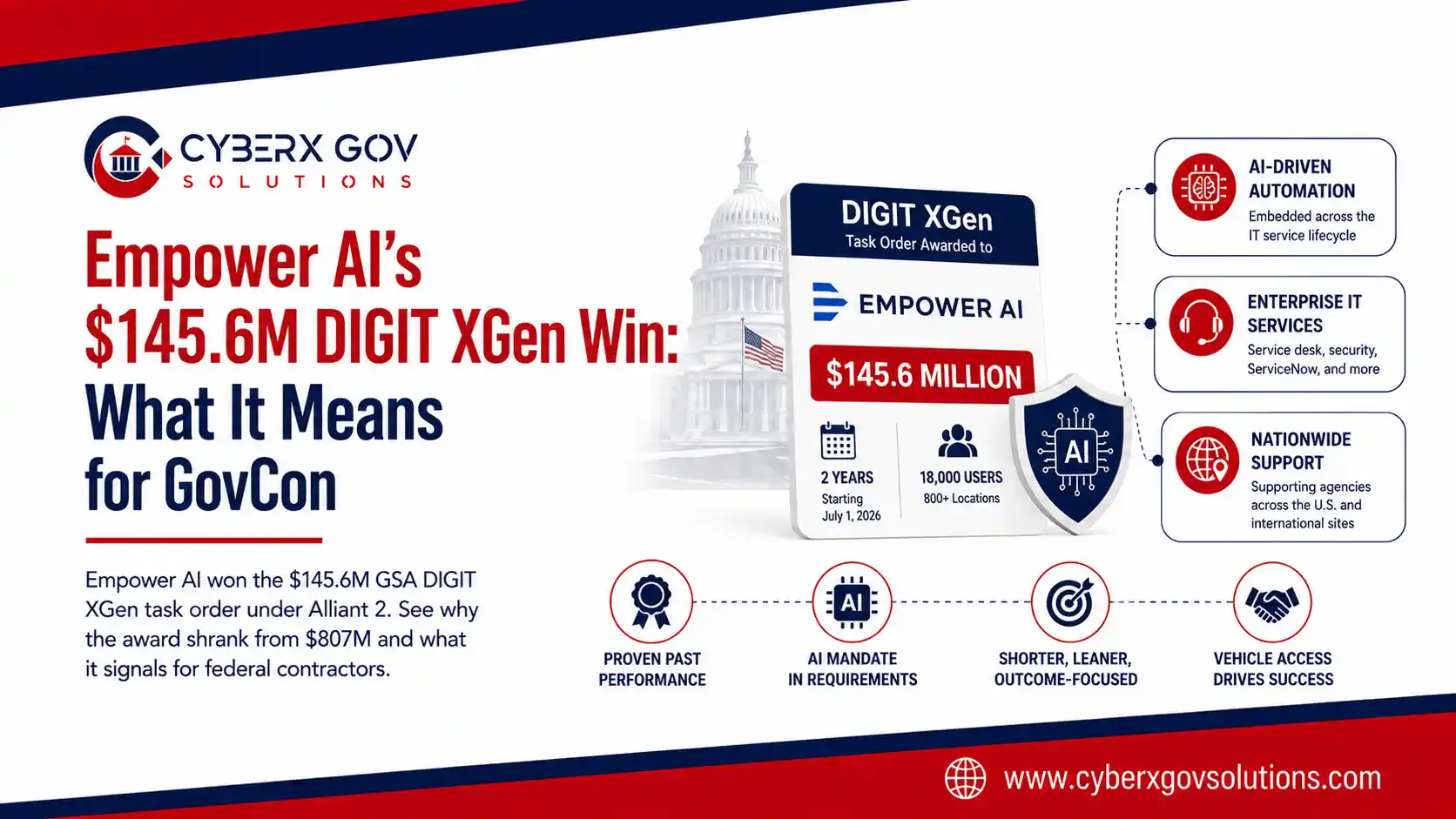
DIGIT XGen (Digital Innovation for GSA Infrastructure Technologies, Next Generation) is a $145.6 million task order that the General Services Administration awarded to Empower AI under the Alliant 2 Governmentwide Acquisition Contract. It covers two years of enterprise IT support starting July 1, 2026, with a built-in mandate to embed AI-driven automation across the IT service lifecycle.
The scope is broad. Empower AI will run omni-channel service desk operations, device and mobile device management, ServiceNow platform engineering, security operations, and solutions engineering. The work supports roughly 18,000 users across more than 800 government installations nationwide, as well as select international sites.
From $807M to $145.6M: How the DIGIT Program Changed
Empower AI is not new to this program. In January 2021, the company (then operating as NCI Information Systems) won the original DIGIT task order valued at $807 million. DIGIT XGen extends that incumbency, but under very different terms.
| Original DIGIT (2021) | DIGIT XGen (2026) | |
| Awardee | NCI Information Systems (now Empower AI) | Empower AI |
| Total value | $807 million | $145.6 million |
| Contract vehicle | GSA Alliant 2 | GSA Alliant 2 |
| Program focus | Digital transformation and AI-based infrastructure modernization | Mandated intelligent automation, AIOps, predictive incident resolution |
| Period of performance | Ran until XGen began | Two years, starting July 1, 2026 |
Part of the difference is simple duration. A two-year order will always look smaller than a longer-term one.
But the structure itself tells a story. GSA rebuilt the program around automation, AI, and machine learning integration, and modern service delivery. When agencies expect AI to handle infrastructure monitoring, incident resolution, and self-service support, they also expect the labor bill to shrink. Shorter, leaner, outcome-focused orders are becoming the norm in federal IT modernization.
Why GSA Now Writes AI Into Task Order Requirements
Here is the detail that matters most for contractors. DIGIT XGen does not simply allow AI. It requires it.
The program includes a mandate to embed intelligent automation throughout the IT service lifecycle. That covers AIOps (AI for IT operations, meaning software that monitors infrastructure and flags problems automatically), predictive incident resolution, and self-service tools for end users.
Five years ago, a contractor could pitch AI as a differentiator. Today, on orders like this one, AI capability is the price of entry. Evaluation teams want production evidence, not slideware. Empower AI pointed to its Accelerator Framework and IT service management AI tools already running in production, and that track record clearly carried weight.
Expect this pattern to spread across federal civilian agencies. If your past performance library has no automation outcomes in it, that gap will start costing you evaluations.
The Vehicle Behind the Award: Alliant 2
None of this happens without a seat on the right contract vehicle. Alliant 2 is a multiple-award, indefinite-delivery/indefinite-quantity (IDIQ) contract that GSA uses to buy IT solutions, including AI, robotic process automation, and other emerging technologies.
A few facts worth knowing:
- GSA raised the Alliant 2 ceiling from $82.5 billion to $90.75 billion to keep up with agency demand.
- The master contract’s option period runs through June 30, 2028.
- Task orders can extend up to five years beyond that, out to June 2033.
The takeaway for smaller firms: Alliant 2 is an unrestricted vehicle held by a limited pool of primes. If your company does not hold a seat, subcontracting and teaming with a prime is the realistic path to this revenue. Building those relationships before an order drops is what capture planning is for.
Five Lessons Contractors Should Take From This Win
- Incumbency is earned with results, not tenure: Empower AI held on to this program by pointing to customer satisfaction scores across 18,000 supported users. Recompetes reward documented performance, so treat every CPARS rating and deliverable as future proposal evidence.
- Answer the AI mandate with proof: Requirements now name specific capabilities such as AIOps and predictive resolution. Winning proposals map real, deployed tools to those requirements instead of promising future innovation.
- Plan for smaller, shorter awards: An $807 million program became a $145.6 million one. Capture strategies built around a single giant award are fragile. Pipelines built around steady task order flow are not.
- Vehicle access decides who can even compete: No Alliant 2-seat meant no prime bid here. Map which vehicles your target agencies actually use, then position for a seat or a teaming role well before the solicitation.
- Momentum compounds: In roughly one month, Empower AI closed a $255.4 million DISA recompete, acquired Highlight Technologies, and won DIGIT XGen. Each win strengthens the past performance story for the next bid. Small firms can build the same flywheel at their own scale, one task order at a time.
How CyberX Gov Solutions Can Help
Awards like DIGIT XGen show how competitive federal IT work has become, and how much preparation separates winners from also-rans.
CyberX Gov Solutions supports contractors at each stage of that preparation. Our proposal development team builds compliance matrices, win themes, and full proposal content for RFPs, RFQs, and task order responses, including recompetes where past performance framing decides the outcome. Firms staffing up after a win use our cleared recruitment service to find pre-screened professionals holding Secret, Top Secret, or TS/SCI clearances. And businesses still working toward their first federal bid can start with Get Fed Ready™, which covers SAM.gov registration support, capability statement development, and opportunity fit analysis.
Conclusion
DIGIT XGen is more than one company’s contract win. It shows an agency restructuring a flagship program around mandated AI, shorter performance periods, and measurable outcomes. Those same expectations are moving through the rest of the federal marketplace.
Contractors who document their performance, build automation into their offerings, and secure the right vehicle positions will compete well in this environment. Those who wait for the market to return to long, labor-heavy contracts will be waiting a long time.
If you want help positioning for your next federal opportunity, whether that means a sharper proposal, cleared talent, or getting fed-ready from scratch, CyberX Gov Solutions can help.
Schedule a free consultation at cyberxgovsolutions.com/schedule-a-meeting/.
Frequently Asked Questions
Who is Empower AI?
Empower AI is a federal technology contractor headquartered in Reston, Virginia, with more than 35 years of government experience. The company, formerly known as NCI Information Systems, provides AI, IT service management, engineering, and mission support services to defense and civilian agencies.
What does AIOps mean in a government contract?
AIOps stands for artificial intelligence for IT operations. It refers to software that monitors systems, detects anomalies, and helps resolve incidents automatically instead of waiting for a human to open a ticket. Federal agencies increasingly list it as a required capability in IT services solicitations.
How long can Alliant 2 task orders run?
Alliant 2’s master contract option period ends June 30, 2028, but task orders may extend up to five years past that date. That means work awarded under the vehicle can continue as late as June 2033.
Can a small business work on a task order like DIGIT XGen?
Usually yes, but as a subcontractor. Alliant 2 is an unrestricted vehicle held by a set pool of prime contractors, so small businesses typically participate through teaming agreements with those primes. Building prime relationships early is the key step.
Why was DIGIT XGen worth so much less than the original DIGIT award?
The main factors are a shorter two-year period of performance and a program redesign centered on automation. When AI handles more monitoring and incident resolution, the government expects lower service delivery costs.
Where can I track upcoming task orders like this one?
Recompetes and new solicitations appear on SAM.gov, and agency forecast sites list expected opportunities before they drop. Watching an incumbent’s contract end dates is one of the most reliable ways to time your capture effort.