For years, holding a VA contract felt like job security. You did the work, you stayed out of trouble, and the recompete was mostly yours to lose. That assumption just took a public hit.
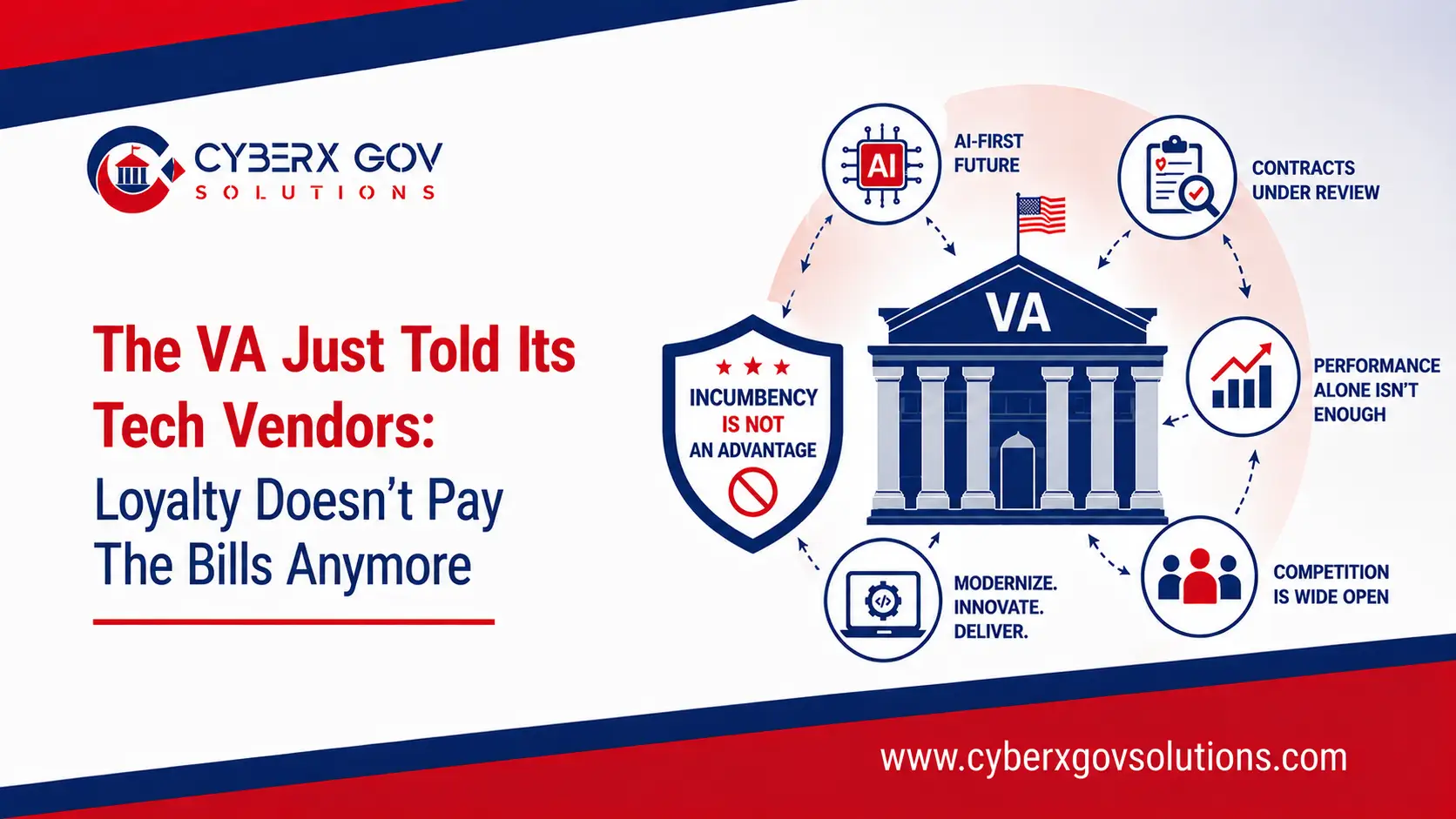
On June 18, 2026, a senior VA technology official said the quiet part out loud. Zack Schwartz, principal deputy assistant secretary in the VA’s Office of Information and Technology, said that “incumbency is not a guarantee, incumbency is not an advantage.” He added that the agency “will not settle just because you’ve supported the VA in the past.”
That is a blunt message to every company holding a VA tech contract. This post breaks down what the VA actually said, why it is saying it now, and the specific moves contractors should make to stay on the right side of the change.
What the VA Actually Said
The comments came right after the VA’s Advanced Planning Brief to Industry (APBI), a hybrid industry day held on June 17, 2026. The APBI is where the VA previews its acquisition priorities and upcoming opportunities for the next fiscal year. Schwartz called this year’s event a breakthrough between the agency and industry.
His core point was simple. The VA wants contractors who can keep pace with its modernization and artificial intelligence (AI) push, and it does not care how long you have been around. Vendors need to bring their “A-game” when it comes to supporting the veteran.
Even long, multi-year contracts are in scope. Schwartz said the VA will keep checking whether a contract still meets the agency’s needs, because those needs change over time. As he put it, a review might happen “not necessarily because your performance has gone downhill,” but because the VA’s requirements have moved since the deal was signed.
In plain terms: doing an adequate job is no longer the finish line. The VA is tying continued work to whether you keep modernizing alongside it.
Why the VA Is Saying This Now
This is not an idle threat. A few forces are pushing the VA to mean it.
First, money and bargaining power. The VA is the fourth-largest spender in the federal government and had spent about $177.7 billion so far in fiscal year 2026 at the time of the announcement. Schwartz framed the agency as the biggest customer for nearly all of its technology vendors, and said it is “about time we start acting like it.” When a buyer that large decides to flex, vendors feel it.
Second, a real modernization sprint. The VA recently finished its second 2026 wave of electronic health record (EHR) modernization, expanding the system to more than 107,000 veterans and roughly 7,200 clinicians and staff at sites in Ohio and Kentucky. Open EHR-related solicitations are already posted across several states. The work is live, not theoretical.
Third, AI has become an expectation, not a bonus. Schwartz said the VA “will not be scared of risks associated with AI to our detriment,” and that AI focus is now “paramount” in every procurement. The agency’s published AI strategy backs this up, with goals to put more AI use cases into production in 2026.
A Fair Question: Will the VA Follow Through?
It is worth staying clear-eyed here. Schwartz himself acknowledged that the industry has met the message with some skepticism about whether the VA will actually deliver fast modernization and truly even-handed contractor selection.
That skepticism is earned. The Government Accountability Office (GAO) has kept VA acquisition management and IT modernization on its High-Risk List for years, citing repeated struggles with delivering IT capabilities. The VA also requested about $7.3 billion for IT in fiscal year 2026, a slight decrease from the prior year, so resources are not unlimited.
So treat this as a strong signal of intent, not a finished transformation. The smart response is not to panic. It is to prepare as if the VA means exactly what it said, because the cost of being caught flat-footed is far higher than the cost of getting ready.
What This Means for Federal Contractors
If you hold or chase VA technology work, the rules of the game just shifted in a few concrete ways.
- Your renewal is no longer a formality. A clean performance record buys you less than it used to. You have to show forward motion, not just steady delivery.
- Mid-contract reviews are now a live risk. The VA says it will reassess active contracts against current needs. A deal you won two years ago can be judged against today’s AI expectations.
- AI capability is becoming table stakes. If your proposals and delivery do not show a credible, governed approach to AI, you look dated next to competitors who do.
- Challengers have a real opening. If you have been trying to break into VA work, an incumbent’s complacency is now your opportunity. The door is more open than it was.
How to Position Your Company Now
Here are practical steps to take before your next VA proposal or contract review.
- Audit your AI story honestly. Can you point to specific, governed AI use in your delivery? Not buzzwords, but real examples with controls. If not, build that capability or partner for it now.
- Respect the VA’s AI guardrails. The VA restricts public generative AI tools for sensitive data and favors VA-hosted instances. Show that you understand responsible, compliant AI, not just the flashy version.
- Rewrite your value story around outcomes. The VA is holding contractors accountable for outcomes, not effort. Frame your past performance around measurable results for veterans, not hours billed.
- Treat every recompete as competitive. Assume a hungry challenger is gunning for your seat. Refresh your win themes, your staffing plan, and your modernization roadmap for each bid.
- Get your foundation in order early. Confirm your registrations, certifications, and capability materials are current so you can move fast when an opportunity posts.
Common Mistakes to Avoid
As contractors react to this news, a few predictable errors will cost some of them work.
- Assuming your incumbency protects you. It is the exact mindset the VA just called out. Coasting is the fastest way to lose a recompete.
- Bolting “AI” onto a proposal as a buzzword. Evaluators can tell the difference between a real capability and a marketing veneer. Hollow claims hurt more than they help.
- Ignoring AI governance. Speed without controls is a liability at an agency handling sensitive veteran data. Lead with responsible use.
- Waiting for the solicitation to drop. By the time the RFP posts, the contractors who prepared early are already ahead. Build your pipeline before the work appears.
How CyberX Gov Solutions Can Help
Repositioning for an outcome-focused, AI-forward buyer is mostly a proposal and strategy problem. That is squarely where a partner helps.
CyberX Gov Solutions supports federal contractors through its Proposal Development service. We help you map requirements, shape win themes, and write the technical, management, staffing, and past performance sections that evaluators actually score, so your modernization and AI story lands with weight instead of buzzwords. If you are still building your footing in the federal market, our Get Fed Ready™ program helps with federal readiness, capability statements, and opportunity-fit analysis so you pursue the right VA work at the right time.
The aim is straightforward: help you show up to your next VA bid looking like the future, not the past.
The Bottom Line
The VA just redrew the line between safe and at-risk for its technology vendors. Loyalty and longevity still matter, but they no longer pay the bills on their own. Modernization and credible AI do.
Whether the agency fully delivers on its promise or not, the cost of preparing is low, and the cost of ignoring it is a lost contract. Audit your AI story, sharpen your outcomes, and treat every recompete as a fight. The contractors who adapt early will be the ones still standing when the VA’s requirements shift again.
Worried your next VA proposal looks more like the past than the future? CyberX Gov Solutions helps federal contractors build modernization-ready, outcome-focused proposals through its Proposal Development service.
Schedule a free consultation at cyberxgovsolutions.com/schedule-a-meeting/ to talk through your VA strategy.
Frequently Asked Questions
Did the VA actually say incumbency no longer matters?
Yes, in substance. VA IT official Zack Schwartz said on June 18, 2026, that “incumbency is not a guarantee, incumbency is not an advantage.” He tied continued work to a contractor’s ability to keep up with modernization and AI.
Can the VA really review a contract in the middle of its term?
According to Schwartz, the VA intends to review whether active contracts still meet the agency’s needs at all points in the term. He noted this can happen because requirements change, not only because performance slips.
What kind of AI does the VA expect from contractors?
The VA wants responsible, governed AI, not just any tool. It restricts public generative AI services for sensitive data and favors VA-hosted instances, so compliant and secure use matters as much as capability.
Is this a good or bad thing for small businesses?
It can be an opening. If incumbency carries less weight, challengers with strong modernization and AI stories have a better shot at unseating established players. The key is preparing before the opportunity posts.
Where can I track upcoming VA technology opportunities?
Watch SAM.gov for VA solicitations and the VA’s digital and acquisition pages for its Advanced Planning Brief to Industry materials. These preview the agency’s priorities and upcoming contract opportunities.