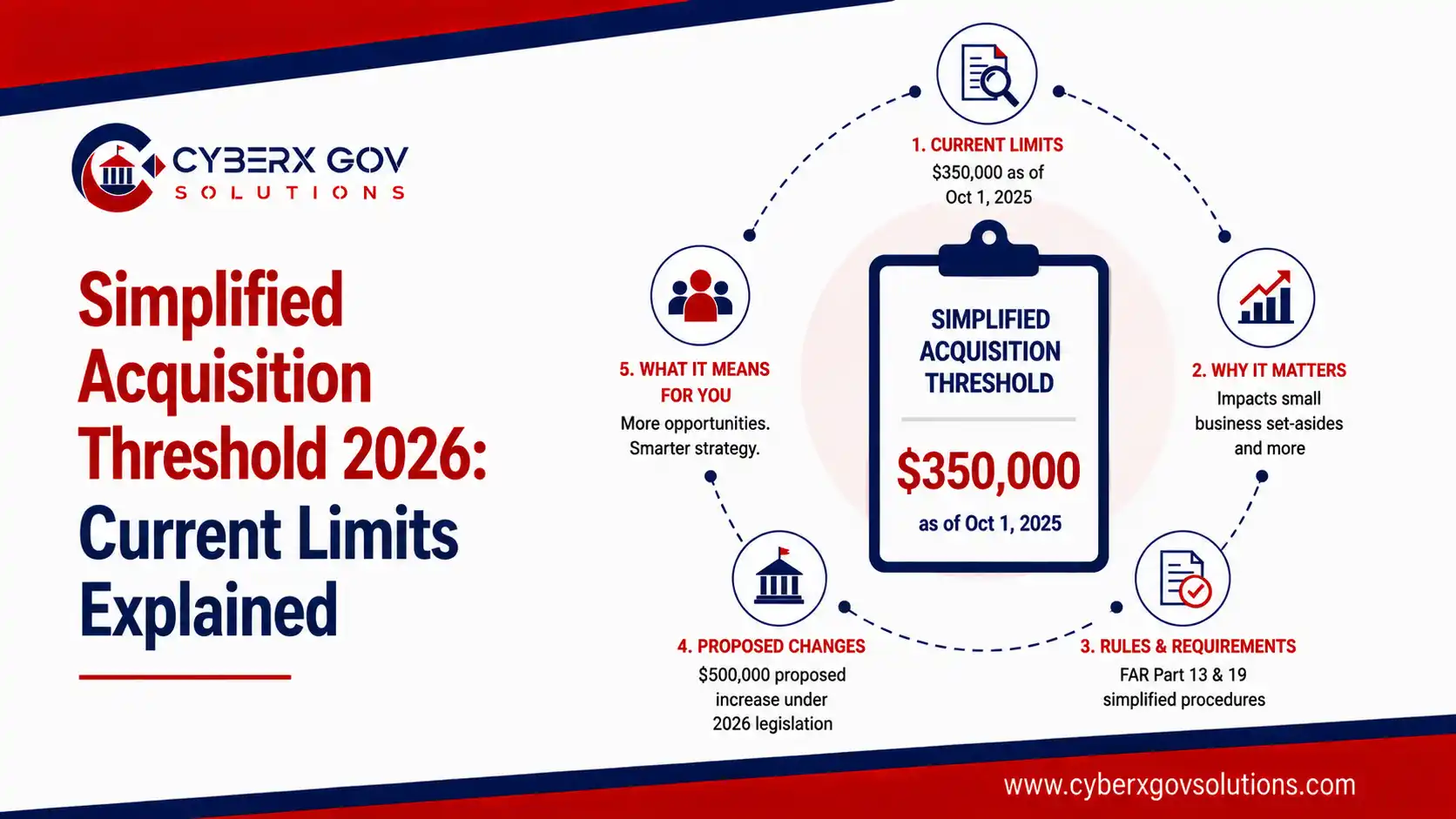
If you have read that the simplified acquisition threshold sits at $250,000, that number is a year out of date. It rose to $350,000 on October 1, 2025, and the micro-purchase threshold moved from $10,000 to $15,000 at the same time.
That distinction matters more than it sounds. The threshold decides which contracts are automatically reserved for small businesses, how much paperwork a contracting officer has to produce, and how fast an award can happen.
This guide covers the current figures, the rules they trigger, and what a set of pending proposals in Congress would change. It also flags one detail in those proposals that most coverage has skipped entirely.
Key Takeaways
- The threshold now stands at $350,000 as of October 1, 2025, up from $250,000.
- The micro-purchase threshold is $15,000, up from $10,000 on the same date.
- Under FAR 19.502-2(a), acquisitions above the micro-purchase threshold and up to that ceiling must generally be set aside for small businesses.
- Legislative proposals submitted in July 2026 would raise the threshold to $500,000, with commercial products and services phasing to $10 million after September 30, 2030.
- Those same proposals would freeze the small business reserve at $350,000 instead of letting it rise with the threshold.
What Is the Simplified Acquisition Threshold?
Definition: The simplified acquisition threshold (SAT) is the dollar ceiling below which federal agencies may buy goods and services using the streamlined procedures in FAR Part 13, rather than the full competitive process required for larger contracts.
Below that ceiling, a contracting officer can move faster. Documentation shrinks, oral quotes become acceptable, and the agency does not need to run a fully negotiated procurement. The Federal Acquisition Regulation (FAR) sets out four goals for these procedures: cutting administrative costs, improving small business access, promoting efficiency, and avoiding unnecessary burden on agencies and contractors.
The micro-purchase threshold sits below it. Purchases at or under that amount face even fewer requirements and are often made with a government purchase card.
Current Federal Acquisition Thresholds
These figures took effect on October 1, 2025, through the FAR Council’s inflation adjustment.
| Threshold | Current Amount | Previous Amount |
| Micro-purchase threshold | $15,000 | $10,000 |
| Simplified acquisition threshold | $350,000 | $250,000 |
| SAT, domestic contingency operations | $1 million | n/a |
| SAT, defense against certain attacks | $2 million | n/a |
| Commercial products test program ceiling | $9.5 million | n/a |
A few micro-purchase exceptions run lower. Construction is subject to wage rate requirements capped at $2,000, and services are subject to labor standards capped at $2,500.
Why the Simplified Acquisition Threshold Matters for Small Businesses
This is the part that gets overlooked. The SAT is not just an administrative convenience for agencies. It defines a protected band of federal spending, and that is why the number is worth knowing precisely.
FAR 19.502-2(a) states that each acquisition above the micro-purchase threshold but not over the simplified acquisition threshold “shall be set aside for small business unless the contracting officer determines there is not a reasonable expectation of obtaining offers from two or more responsible small business concerns that are competitive in terms of fair market prices, quality, and delivery.”
Contractors know that condition as the “Rule of Two”. In practice, it means every federal purchase between $15,000 and $350,000 starts as a small business opportunity by default. The contracting officer has to justify going unrestricted, not the other way around.
Expert tip: When you research past awards in your NAICS code, pay attention to how many landed under $350,000. That band is where a newer contractor has the least competition from large primes.
What the Proposed Increases Would Change
In July 2026, the administration sent Congress 20 legislative proposals on acquisition reform. Two of them would reset these thresholds on a phased schedule.
| Threshold | Proposed Schedule |
| SAT (general) | $500,000 |
| SAT, commercial products and services | $2 million through Sept 30, 2027; $5 million Oct 1, 2027, through Sept 30, 2030; $10 million after Sept 30, 2030 |
| Micro-purchase threshold | $25,000 through Sept 30, 2027; $50,000 Oct 1, 2027, through Sept 30, 2030; $100,000 after Sept 30, 2030 |
GSA’s supporting documentation estimates the threshold change would affect over 100,000 federal transactions, and the micro-purchase change would affect more than 500,000 transactions annually.
Note the dates carefully. The $10 million and $100,000 figures arrive after September 30, 2030, not by 2030. Several summaries circulating online have compressed that timeline.
How the Simplified Acquisition Threshold Affects the Small Business Reserve
Here is the provision worth reading twice. The proposals would remove the existing link between the SAT and the small business reserve, then fix that reserve ceiling at $350,000.
Right now, those two numbers move together. If the ceiling rises to $500,000 while the reserve stays at $350,000, the automatic small business set-aside no longer covers the full simplified acquisition range. Purchases between $350,000 and the new ceiling would sit outside that protection.
The micro-purchase change works in the other direction. Because the set-aside applies only above the micro-purchase threshold, moving that floor to $100,000 would lift a large block of purchases out of the reserved band as well.
Put together, the automatically protected range could narrow from $15,000 to $350,000 today, down to $100,000 to $350,000 later this decade. Small business advocates and procurement attorneys have raised this concern. Any summary presenting these proposals as a straightforward win for small business is telling half the story.
What This Means for Your Business Right Now
Nothing in the July 2026 package has passed. Congress has to enact it, and the President has to sign it, and the FY2026 National Defense Authorization Act already scaled back several acquisition reform proposals. Treat the current figures as operative and the proposed ones as a planning context.
Practical steps worth taking:
- Update your internal templates. Any capability statement, pricing model, or bid checklist referencing $250,000 or $10,000 needs correcting.
- Mine the sub-$350,000 band. Search past awards in your NAICS codes within that range to find agencies already buying at a size you can win.
- Build past performance below the threshold. Smaller, simplified acquisitions are a realistic entry point, and they create the record you need for larger bids later.
- Watch the reserve provision. If the reserve freezes at $350,000, positioning for unrestricted competition becomes more important sooner than you might expect.
Common Misconceptions Worth Correcting
- “The threshold is $250,000.” It was, until September 30, 2025. It is now $350,000.
- “The micro-purchase threshold is $10,000.” It is $15,000.
- “The threshold is already $500,000.” That figure is a proposal, not current law.
- “Higher thresholds automatically help small businesses.” Not necessarily, given the reserve decoupling described above.
- “Below the threshold means no competition.” Agencies still must promote competition to the maximum extent practicable under FAR Part 13.
How CyberX Gov Solutions Can Help
Knowing where the threshold sits is useful only if you act on it. The Get Fed Ready™ program covers federal readiness assessment, SAM.gov registration support, capability statement development, and opportunity identification with fit analysis, which is exactly the work of matching your business to contracts within the range you can realistically win.
For solicitations above the threshold, where full proposals and formal evaluation apply, Proposal Development covers compliance matrix creation, win theme development, and writing across technical, management, and past performance sections.
Conclusion
The simplified acquisition threshold is $350,000 today, and the micro-purchase threshold is $15,000. Those two numbers shape which federal purchases are reserved for small businesses, how quickly agencies can award, and where a growing contractor should focus first.
The proposals now with Congress would push those ceilings higher, but they carry a detail that cuts against the headline: the small business reserve would stop rising with the threshold. Watch that provision as closely as the dollar figures.
Accurate numbers beat exciting ones. Build your pipeline on what the rules say today, and adjust when Congress actually acts.
Ready to Find Opportunities in Your Range?
If you want help identifying federal opportunities that fit your size, past performance, and NAICS codes, that is a conversation worth having before the next solicitation cycle.
Schedule a free consultation at cyberxgovsolutions.com/schedule-a-meeting/ to review where your business fits against the current simplified acquisition threshold and the opportunities sitting below it.
Frequently Asked Questions
Is the simplified acquisition threshold still $250,000?
No. It increased to $350,000 effective October 1, 2025, through the FAR Council’s periodic inflation adjustment. The $250,000 figure applied before that date, which is why it still appears in older articles, templates, and training material that have not been updated.
What is the difference between the micro-purchase threshold and the simplified acquisition threshold?
The micro-purchase threshold is $15,000 and covers very small buys with minimal process, often on a purchase card. The simplified acquisition threshold is $350,000 and sets the ceiling for streamlined FAR Part 13 procedures. The band between them is where small business set-asides generally apply.
Do contracts under the simplified acquisition threshold require competition?
Yes, though less formally. Agencies must promote competition to the maximum extent practicable under FAR Part 13, and contracting officers ordinarily consider at least three sources. Full negotiated procurement rules do not apply, which is what makes these awards faster.
When would the proposed $500,000 threshold take effect?
There is no effective date because the proposal is not law. It was submitted to Congress in July 2026 as part of a 20-item acquisition reform package and requires legislation to take effect. Contractors should plan around the current $350,000 figure until that changes.
How do I find federal contracts under the simplified acquisition threshold?
Search SAM.gov contract opportunities and filter by your NAICS codes and award value. Reviewing historical awards in that dollar range also shows which agencies buy what you sell at a size your business can deliver, which is often more useful than watching open solicitations alone.
Does a higher simplified acquisition threshold mean more small business contracts?
Not automatically. The July 2026 proposals would decouple the small business reserve from the threshold and hold it at $350,000, so the automatic set-aside would not expand alongside the higher ceiling. The net effect on small businesses depends on how Congress handles that specific provision.
What happens to Buy American requirements at these thresholds?
The July 2026 proposals would keep Buy American Act exemptions capped at $15,000 while applying those requirements to purchases above that amount, even as the micro-purchase threshold rises. That treatment is separate from the threshold increases themselves and is worth tracking independently.