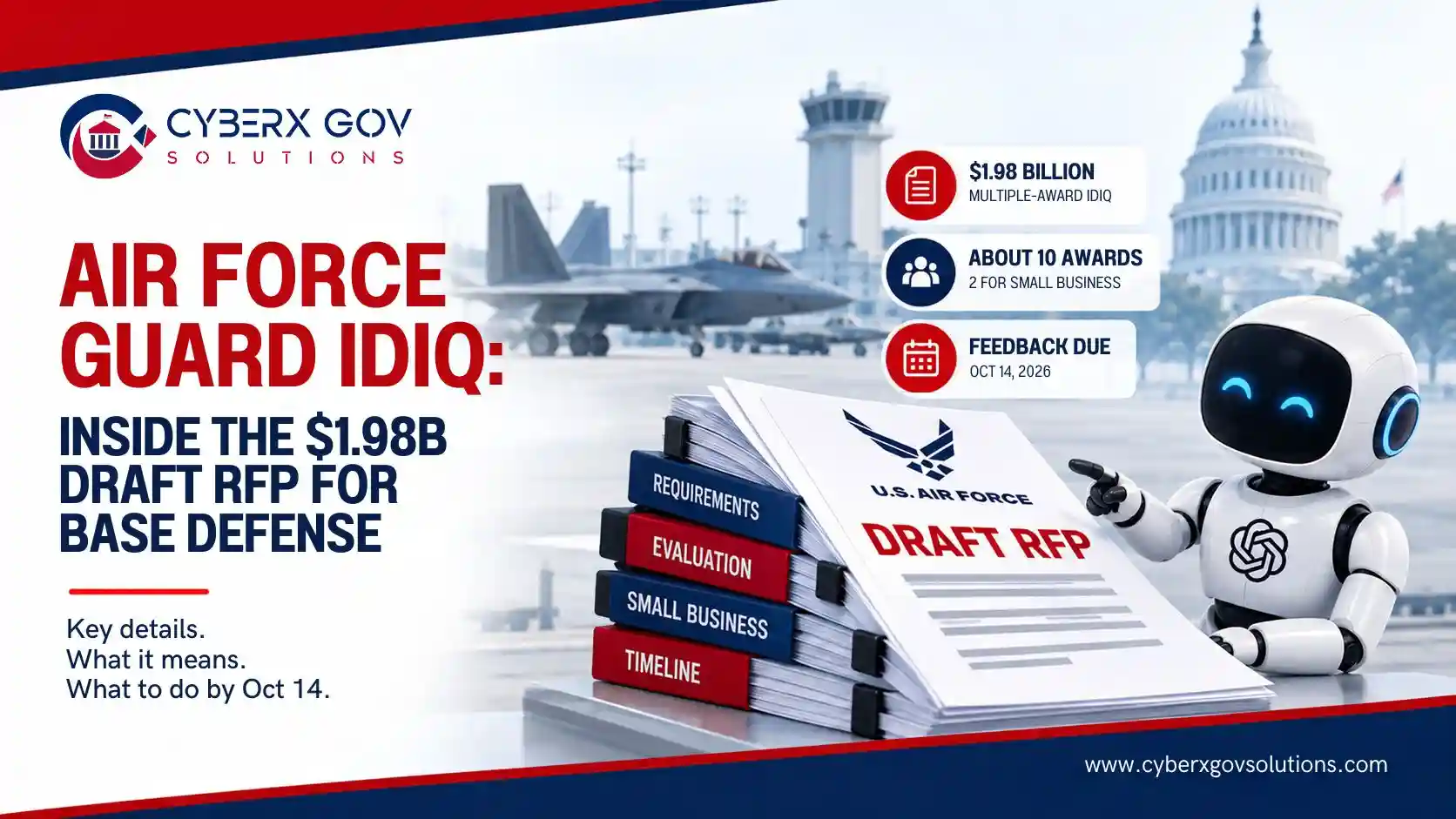
The U.S. Air Force just opened a rare window. It released a draft request for proposal, issued as a request for information, for the Global Unified Airbase Readiness and Defense (GUARD) IDIQ, a multiple-award contract with a $1.98 billion ceiling for base defense and security systems.
Here is why it matters now. The draft is not the final solicitation. It is the Air Force asking industry for feedback before it locks the requirements, and that feedback is due October 14, 2026, at 12:00 p.m. EDT. For contractors, this is the cheapest influence you will ever get on a bid this size: a chance to shape the rules before you have to play by them.
This guide breaks down what the GUARD IDIQ actually is, the numbers that matter, how the Air Force plans to evaluate offers, what it means for small businesses, and exactly what to do before the deadline. All figures come from the draft documents and may change in the final RFP.
Key Takeaways
- GUARD IDIQ is a $1.98 billion multiple-award contract for Integrated Base Defense Security Systems.
- The Air Force anticipates about 10 awards, with two reserved for qualified small businesses.
- It is a partial small business set-aside under NAICS 561621.
- Awards use a highest technically rated offeror (HTRO) approach with sample problems, not a traditional lowest-price bid.
- The draft phase closes on October 14, 2026, and it is your best chance to influence the final terms.
What Is the GUARD IDIQ?
The GUARD IDIQ (Global Unified Airbase Readiness and Defense) is a planned multiple-award, indefinite-delivery/indefinite-quantity contract through which the Air Force will acquire, integrate, and sustain Integrated Base Defense Security Systems (IBDSS). It carries a $1.98 billion ceiling and is managed by the AFLCMC Force Protection Systems Division at Hanscom AFB.
In plain terms, this contract funds the systems that protect air bases: the tools that help Security Forces deter, detect, delay, and assess threats to people and resources. GUARD is the recompete of the predecessor effort, IBDSS Next, and it changes how the work is ordered.
Under the old approach, design-and-install work and sustainment were split by region, with a single contractor handling each region. Under GUARD, orders are separated, sustainment stays regional, and design-and-install work is competed among the IDIQ holders through smaller, more frequent delivery orders. That shift means more chances to compete for work across the life of the contract.
The GUARD IDIQ Numbers That Matter
A quick reference to the figures that drive a bid/no-bid decision, all drawn from the draft documents.
| Element | Detail (per draft RFP) |
| Ceiling value | 1,980,000,000) maximum |
| Contract type | Multiple-award IDIQ |
| Anticipated awards | About 10, with two reserved for small businesses |
| Set-aside | Partial small business set-aside |
| NAICS code | 561621 (Security Systems Services) |
| Size standard | $25 million average annual receipts |
| Ordering period | 2-year base, options up to 10 years total |
| Max performance | Up to 5 more years to complete orders (15-year horizon) |
| Feedback deadline | October 14, 2026, 12:00 p.m. EDT |
Read one point carefully: the $1.98 billion is a ceiling, not guaranteed spending. IDIQ contracts set a maximum, and the actual dollars flow through individual task and delivery orders over time.
What Work Is In Scope
The GUARD IDIQ covers the full IBDSS portfolio across three system families and the services that support them.
- Fixed-site electronic security systems, such as intrusion detection, video management, access control, and surveillance tools.
- Tactical systems used for force protection missions, including the Tactical Automated Security System and related command-and-control families.
- Delay and denial systems, such as remote engagement systems, fencing, barriers, and bollards.
The contract also spans the work around those systems: site surveys and installation, systems engineering, testing and verification, cybersecurity assessment under the Risk Management Framework, operator and maintenance training, and lifecycle sustainment that can include spare parts, obsolescence management, and help desk support. Future capabilities are expected to run on a modular open systems architecture that supports Internet of Things, cloud, and AI integration. Work spans the continental U.S. and overseas.
Expert tip: The move to a modular open systems architecture is a signal. The Air Force wants interoperable, upgradeable systems, so a response that shows how your approach avoids vendor lock-in and supports open standards speaks directly to a stated priority.
How the Air Force Plans to Evaluate Offers
This is where many news summaries stop short, and where a smart contractor leans in. GUARD does not use a traditional lowest-price model. Per the draft Section M, the Air Force intends to award to the highest technically rated offerors with a fair and reasonable price, an approach known as HTRO.
The draft describes a sample problem phase, where offerors work through realistic scenarios rather than only writing narrative claims. It references examples such as a conceptual design for an intrusion detection system and a network engineering problem. The draft also indicates the Air Force anticipates evaluating the offerors with the highest numerical scores, roughly the top fifteen, in that phase before making its ten awards.
The takeaway for your capture strategy: GUARD rewards demonstrated technical capability. Your past performance and your ability to solve the sample problems will count for more than shaving your price to the bone.
What the GUARD IDIQ Means for Small Businesses
There is real, reserved room here for small firms. Per the draft, GUARD is a partial small business set-aside, and the Air Force plans to reserve two of the roughly ten IDIQ awards for qualified small businesses.
A few specifics shape whether that applies to you:
- The NAICS code is 561621, Security Systems Services, with a size standard of $25 million in average annual receipts. That determines whether your firm counts as small for this contract.
- Small business set-aside delivery orders may be issued over the life of the contract, which creates ongoing opportunity, not just a one-time award.
- Teaming is a smart play. If priming the full scope is a stretch, a teaming arrangement or subcontract role can get you onto a winning team and build the past performance that supports a future prime bid.
Expert tip: If you are near the $25 million size threshold, confirm your status early. Your size at the time of the offer governs eligibility for the reserved small business awards, and getting it wrong late is an expensive surprise.
What Contractors Should Do Before October 14
The draft phase is a capture window, not a spectator event. Here is a focused plan.
- Pull and read the full draft package on SAM.gov. The Section L instructions, Section M evaluation criteria, and the statement of work tell you how you will actually be judged.
- Run an honest bid/no-bid and capability gap check. Map your experience against the IBDSS scope and the sample problem areas, and name your gaps now.
- Decide your lane. Prime, small business reserve, or team member. Your size status and past performance point to the answer.
- Line up teaming conversations early. The strongest teams form before the final RFP, not after.
- Submit focused, actionable feedback by the deadline. Use the government’s comment matrix, flag anything in the draft that is unclear or unfairly limiting, and submit by October 14, 2026, at 12:00 p.m. EDT.
Why the Draft Phase Is Your Best Chance to Influence the Bid
Once the final RFP drops, the requirements are fixed, and your only move is to respond to them. Right now, the Air Force is explicitly asking whether the requirements make sense. That is an influence you will not have again on this contract.
Good draft feedback does two things. It can improve the solicitation, for example, by clarifying an evaluation factor or loosening a requirement that unintentionally shuts out capable firms. And it signals to the government that you understand the mission, which is exactly the credibility you want to carry into the final competition.
How CyberX Gov Solutions Can Help
A $1.98 billion opportunity with an HTRO evaluation and a sample problem phase rewards teams that prepare early and respond with precision.
CyberX Gov Solutions provides federal proposal development support that covers exactly this moment: reading the draft, mapping your capabilities to Sections L and M, coordinating teaming partners, and building a compliant, competitive response. For firms still shaping their federal footing, our Get Fed Ready™ program helps with opportunity fit analysis and bid readiness so you can pursue GUARD with a clear plan. Based in New York and working with contractors nationwide, we help you turn a draft RFP into a real shot at award.
Conclusion
The GUARD IDIQ is one of the more significant base defense opportunities on the board, a $1.98 billion multiple-award contract with roughly ten awards, two reserved for small businesses, and an evaluation that favors demonstrated technical skill over the lowest price. The draft phase, closing October 14, 2026, is the time to read the requirements closely, assess your fit, line up teaming, and submit feedback that shapes the final solicitation.
Treat this window as the start of your capture effort, not a news item to file away. The contractors who engage now will be the ones ready to compete when the final GUARD IDIQ RFP arrives.
Pursuing the GUARD IDIQ or a similar federal opportunity?
CyberX Gov Solutions helps contractors assess fit, build teams, and develop winning proposals for competitions like this one.
Schedule a free consultation at cyberxgovsolutions.com/schedule-a-meeting and start your GUARD capture the right way.
Frequently Asked Questions
What is the Air Force GUARD IDIQ?
The GUARD IDIQ (Global Unified Airbase Readiness and Defense) is a planned multiple-award, indefinite-delivery/indefinite-quantity contract for Integrated Base Defense Security Systems. It carries a $1.98 billion ceiling and is run by the AFLCMC Force Protection Systems Division. The Air Force released a draft RFP, as an RFI, to gather industry feedback before the final solicitation.
How much is the GUARD IDIQ worth?
The draft documents establish a ceiling of $1.98 billion, or $1,980,000,000. That figure is a maximum, not guaranteed spending. Actual dollars flow through individual task and delivery orders issued to awardees over the life of the contract, so the real value to any one awardee depends on the orders they win.
How many GUARD IDIQ awards will the Air Force make?
Per the draft, the Air Force anticipates awarding about ten IDIQ contracts to the highest technically rated offerors with a fair and reasonable price, and it reserves the right to award more. Two of those awards are reserved for qualified small businesses under a partial small business set-aside.
Is the GUARD IDIQ a small business set-aside?
It is a partial small business set-aside. The draft states the Air Force will reserve two IDIQ awards for qualified small businesses, while other awards are open to all offerors. The applicable NAICS code is 561621, Security Systems Services, with a size standard of $25 million in average annual receipts.
When are GUARD IDIQ draft responses due?
Industry feedback on the draft RFP is due October 14, 2026, at 12:00 p.m. EDT, submitted by email to the government points of contact listed in the notice. The draft phase is for comments and questions only. It is not the final solicitation, and submitting feedback does not obligate the government.
What does the GUARD IDIQ cover?
It covers Integrated Base Defense Security Systems across three families: fixed-site electronic security such as intrusion detection and access control, tactical force protection systems, and delay and denial systems like barriers and bollards. It also spans site surveys, installation, systems engineering, testing, cybersecurity, training, and lifecycle sustainment.
How will the Air Force evaluate GUARD IDIQ offers?
The draft describes a highest technically rated offeror (HTRO) approach with a fair and reasonable price, rather than a lowest-price award. It includes a sample problem phase in which offerors work through realistic technical scenarios. Demonstrated technical capability and past performance carry significant weight in this model.
What should contractors do during the GUARD IDIQ draft phase?
Read the full draft package on SAM.gov, run a bid/no-bid and capability gap check, decide whether to prime or team, start teaming conversations early, and submit focused feedback through the government’s comment matrix before the October 14, 2026 deadline. The draft phase is the best chance to shape the final solicitation.