One contractor spent months preparing for certification. The company put six figures into documentation, consultants, and a mock assessment. Then the deadline that was racing toward disappeared.
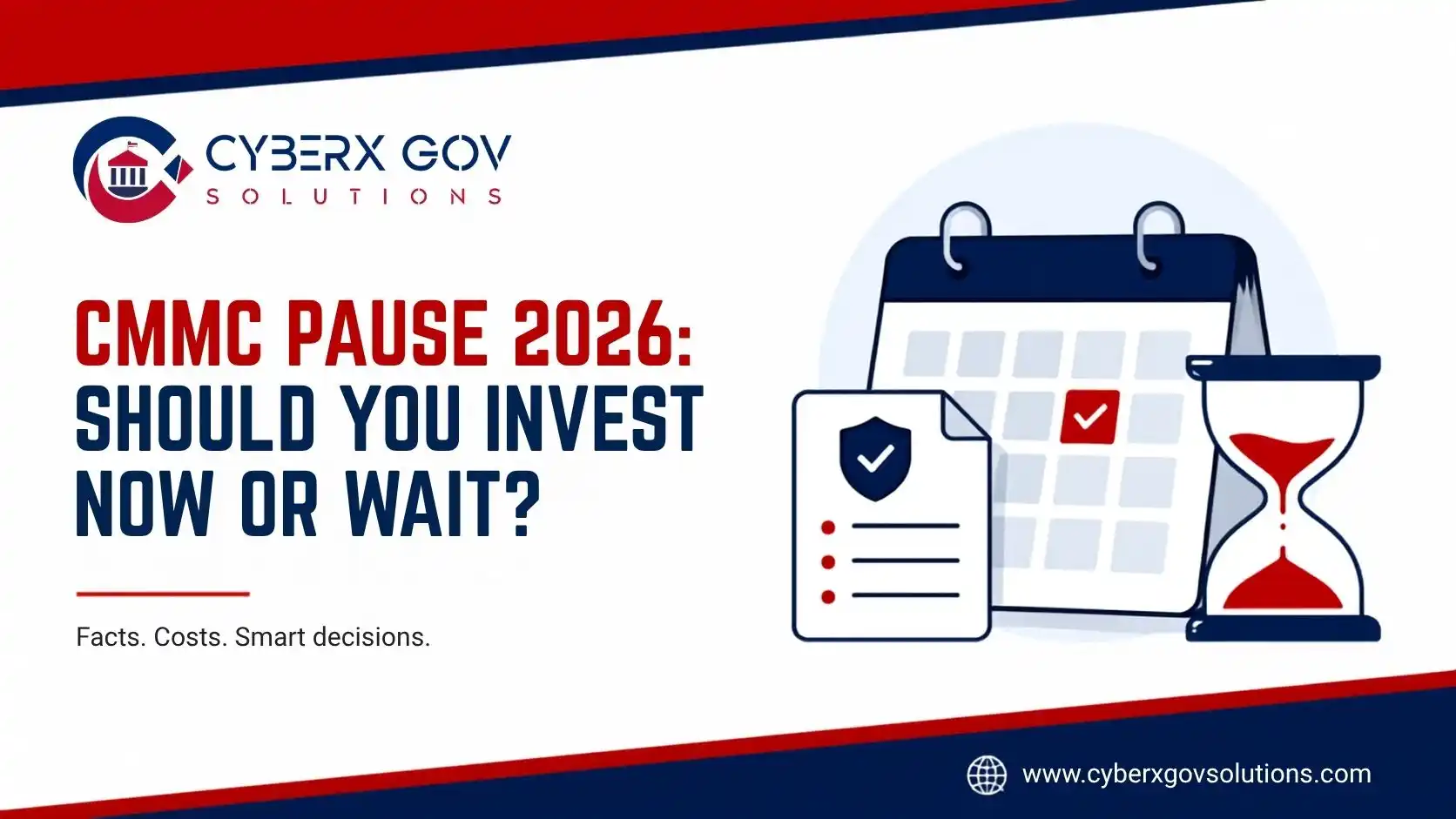
That is the position many federal contractors found themselves in this summer. The CMMC pause changed the timing of a major requirement, but it did not change the security duties you already carry. So the real question is not “Is CMMC dead?” It is “Should I keep spending, or hold?”
Here is the short answer. The pause affects when mandatory third-party assessments arrive, not whether you must protect government data today. If your current contracts or upcoming bids involve sensitive information like CUI, waiting can cost you more than acting. For less sensitive data such as FCI, you may have more flexibility to plan. This article gives you the facts and a clear framework to assess your risks and decide on your cybersecurity investments.
Key Takeaways
- On July 13, 2026, the Department of War suspended CMMC Phase 2 third-party assessments and opened a 60-day review.
- The pause did not remove your existing duties under DFARS 252.204-7012 and NIST SP 800-171.
- Full CMMC compliance was estimated by the SBA at roughly $593,800 for a third-party certification, which is why the burden on small firms drove the pause.
- The old November 10, 2026 date was a starting point for contracting officers, not a hard deadline for every contractor.
- Tie your compliance spending to your actual pipeline, not to news cycles.
What Is the CMMC Pause?
The CMMC pause is the Department of Defense’s July 13, 2026, decision to suspend Phase 2 of the Cybersecurity Maturity Model Certification program and review the whole approach. Phase 2 would have required mandatory assessments by certified third-party organizations, known as C3PAOs, starting November 10, 2026.
Alongside the suspension, the Department launched a 60-day reform review and created a CMMC Reform Task Force, which held its first meeting on July 16, 2026. The stated reason was cost. Officials pointed to heavy financial and administrative pressure on small, mid-sized, and nontraditional contractors and warned that these burdens were pushing innovative companies away from federal work.
Definition: CMMC (Cybersecurity Maturity Model Certification) is a Department of War program that verifies defense contractors protect Federal Contract Information (FCI) and Controlled Unclassified Information (CUI) to a set standard.
CMMC Did Not Appear Overnight
CMMC is the product of a long push to raise cybersecurity across the defense supply chain. Understanding that history explains why so many contractors treated it as unavoidable and invested early.
The program launched in 2020 with five levels and required outside assessments for certain contractors. In 2021, the Department began a review and built a simpler model. That became CMMC 2.0, which cut the model to three levels and leaned heavily on existing National Institute of Standards and Technology (NIST) requirements.
The three levels work like this:
• Level 1 protects Federal Contract Information and uses a self-assessment.
• Level 2 protects Controlled Unclassified Information and aligns with NIST SP 800-171.
• Level 3 covers the most sensitive CUI and adds controls from NIST SP 800-172.
Then the rules became real. Here is the timeline that matters:
| Milestone | Date | What It Meant |
| CMMC 1.0 introduced | 2020 | Five-level model, third-party assessments |
| CMMC 2.0 announced | 2021 | Simplified to three levels |
| 32 CFR program rule effective | December 16, 2024 | CMMC became an official program |
| 48 CFR (DFARS) rule effective | November 10, 2025 | Phase 1 began: self-assessments in new contracts |
| Phase 2 target date | November 10, 2026 | Third-party assessments planned, now paused |
| Phase 2 suspended | July 13, 2026 | 60-day review launched |
By the time Phase 2 loomed, many contractors saw certification as the price of staying in the game. That is why the pause hit some of them so hard.
What the Pause Did Not Change
This is the most important section for anyone tempted to relax. A paused requirement is not a cancelled obligation.
The suspension touched Phase 2 third-party assessments only. Your baseline security duties remain fully in force. During the pause, contractors must still:
- Meet Phase 1 self-assessment requirements in applicable contracts.
- Comply with DFARS 252.204-7012, the clause that requires safeguarding covered defense information and has been in effect since 2016.
- Implement the security controls in NIST SP 800-171 Rev. 2.
- Report cyber incidents and flow requirements down to subcontractors.
Expert tip: Treat the pause as extra runway, not a stop sign. When a verification mechanism returns, the work you skipped will still be waiting, and so will the bill.
Why Some Contractors Invested Early and Got Caught
Early preparation made sense for a reason. Companies that handle CUI cannot fix years of security gaps in a few weeks, so waiting carried real risk.
Consider the case of IntelliGenesis, a woman- and veteran-owned firm with about 140 employees. As reported by Federal News Network, the company pursued CMMC Level 2 certification early. It had already spent around $100,000, expected a total near $180,000 to $200,000, and paid roughly $40,000 for a mock assessment alone.
The company also ran into a bottleneck that few outsiders see. Certified assessors were scarce. Getting on an assessor’s schedule meant waiting months, which stretched timelines and pushed up costs.
The lesson is not that early investment was wrong. It is that large compliance spending needs a clear link to real contract requirements. By planning proactively and asking whether the investment connects to a current obligation, a likely future requirement, a customer expectation, or simply a guess about what the government might do, contractors can feel purposeful and confident in their cybersecurity efforts.
What CMMC Actually Costs
Cost is the reason the pause happened, so contractors deserve real numbers. Independent government estimates show why small firms pushed back.
| Compliance Path | Estimated Cost per Certification | Source |
| Third-party assessment (full) | ~$593,800 | Small Business Administration |
| Self-assessment eligible firm | ~$388,600 | Small Business Administration |
| Initial Level 2 third-party assessment | ~$31,000 | Pentagon estimate |
| Initial assessment package | ~$102,000 | Pentagon estimate |
More than 120,000 small defense contractors would have faced these requirements had Phase 2 launched. The system was not ready for them either. By late 2025, only 92 approved assessment organizations and 633 certified assessors existed nationwide.
SBA Administrator Kelly Loeffler summed up the concern plainly: “Cybersecurity cannot come at the cost of bureaucracy that shuts out the very companies our warfighters depend on.”
Invest Now or Wait? A Practical Decision Framework
There is no single right answer for every contractor. Waiting saves money now but can create a compliance backlog. Investing now improves security but drains limited cash and staff. The key is to approach compliance with a strategic plan, giving you a sense of control and readiness for future requirements. The smart move is to separate what you must do today from what you might need tomorrow.
Before committing serious money, work through these four areas.
- Review your current contract requirements. Do your active contracts involve FCI or CUI? Do they already carry cybersecurity clauses? The pause does not suspend obligations you already signed up for. Keep meeting them.
- Examine your opportunity pipeline. Look at the DoD work you expect to chase. If those solicitations involve CUI or reference CMMC, readiness has direct business value. Waiting could put you behind ready competitors.
- Measure the cost of readiness. You do not have to spend everything at once. Conduct a focused gap assessment to identify which controls, documents, and practices need attention. This approach helps you develop a phased roadmap, enabling you to prioritize investments based on your current cybersecurity posture and upcoming contract requirements.
- Weigh the value beyond CMMC. Better security lowers business risk, builds customer trust, and strengthens your standing with larger primes. Some improvements pay off even if a specific deadline shifts again.
Expert tip: Fold compliance planning into your capture and proposal process. It is a business decision, not just an IT project.
Is November 10, 2026, Still a Deadline?
No, and it never was a universal deadline. That date marked when contracting officers could start requiring third-party assessments in new contracts. It was not a cutoff by which every contractor had to be certified.
Many prime contractors misread it. Some began demanding CMMC Level 2 from subcontractors who never touch CUI, which added cost and pressure with no security benefit. If a prime asks you to certify, confirm what data the work actually involves before you spend a dollar. You may need far less than they assume.
What Small Businesses Should Do Right Now
The moment calls for preparedness without panic. Keep watching official announcements while you get your own house in order. Here is a checklist you can act on this quarter:
- Identify whether your current or planned work involves FCI or CUI.
- Review the cybersecurity clauses in your existing contracts.
- Monitor upcoming solicitations for CMMC and related language.
- Run a cybersecurity gap assessment against NIST SP 800-171.
- Prioritize high-value fixes over a full, immediate overhaul.
- Keep your policies and compliance documentation current.
- Talk with potential primes about their expectations.
- Build compliance costs into your future pricing.
Above all, do not make compliance decisions from headlines alone. A delayed requirement is not a dead one. And a new mandate does not mean every contractor must buy everything today.
How CyberX Gov Solutions Can Help
The CMMC pause proves a hard truth about federal work: requirements shift, but you still have to make decisions now. The goal is not to chase every rule. It is to know which rules touch the contracts that matter most to you.
That is where the right partner helps. CyberX Gov Solutions works with small and mid-sized contractors to read their opportunity pipeline, understand the security requirements tied to specific bids, and build a practical pursuit strategy around changing DoW expectations. Through the Get Fed Ready™ program, teams can assess where they stand and plan smart, phased steps instead of rushing into cost.
The Bottom Line
The CMMC pause is more than a schedule change. It is a case study in how to handle shifting federal requirements without wasting money or falling behind.
For small and mid-sized businesses, the lesson is simple. Do not wait for a requirement to show up in a solicitation, and do not invest blindly either. Connect your compliance planning to your contracting strategy. Know your current duties, watch what is coming, study your pipeline, and fund the improvements that deliver both security and business value.
Handle the CMMC pause this way, and you stay ready without spending scarce resources before you know where they will do the most good.
Ready to make a confident call?
Do not wait for a compliance requirement to appear in the solicitation. CyberX Gov Solutions can help your team assess upcoming federal opportunities, decode their cybersecurity requirements, and build a pursuit strategy around the CMMC pause and shifting DoW rules.
Schedule a free consultation at cyberxgovsolutions.com/schedule-a-meeting/
Frequently Asked Questions
Is CMMC still required in 2026?
Yes. The CMMC pause suspended only Phase 2 third-party assessments. Contractors must still meet Phase 1 self-assessment rules, DFARS 252.204-7012, and NIST SP 800-171 controls in applicable contracts. The program is under review, not cancelled, so plan for verification to return in some form.
Does the pause mean I can stop working on NIST 800-171?
No. NIST SP 800-171 controls still apply through DFARS 252.204-7012, which has been in effect since 2016. The pause changed the assessment timeline, not your duty to protect Controlled Unclassified Information. Continuing this work now reduces cost and stress when formal verification returns.
How much does CMMC certification cost for a small business?
The Small Business Administration estimated roughly $593,800 for a full third-party certification and about $388,600 for firms eligible to self-assess. Pentagon figures put an initial Level 2 assessment near $31,000. Actual costs vary widely based on your systems, staff, and current security maturity.
Should I get CMMC certified now or wait?
It depends on your pipeline. If your contracts or upcoming bids involve CUI, prepare now to stay competitive. If they do not, a phased approach may work. Start with a gap assessment so you know your position before committing a large budget.
When will CMMC Phase 2 resume?
No firm date exists. The CMMC Reform Task Force has 60 days to review industry feedback, then 15 days to recommend changes. Any real change requires formal rulemaking, which can take up to two years. Watch official DoW and Federal Register announcements for updates.
Do subcontractors need CMMC certification?
Only if they handle FCI or CUI on the contract. Some prime contractors ask all subs to certify, even when the work involves no sensitive data. Confirm what information your role actually touches before you agree to certify, since you may need a lower level or none.
What is the difference between CMMC Phase 1 and Phase 2?
Phase 1, which began November 10, 2025, introduced self-assessment requirements in new contracts. Phase 2 would have added mandatory third-party assessments by certified organizations. Phase 2 is the part suspended in July 2026, while Phase 1 self-assessment expectations remain in place.
Is the CMMC pause permanent?
No indication suggests it is permanent. Officials framed it as a review to cut costs and fix capacity problems, not an end to the program. A pause driven by burden usually returns as a revised requirement, so treating this as a break rather than a cancellation is the safer bet.