
For three years, the 8(a) Business Development Program sat in limbo. A federal court told the Small Business Administration (SBA) it could no longer presume that members of certain racial and ethnic groups were socially disadvantaged. Yet the regulation holding that presumption stayed on the books, unenforced. Applicants wrote narratives into a void, and decisions slowed to a crawl.
That gap is now closed. On August 11, 2026, the SBA published its final rule at 91 FR 51568. It takes effect September 10, 2026, and it rebuilds the 8(a) social disadvantage requirements in 13 CFR 124.103 from the ground up. If you run an individually owned firm with a pending 8(a) application, or you have been waiting for clarity before applying, this is the biggest shift to hit the program since the court ruling that started it all.
Here is what changed, what the new test asks of you, and the steps to take before the rule goes live.
Key Takeaways
• The rebuttable presumption of social disadvantage for individually owned firms is eliminated as of September 10, 2026.
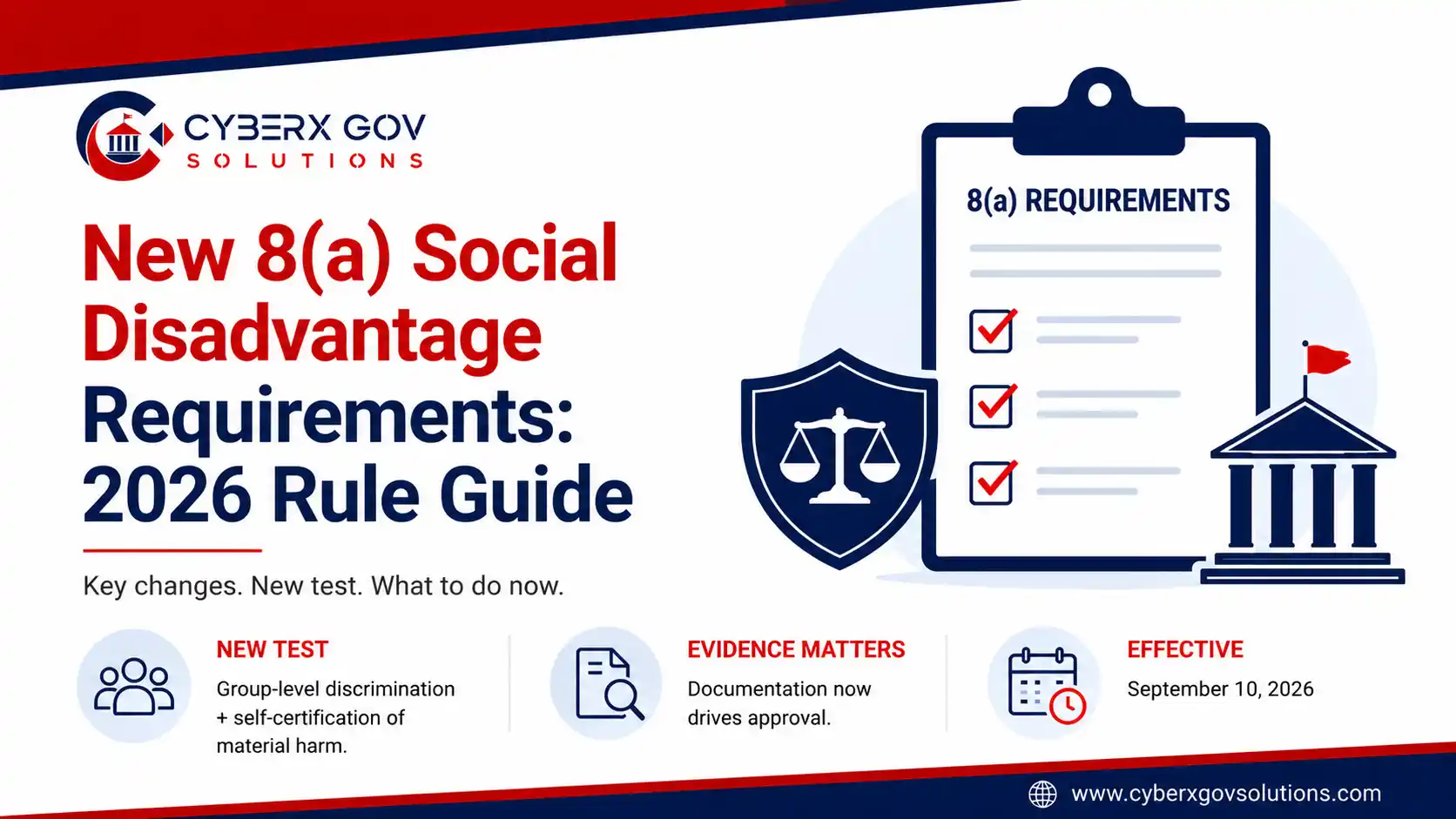
• The new 8(a) social disadvantage requirements ask for two things together: evidence of a group-level policy or practice, plus self-certification of the material harm it caused you.
• Documentation now drives approval. Group membership alone no longer opens the door, and neither does a personal story on its own.
• Current 8(a) participants and entity-owned firms (Tribes, ANCs, NHOs, CDCs) are not affected.
• Pending applicants should expect a request for supplemental information and should start rebuilding their evidence file now.
What Are the 8(a) Social Disadvantage Requirements?
The 8(a) social disadvantage requirements are the standard the SBA uses to decide whether a business owner qualifies as socially disadvantaged for the 8(a) Business Development Program. Under the 2026 final rule, an individually owned applicant must show a documented instance of group-level discrimination or bias and self-certify that it caused them material harm.
Social disadvantage is one half of the eligibility test. Owners must show both social and economic disadvantage. This rule changes only the social half, and only for individually owned firms.
Definition: Social disadvantage means being subject to racial, ethnic, cultural, or similar bias within American society, beyond your individual capacities and through no fault of your own. The 2026 rule keeps that concept but changes how you prove it.
Why the SBA Changed the Rule
From 1986 onward, the SBA satisfied the social disadvantage test for most applicants through a shortcut. People identified as Black American, Hispanic American, Native American, Asian Pacific American, or Subcontinent Asian American were presumed socially disadvantaged. Everyone else had to write a personal narrative documenting bias that held back their entry into or advancement in business.
In July 2023, a federal court in Ultima Services Corp. v. USDA held that this presumption failed equal protection review. The SBA stopped applying it right away and required every applicant to submit a narrative. But the regulation itself was never amended, which left applicants guessing.
Two events pushed the agency to act. In November 2025, the Department of Justice notified Congress that it viewed the presumption as unconstitutional and would not defend it. Then in June 2026, the SBA proposed a race-neutral test. The final rule adopts that proposal with two meaningful refinements.
What the New 8(a) Social Disadvantage Test Actually Requires
Early coverage of the rule has been confusing, so this point matters. Several summaries describe the new framework as a choice between two options: either produce documentary evidence of group discrimination, or self-certify group membership and harm.
That reading does not match the regulatory text. The rule states plainly that an applicant must satisfy both paragraph (c)(1) and paragraph (c)(2). The two elements are cumulative, not alternative.
Element 1: Evidence of group-level discrimination or bias. You must show that an entity in the United States, whether a federal, state, or local government, a university, or a corporation, took an action, adopted a policy, or kept a practice that favored other groups, disadvantaged your group, or otherwise disfavored it.
Element 2: Self-certification of membership and material harm. You must certify that you belonged to that group when the action occurred or while the policy was in effect, and that the action caused you material harm.
The flexibility lives inside Element 1. Where documentary evidence tied to a specific entity is not readily available, you may present other adequate evidence of the discrimination or bias. That is a safety valve for hard cases, not a way around the evidence requirement.
The rule defines material harm as loss of access to, or diminished opportunities related to, economic advancement. The SBA calls this broader than the old narrative standard. Under the prior test, someone deterred from applying to a program because of known barriers might struggle to show personal discriminatory treatment. Under the new one, that same person can certify material harm.
What Counts as Evidence
The SBA listed acceptable documentation and expanded it in the final rule. The categories below show what you can use to satisfy Element 1.
| Category | Examples |
| Institutional records | Government, university, and corporate websites, policies, regulations, guidance, procedures |
| Official statements | Statements by government, university, or corporate officials |
| Findings and audits | Reports, audits, or findings issued by those entities |
| Adjudications | Court decisions and administrative rulings |
| Legislative record | Specific Congressional findings, newly added in the final rule |
| Fallback | Any other adequate evidence, where entity-specific documentation is not readily available |
On substance, the rule names unlawful diversity, equity, and inclusion (DEI) programs, unlawful affirmative action policies, race-based quotas, set-asides, and hiring targets. It also points to two fact patterns: barriers to a federal program or contract that other groups did not face, and disadvantage in university admissions or private-sector discrimination of the kind at issue in Students for Fair Admissions v. Harvard (2023) and Ames v. Ohio Department of Youth Services (2025).
One detail carries real weight. Prior versions of 13 CFR 124.103 are themselves named as qualifying evidence. If your racial or ethnic group was left off the old presumption list, the regulation that excluded you now supports your claim.
This Is Not Only About Race
The most useful clarification in the final rule is that the test reaches beyond race and ethnicity. Commenters worried the DEI-heavy examples signaled a race-only framework. The SBA said that was never the intent and offered two illustrations that work as roadmaps.
Sex: Before the Equal Credit Opportunity Act of 1974, many banks kept official policies barring women from getting credit cards in their own names. The SBA treats that as documented group discrimination with an obvious economic effect, since the inability to build credit history is a real barrier to full economic participation. A woman who can certify that limitation harmed her meets the test.
Disability: When Congress passed the Americans with Disabilities Act in 1990, it made specific findings that discrimination against people with disabilities was pervasive. Those Congressional findings stand as evidence on their own. A person with an ADA-covered disability who was alive before 1990 and certifies material harm qualifies.
Both examples share a structure worth memorizing: identify a documented, group-level policy or finding, establish membership during the relevant period, then certify the economic harm. That is the template.
Who Is Affected and Who Is Not
The rule does not treat everyone the same. Use the table to find your situation.
| Your situation | Impact |
| Currently certified individually owned 8(a) participant | No impact. Social disadvantage is a one-time determination, and the SBA confirmed it will not be revisited at annual review. |
| Application pending as of September 10, 2026 | Must meet the new test. Expect a request for supplemental information. |
| Planning to apply after September 10, 2026 | The new test applies from the outset. |
| Entity-owned firm (Tribe, ANC, NHO, CDC) | No impact. Social disadvantage is not a statutory eligibility element for entity-owned concerns. |
What to Do Now: A Step-by-Step Checklist
The SBA signaled that pending applicants will need to supplement their files. Treat the coming weeks as preparation time and work through these steps.
- Audit your pending application. If your file rests on a narrative or on presumed group membership, it will not survive the transition in its current form.
- Build the evidence package first. Start from Element 1. Identify the specific policy, finding, or decision, then pull the primary document. Do not rely on secondary commentary.
- Refresh the supporting file. Financial statements, tax returns, and contract documentation age out. Older pending applications likely need updating.
- Take the self-certification seriously. It is submitted under penalty for false statements to the federal government. Certify only what you can substantiate.
- Expect the forms to change. The SBA is revising SBA Form 2413 under the Unified Certification System, and it has removed race and ethnicity questions from the collection.
- Keep more than one lane open. If certification timing is uncertain, maintain parallel paths. Teaming and mentor-protege arrangements, HUBZone or Service-Disabled Veteran-Owned Small Business (SDVOSB) status where you qualify, and simplified acquisition work that does not depend on a set-aside can all keep revenue moving.
Expert tip: Work backward from the document. Name the exact policy or finding first, then connect it to your group and your economic outcome. Applications built around a specific, verifiable record will move faster than those built around a story.
What to Watch
Three open questions will shape how this plays out.
Does the queue actually move?
The SBA effectively paused individually owned 8(a) decisions for an extended period. The agency argues an objective test will speed adjudication. Whether that happens over the fall is the question every pending applicant cares about.
How consistently will “other adequate evidence” be applied?
The fallback provision is necessary, but it reintroduces the subjectivity the rule was meant to reduce. Early determinations will set the practical standard.
Will there be litigation?
The SBA built a severability clause into the rule, which suggests it anticipates a challenge. That is worth monitoring, though it does not change what applicants should be doing between now and September 10.
How CyberX Gov Solutions Can Help
Meeting the new 8(a) social disadvantage requirements is a documentation exercise, and that is where preparation pays off. CyberX Gov Solutions helps small businesses get federal-ready through its Get Fed Ready™ program, which covers federal readiness assessments, SAM.gov registration support, capability statement development, compliance documentation guidance, and opportunity identification so you can pursue the right work while your certification is in process.
If your strategy depends on winning task orders once you are positioned, our proposal development team supports compliance matrices, win themes, and past performance sections for RFPs, RFQs, and task orders. And because no single certification should carry your whole pipeline, we help you keep parallel lanes open so a shift in timing does not stall your growth.
Conclusion
The 8(a) program is not going away. What changed is the currency of admission. Group membership no longer opens the door on its own, and neither does a well-written personal narrative. Documentation does. The 8(a) social disadvantage requirements now reward applicants who can locate a specific, verifiable policy or finding that disadvantaged their group and connect it credibly to their own economic outcomes.
For firms that have been waiting on a decision, the practical takeaway is simple. The paperwork you filed is probably not the paperwork you will need. Start rebuilding it now.
Ready to get your file in shape before September 10?
Preparing for the new 8(a) social disadvantage requirements starts with an honest look at your federal readiness and your supporting documentation. CyberX Gov Solutions can help you organize that groundwork through the Get Fed Ready program.
Schedule a free consultation at cyberxgovsolutions.com/schedule-a-meeting/.
Frequently Asked Questions
Is the 8(a) social disadvantage narrative still required?
Not in its old form. For individually owned applicants under the 2026 final rule, the personal narrative is replaced by a two-part test: documentary evidence of a group-level policy or practice that disfavored your group, plus a self-certification of the material harm it caused you. A story alone no longer satisfies the standard.
When does the new 8(a) social disadvantage rule take effect?
The final rule takes effect September 10, 2026. It was published August 11, 2026, at 91 FR 51568. The new 8(a) social disadvantage requirements apply to all individually owned applications pending as of that date and to anyone applying afterward.
Does the new rule affect current 8(a) participants?
No. Social disadvantage is a one-time determination, and the SBA confirmed it will not be revisited at annual review. If you are already an individually owned 8(a) participant, your status is not reopened. Entity-owned firms such as Tribes, ANCs, NHOs, and CDCs are also unaffected.
What counts as evidence of social disadvantage now?
Acceptable evidence includes institutional records, official statements, reports and audits, court and administrative rulings, and specific Congressional findings. Where entity-specific documentation is not readily available, you may present other adequate evidence. The goal is to point to a real, verifiable policy or finding, not a general claim.
Can a woman-owned or disability-owned business qualify?
Yes, if the facts fit. The SBA confirmed the test reaches beyond race and ethnicity. A woman harmed by pre-1974 bank policies that barred credit in her own name, or a person with an ADA-covered disability alive before 1990, can point to documented group discrimination and certify material harm.
What should I do if my 8(a) application is already pending?
Expect a request for supplemental information. Audit your file, then build an evidence package around a specific policy or finding, refresh your financial and contract documents, and prepare an accurate self-certification. Firms that start now will be positioned when the SBA resumes decisions.
What is material harm under the new 8(a) test?
Material harm is defined as loss of access to, or diminished opportunities related to, economic advancement. The SBA describes this as broader than the old narrative standard, so an applicant deterred from an opportunity by known barriers may be able to certify harm even without proof of individual discriminatory treatment.
Should 8(a) be my only certification strategy?
No. Because certification timing is uncertain during the transition, keep parallel paths open. Teaming and mentor-protege arrangements, HUBZone or SDVOSB status where you qualify, and simplified acquisition work that does not depend on a set-aside can all keep your pipeline active.