What the FY2025 SBA scorecard really means, and what to do about it
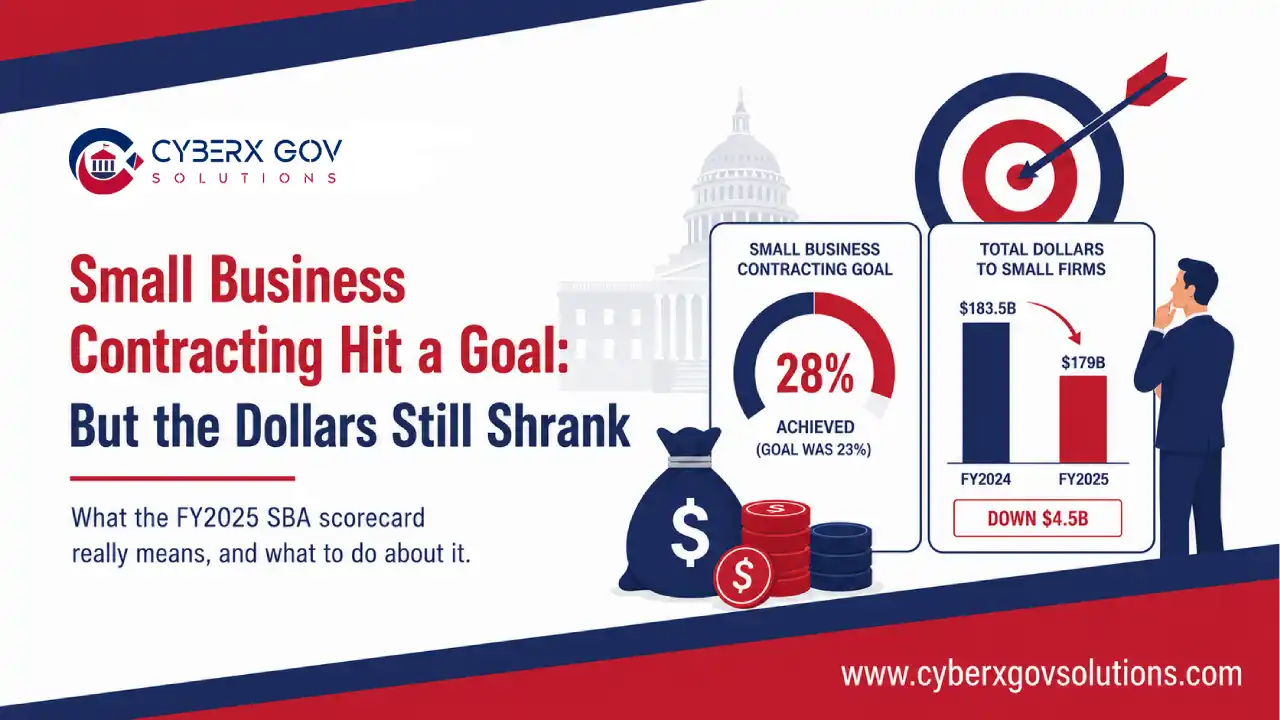
Here is a number that does not add up at first glance. Federal agencies beat their small business contracting goal in fiscal year 2025. Yet the actual money going to small firms went down.
The Small Business Administration (SBA) says agencies awarded nearly 28% of prime contract dollars to small businesses, well past the 23% goal set by law. But the dollar total fell from $183.5 billion in 2024 to $179 billion in 2025, even though overall federal contract spending grew.
Most coverage stops at reporting that gap. This guide does the part that matters more: it explains what actually changed, and what you should do differently to keep winning small business contracts in this tighter market.
The FY2025 Scorecard at a Glance
If you read nothing else, these are the numbers that define the year:
| Metric | FY2025 result |
| Small business prime share | Nearly 28% (goal was 23%) |
| Total dollars to small firms | $179B, down from $183.5B |
| Government-wide grade | about 105% of goals |
| 8(a) program share | 3.7%, down $1.5B to $24.3B |
| Women-owned (WOSB) share | 4.2%, missed the 5% goal |
| HUBZone share | 2.66%, missed the 3% goal again |
Why Did the Dollars Fall if the Percentage Rose?
The answer is in how SBA does the math. It measures the small-business share against an “addressable market,” which is the slice of contracts that small firms could realistically compete for. It does not measure against total federal spending.
So the percentage can climb while the raw dollars drop. The two figures describe different things. SBA did not respond to requests to explain the methodology further.
A separate view comes from the Government Accountability Office, which reported that total federal contract spending rose to about $793 billion in 2025 from $755 billion in 2024. More money flowed out, but a smaller share of it reached small businesses.
Every Small Business Category Lost Ground
Look past the headline, and one pattern holds across the board. Every specific set-aside category dropped in both dollars and share. Set-asides are contracts that the government reserves for certain types of small firms.
- 8(a) firms (owned by socially and economically disadvantaged people) fell to 3.7% of prime contracts, a $1.5 billion drop to $24.3 billion. That is the steepest single-year fall in a decade, driven by SBA audits that began removing nearly 800 firms.
- Small disadvantaged businesses (SDBs) dropped to 11.6% from 12.27%, the first decline in ten years, after the administration reset the goal to the 5% legal minimum.
- Service-disabled veteran-owned (SDVOSBs) slipped to $32.5 billion from $32.8 billion, even as SBA cleared a backlog of more than 2,700 veteran certifications.
- Women-owned (WOSBs) fell to 4.2% from 4.97%, missing the 5% goal, with 936 fewer firms in the market.
- HUBZone firms (based in underserved areas) missed the 3% goal again at 2.66%, the sixth year in a row.
Senator Ed Markey, ranking member of the Senate Small Business Committee, framed it more bluntly. His report counts a $47 billion drop in small business spending, a 19% fall, over the 15 months since January 2025, with more than 6,500 firms leaving the federal market.
What This Means for Your Business
Tighter dollars and tougher audits do not mean you should sit out. They mean that the firms that stay organized and visible will take the remaining work. Here is where to focus.
1. Fix Your SAM.gov and SBS Profiles First
You cannot bid as a prime without an active registration in SAM.gov, the federal vendor portal. But registration alone is not enough anymore.
In mid-2025, SBA replaced the old DSBS directory with the Small Business Search (SBS). This is the database contracting officers use to find small firms by industry code and certification. If your profile is outdated or miscoded, buyers cannot find you. Claim your SBS profile, match your industry codes, and keep your certification status current.
2. Use the Rule of Two to Your Advantage
The Rule of Two is one of the most useful rules small firms overlook. It requires agencies to set a contract aside for small businesses when at least two qualified small firms are likely to bid at a fair price.
Here is the practical part. If you and one other qualified small business are both visible and clearly capable in SBS, you make it easier for the contracting officer to reserve that work for small firms. Your visibility helps trigger the rule that protects you. Senators are now pushing to write this rule firmly into law, so it is worth understanding.
3. Start With Subcontracting and Smaller Buys
When prime dollars tighten, the easiest way in is through the side door. Two low-competition entry points stand out:
- Subcontracting under an established prime contractor. You build federal past performance and earn revenue without winning a prime contract first.
- Simplified acquisitions, which are smaller contracts that often weigh price and capability more than a long track record.
Both build the experience that makes your next, larger bid credible.
4. Keep Your Records Audit-Ready
Audits are expanding across the 8(a), women-owned, and veteran programs. SBA has even asked some firms for three years of personal and business tax returns. If your certification paperwork is messy, that is now a direct risk to your eligibility.
Treat clean documentation as part of your bid strategy, not just back-office admin.
What Changes in 2026
SBA has signaled it is overhauling the scorecard itself. Expected changes include more focus on veterans in general, fewer no-bid 8(a) awards, folding small disadvantaged businesses into a broader “economically disadvantaged” label, continued anti-fraud enforcement, and a new emphasis on “competitive value to the taxpayer.”
That means next year’s scorecard may not line up neatly with this one. For planning purposes, the rulebook is moving. The firms that stay registered, visible, and compliant will adapt fastest.
How CyberX Gov Solutions Can Help
A shifting market is hard to plan around alone. CyberX Gov Solutions helps small businesses get ready for the federal marketplace and stay ready as the rules change.
Through the Get Fed Ready™ program, CyberX supports your SAM.gov registration, helps build your capability statement, and guides you through compliance and opportunity planning. When a real bid lands, the proposal development team helps you put together a compliant, well-organized response, from the compliance matrix to final submission.
The Bottom Line
Agencies technically beat their small business goal in 2025. But dollars to small firms fell, every category lost ground, and thousands of firms left the market while overall spending grew. Whether that is a cleanup or a contraction depends on which numbers you emphasize.
Either way, the response is the same. Get registered, get visible in SBS, keep your records clean, and bid where competition is thinnest. With the methodology changing again in 2026, this is the year to tighten your foundation, not wait and see.
If you want help getting federal-ready, CyberX Gov Solutions can walk you through it step by step.
Schedule a free consultation at cyberxgovsolutions.com/schedule-a-meeting.
Frequently Asked Questions
What is the small business contracting goal for 2025?
The federal government aims to award at least 23% of prime contract dollars to small businesses each year. In fiscal 2025, agencies awarded nearly 28%, beating the goal even as total dollars to small firms declined.
What is the Rule of Two in federal contracting?
The Rule of Two requires agencies to set a contract aside for small businesses when at least two qualified small firms are expected to bid at a fair price. Staying visible in SBS makes it easier for contracting officers to apply it.
What replaced DSBS for finding small business contractors?
In mid-2025, SBA replaced the Dynamic Small Business Search (DSBS) with the Small Business Search (SBS). Contracting officers use it to find small firms, so an accurate, current profile is now essential for visibility.
How can a new business win federal contracts with no experience?
Start with subcontracting under a prime contractor and with simplified acquisitions, which are smaller contracts that weigh price and capability over a long track record. Both build on the past performance that supports larger bids later.
Do I need a certification to bid on federal contracts?
Not for general small business set-asides, which you can self-certify through SAM.gov. Programs like 8(a), HUBZone, and WOSB require formal certification but open access to contracts reserved only for those firms.