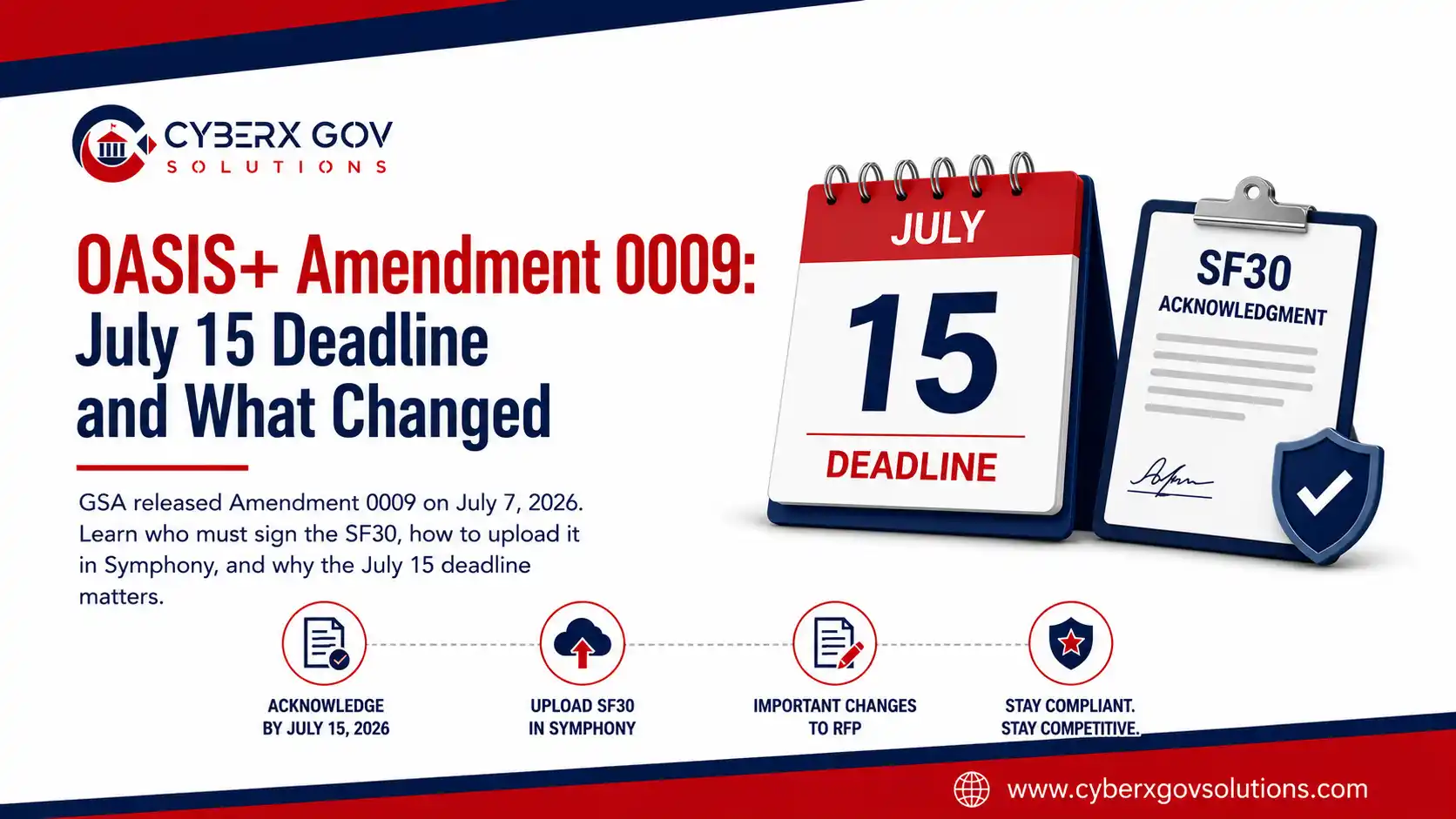
One signature could decide whether your OASIS+ proposal stays in the running. On July 7, 2026, the General Services Administration (GSA) posted Amendment 0009 for the OASIS+ Phase II solicitations. The amendment applies to all six contract tracks, from 8(a) to Unrestricted.
Two things happened at once here. First, offerors with pending proposals received a hard deadline: acknowledge the amendment by July 15, 2026, or risk dropping out of consideration. Second, GSA rewrote rules across the solicitation that change how proposals get evaluated, how contract terms get calculated, and how teams qualify.
This post explains what OASIS+ Amendment 0009 requires, who must respond, and which changes in the conformed Request for Proposal (RFP) deserve your attention after the deadline passes.
What Is OASIS+ Amendment 0009?
OASIS+ stands for One Acquisition Solution for Integrated Services Plus. It is GSA’s government-wide contract vehicle for professional services, covering 13 domains such as management and advisory, technical and engineering, and human capital. Phase II opened in January 2026 with Amendment 0008, which turned the program into a continuously open solicitation with rolling awards.
Amendment 0009, often shortened to Amendment 9, updates each of those open solicitations. The conformed RFP carries an issuance date of July 1, 2026, and reflects the current Federal Acquisition Circular, FAC 2026-01. GSA also refreshed the supporting attachments, including the domain qualifications matrices and scorecards (J.P-1), the Project Verification Form (J.P-3), the Cost/Price Template (J.P-9), and the Lateral Springboarding Summary Sheet (J.P-14).
Who Must Acknowledge Amendment 0009
The new RFP section L.5.1.1.1 sorts of offerors into clear groups. Your obligations depend on where your proposal stands today.
Offerors With Proposals Still Under Review
This group carries the real deadline. If you submitted a Phase II proposal and have not yet received an award or an unsuccessful offer notification, GSA requires you to acknowledge Amendment 0009. You do this by signing the SF30 form and uploading it to the Business Factors section in Symphony, the OASIS+ submission portal, by July 15, 2026.
The RFP language leaves no room for improvisation. The acknowledgment cannot be used to revise, supplement, or cure any part of your submitted offer. Failure to acknowledge by the deadline may make your offer ineligible for further consideration.
New Offerors Preparing a Submission
Companies that have not yet submitted follow a simpler path. Build your proposal on the conformed Amendment 0009 RFP and its current attachments, and acknowledge active amendments during the Symphony submission process. Old templates are a real hazard: scorecards, verification forms, and pricing files all changed with this update.
Awardees and Unsuccessful Offerors
If GSA has already awarded your contract, or already told you that your offer was unsuccessful, this acknowledgment cycle does not apply to you. Current contract holders receive changes through contract modifications instead.
How to Complete the SF30 Acknowledgment
The process takes minutes if you know where to go. Follow these steps for each solicitation where you have a pending proposal:
- Step 1: Download Amendment 0009 from the SAM.gov posting for your track (8(a), WOSB, SDVOSB, HUBZone, Small Business, or Unrestricted).
- Step 2: Read the amendment and confirm which of your pending proposals it covers.
- Step 3: Sign the SF30. An authorized company representative should complete the signature blocks.
- Step 4: Log in to Symphony and open the record for the applicable solicitation.
- Step 5: Upload the signed SF30 to the Business Factors section.
- Step 6: Repeat for every track where you hold a pending proposal, then confirm each upload saved correctly.
Acknowledgments Are Now a Permanent Feature
Here is the detail most coverage misses. Amendment 0009 added a standing section to the RFP, L.5.1.1.1 Solicitation Amendments, that governs every future amendment too. Each new amendment will state whether offerors with pending proposals must acknowledge it, and by what deadline.
In plain terms, this July 15 exercise is not a one-time event. As long as your proposal sits in the evaluation queue, you own an ongoing duty to watch SAM.gov and respond to amendment instructions. Assign that job to someone on your team now.
Key Changes Inside Amendment 0009
The deadline grabs the headlines, but the section-by-section changes matter more over the life of the contract. Five stand out.
Later Awards Get Shorter Contract Terms
Every contract in a family shares the same final end date, set by the initial awards. Contracts awarded now will not receive a full ten-year term. The 8(a) RFP gives a worked example: initial awards run from November 2024 with an option end date of November 5, 2034, so a July 2026 award would carry a base period ending July 2031 and the same 2034 ceiling. Waiting to bid now has a measurable cost.
Evaluation Happens in Independent Stages
Section M.4 spells out that GSA screens offers in stages: acceptability, technical qualification, responsibility, and fair and reasonable pricing. Each stage stands alone, so errors or omissions can sink an offer at any point. The acceptability review checks for items like joint venture agreements, subcontractor commitment letters, the Cost/Price Template, the indirect rates Basis of Estimate, and claimed credits that meet the domain threshold. A strong self-score cannot rescue a package with a missing document.
Tougher Rules for Mentor-Protégé Joint Ventures
For each proposed domain, a mentor-protégé joint venture must now include at least one relevant Qualifying Project from the protégé or the joint venture itself. Borrowed experience from a commitment-letter partner cannot fill that slot. GSA also tightened mentor participation: if one mentor submits multiple mentor-protégé offers under the same solicitation, all of them get rejected.
SAM.gov Replaces FPDS for Verification
The Federal Procurement Data System (FPDS) reports that offerors used to verify project experience now live in SAM.gov. The RFP renames them SAM.gov Contract Award and Contract Detail Reports and updates the verification instructions to match. Proof standards tightened elsewhere too. Cybersecurity Maturity Model Certification (CMMC) self-assessments only earn credit with official government acceptance evidence, and past performance forms for non-federal projects need a signature from a customer official who actually oversaw the work.
New Guardrails for Current Awardees
Add Domain requests must meet the current solicitation criteria, including a fresh size representation, and price proposals will not be accepted with them. On the 8(a) track, contractors who have exited the 8(a) program can no longer add domains. Lateral springboarding requests now go to the contracting officer through FedConnect with four required documents, including a signed SF33 and the updated summary sheet. One softer change: a contractor that outgrows the size standard on some NAICS codes only sees the affected contract line items go dormant, not the whole contract.
Amendment 8 vs Amendment 9 at a Glance
A section-by-section comparison of the two RFP versions shows where the ground shifted. The table below summarizes the most consequential differences.
| Area | Amendment 8 (January 2026) | Amendment 9 (July 2026) |
| RFP baseline | Issued January 12, 2026; current as of FAC 2025-06 | Issued July 1, 2026; current as of FAC 2026-01 |
| Amendment acknowledgment | No standing process for pending offerors | New Section L.5.1.1.1: signed SF30 upload in Symphony when an amendment directs it |
| Domain list (C.2) | 12 domains in a bulleted list | Numbered list of 13, adding a Reserved slot for Enterprise Solutions (Unrestricted only) |
| Project verification data | FPDS reports | SAM.gov Contract Award and Contract Detail Reports (formerly FPDS) |
| Blanket Purchase Agreements | Brief mention that task orders may incorporate BPAs | BPA orders must follow BPA ordering procedures and FAR 16.507 fair opportunity rules |
| Size re-representation | Whole contract placed in Dormant Status | Only affected contract line items go dormant (13 CFR 125.12(e)(2)) |
| Add Domain requests | Price proposal not required | Price proposals not accepted; 8(a) firms need an active 8(a) certification; new J.P-7 for new team members only |
| Lateral springboarding | Reps and certs plus summary sheet | Adds SAM.gov reps copy, a signed SF33, rate confirmation, and explicit project listing |
| C-SCRM plan timing | Due “within 90 days” of Notice to Proceed | Due “not later than 90 days” after Notice to Proceed |
| Program office | Office of Professional Services and Human Capital (PSHC) | Office of Acquisition Solutions Development (ASD) |
Most rows read like housekeeping. Together they signal something bigger: GSA is standardizing OASIS+ around SAM.gov data and building compliance duties directly into the solicitation text.
Common Mistakes to Avoid This Week
A few errors show up repeatedly when contractors handle acknowledgments under time pressure.
The first is acknowledging only one solicitation. Each track has its own SF30, and each pending proposal needs its own upload in Symphony. The second is signature problems: route the form early to someone with authority to bind the company. The third is assuming silence means safety. Verify that each upload saved to the Business Factors section, and keep a screenshot for your records.
How CyberX Gov Solutions Can Help
Deadlines like this reward companies with steady proposal operations. CyberX Gov Solutions supports federal contractors through its Proposal Development service, which covers compliance checks, proposal strategy, and final submission support for RFPs and contract vehicles like OASIS+. If you are weighing a Phase II submission, the team can help you assess readiness before you invest in a full proposal effort.
For businesses newer to the federal marketplace, the Get Fed Ready™ program walks you through SAM.gov registration support, capability statement development, and opportunity fit analysis so you can pursue vehicles like OASIS+ from a solid foundation.
Schedule a free consultation at cyberxgovsolutions.com/schedule-a-meeting/.
Conclusion
Amendment 0009 asks two different things of you. This week, offerors with pending proposals must sign the SF30 and upload it to the Business Factors section in Symphony by July 15, 2026. After that, everyone touching OASIS+ should reread the conformed RFP for their track, because evaluation stages, verification documents, joint venture rules, and contract terms all shifted.
The bigger lesson is structural. GSA has built amendment acknowledgment into the RFP as a permanent duty for pending offerors. Continuous solicitations demand continuous attention, so make SAM.gov monitoring part of someone’s job description.
Need a second set of eyes on your OASIS+ compliance or your next federal proposal? CyberX Gov Solutions helps small businesses and growing contractors submit clean, compliant offers.
Schedule a free consultation at cyberxgovsolutions.com/schedule-a-meeting/.
Frequently Asked Questions
Is OASIS+ Amendment 9 the same as Amendment 0009?
Yes. GSA numbers amendments with four digits, so the official designation is Amendment 0009. Contractors and industry blogs often shorten it to Amendment 9. Both names refer to the July 2026 update to the six OASIS+ Phase II solicitations.
What is an SF30 form in government contracting?
The SF30 is the Standard Form 30, titled Amendment of Solicitation/Modification of Contract. Agencies use it to issue changes to open solicitations and existing contracts. Offerors sign it to confirm they have received and accepted an amendment.
Will I still get a full ten-year contract if I win OASIS+ now?
No. All contracts in a family share the final end date set by the initial awards. Awards made after the initial round receive a base period of no more than five years and a shorter option period, so the total term shrinks the later your award arrives.
Can I update my rejected OASIS+ proposal and resubmit it?
No. Section L.5.9 requires a completely new proposal in Symphony, since the prior offer cannot be updated or re-evaluated. The new offer must include a signed letter on company letterhead responding to every finding in your debriefing letter.
Do SAM.gov reports replace FPDS reports in OASIS+ proposals?
Yes. Amendment 0009 updates the verification language to reference SAM.gov Contract Award and Contract Detail Reports, formerly known as FPDS reports. Offerors use these reports to verify claimed project experience and federal prime experience credits.
Can I still submit a new OASIS+ Phase II proposal after July 15, 2026?
Yes. The July 15 date applies only to SF30 acknowledgments from offerors with pending proposals. The Phase II solicitations remain continuously open, with posted response dates that GSA extends on a rolling basis, so new offers may be submitted at any time using the current RFP package.