If the phrase “Cost Accounting Standards” has ever made you hesitate before pursuing a larger federal contract, 2026 brings good news. The rules just got a major rewrite, and the changes favor small and growing contractors.
Here is the short version. Two separate rules reshaped how CAS works. One brings several old standards in line with commercial accounting. The other lifts the dollar thresholds that decide who has to comply in the first place. Together, they let more growing firms go after larger contracts without setting off a costly compliance overhaul.
This guide covers what the Cost Accounting Standards are, what exactly changed, when each piece takes effect-such as August 7, 2026, and October 1, 2026-and what steps your business should take to prepare for these updates. Clear timelines enable you to plan your compliance activities proactively.
Key Takeaways
• Two rules, two dates. GAAP conformance took effect on August 7, 2026. The higher thresholds take effect on October 1, 2026.
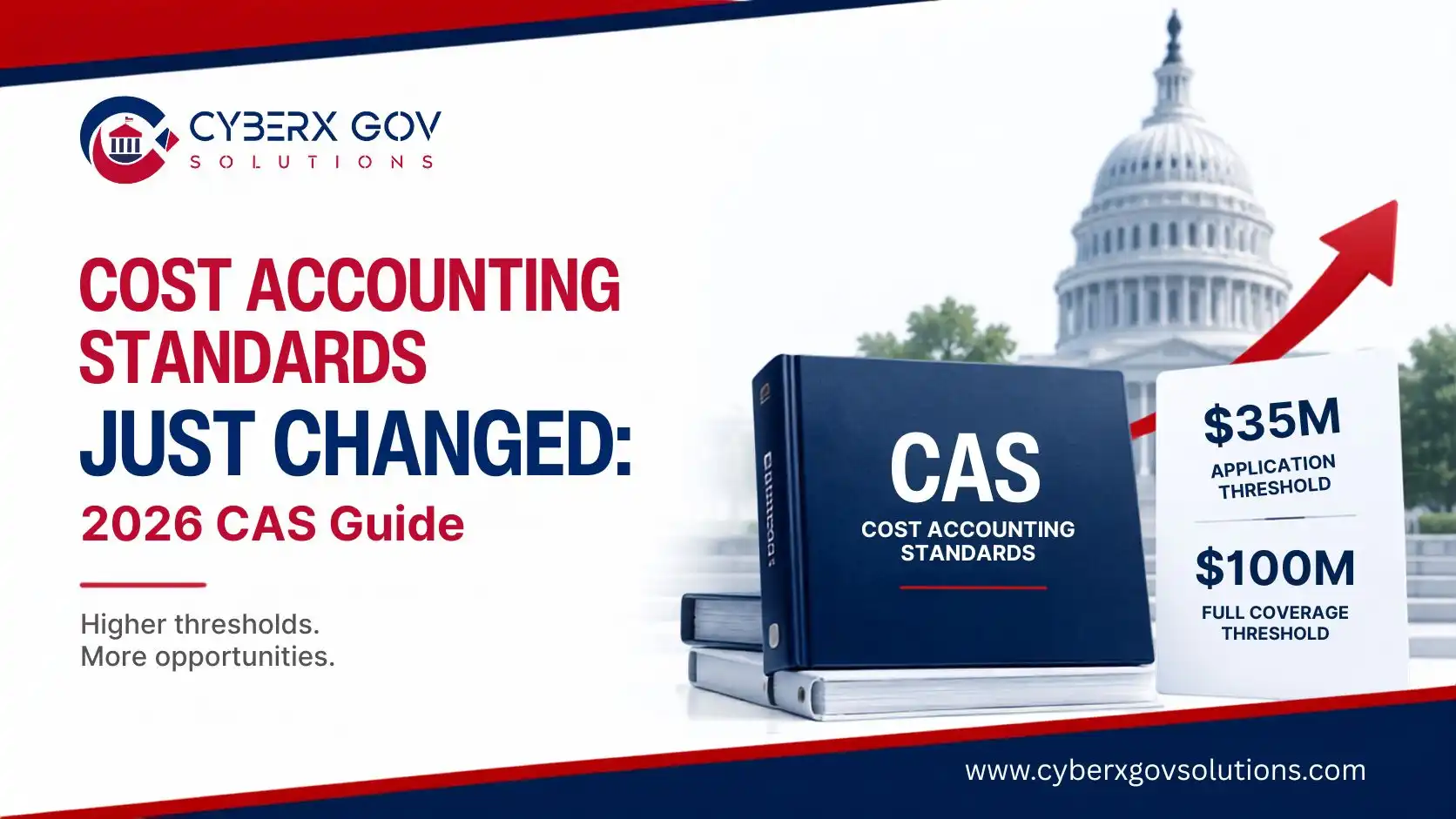
• The basic applicability threshold jumped from $2.5 million to $35 million.
• Full CAS coverage doubled from $50 million to $100 million.
• The $7.5 million trigger contract rule is gone.
• Small businesses were already exempt. The biggest winners are growing firms moving into mid-tier work.
What Are the Cost Accounting Standards?
The Cost Accounting Standards (CAS) are a set of 19 federal rules that govern how certain contractors measure, assign, and allocate costs on government contracts. They exist so agencies can audit and compare contractor costs on the same footing.
CAS applies to larger negotiated contracts, not every federal deal. Once a contract is “CAS covered,” the contractor has to follow specific accounting practices and, in many cases, file a formal Disclosure Statement laying them out. The Defense Contract Audit Agency (DCAA) then reviews the work.
Coverage comes in two levels. Full coverage means every applicable standard applies and a Disclosure Statement is usually required. Modified coverage applies to a smaller subset. The dollar value of your covered work decides which level lands on you.
Quick definition: A Disclosure Statement is a written account of your cost accounting practices that CAS-covered contractors file with the government. Putting one together takes real time and expertise, which is why the coverage thresholds carry so much weight.
Why the 2026 Changes Matter
For years, CAS acted as a wall that growing contractors slammed into. A firm would win enough work to cross a threshold, then face a pricey scramble to stand up CAS-compliant systems and file the disclosure paperwork. Sometimes the cost of compliance swallowed the value of the next contract.
The 2026 changes push that wall much further back. By lifting the thresholds and simplifying several standards, the CAS Board shrank the pool of firms dragged into full compliance. By the Board’s own math, raising full coverage to $100 million keeps nearly 99 percent of the dollars currently under full coverage while dropping nearly 30 percent of the entities out of it.
Read that twice. Almost the same amount of money stays covered, yet far fewer companies carry the load. That trade is the whole point of the reform.
The First Change: CAS Conforms to GAAP
Effective August 7, 2026, the CAS Board rescinded or trimmed four standards that overlapped with commercial accounting, clearing the way for contractors to lean on Generally Accepted Accounting Principles (GAAP) instead.
GAAP is the standard accounting framework U.S. companies already run on, maintained by the Financial Accounting Standards Board. The Board concluded that GAAP now covers the same ground these older CAS rules once did.
Here is what moved:
- CAS 408 (compensated personal absence, such as paid leave) and CAS 411 (acquisition costs of materials) were rescinded in full.
- CAS 404 (capitalization of tangible assets) and CAS 409 (depreciation) were mostly rescinded, with a handful of provisions kept.
The Board pointed out that these standards had sat unchanged for over 50 years while GAAP kept evolving. The conformance rule, effective August 7, 2026, reduces the regulatory burden by eliminating 68 of 72 requirements and over 10,000 words of regulatory text. This change means your existing accounting systems aligned with GAAP will require fewer adjustments, simplifying compliance for contractors already using GAAP-based practices.
The Second Change: Higher Dollar Thresholds
Effective October 1, 2026, the thresholds that decide CAS coverage climb sharply. The basic applicability threshold rises from $2.5 million to $35 million, and the full coverage threshold doubles from $50 million to $100 million.
This is the change most likely to touch your pipeline. The increases trace back to Section 1806 of the FY2026 National Defense Authorization Act (NDAA), carried into the CAS rules by the CAS Board.
Three things happened together:
- The basic applicability threshold rose from $2.5 million to $35 million. Contracts below this line sit outside CAS entirely.
- The full coverage threshold doubled from $50 million to $100 million. Fewer firms will need full compliance and a Disclosure Statement.
- The separate $7.5 million trigger contract rule was scrapped. With a far higher applicability threshold, that trigger served no purpose.
Clearing Up a Common Mix-Up
Plenty of the online chatter claims the old $7.5 million trigger “became” the new $35 million threshold. That is not quite right, and the difference matters.
Understanding that the $35 million threshold replaces the old $2.5 million helps contractors feel more confident in assessing their compliance needs.
CAS Thresholds: Before and After
| Rule | Before | After (Oct 1, 2026) |
| Basic applicability threshold | $2.5 million | $35 million |
| Full coverage + Disclosure Statement | $50 million | $100 million |
| Trigger contract rule | $7.5 million | Eliminated |
| CAS 404, 408, 409, 411 | In force | Rescinded or trimmed (as of Aug 7, 2026) |
What This Means If You Are a Small or Growing Contractor
The shift means growing firms can pursue larger contracts with less immediate compliance pressure, fostering confidence in expansion.
- You can go after larger contracts without immediately tripping full CAS coverage.
- The jump from exempt to fully covered is less jarring because the thresholds now sit much higher.
- Growth planning gets easier, since a single mid-size award will not automatically pull you into a Disclosure Statement.
Expert tip: If your firm is nearing or leaving small-business size standards, take a fresh look at your CAS exposure now. The old assumption that a $10 million or $50 million award means heavy compliance no longer holds the way it once did.
What the Changes Do Not Do
Being straight about the limits matters as much as the headlines.
- They do not wipe out all cost rules. FAR Part 31 cost allowability rules and the need for an adequate accounting system still apply to cost-type work.
- They do not end DCAA oversight. Audits of allowable costs and accounting systems carry on.
- They do not change the small business exemption. That was already in place, so the reform gives small firms no new benefit there.
- They do not erase existing coverage overnight. If you are already CAS-covered, check how the new thresholds and the GAAP conformance affect your current contracts and disclosure practices.
What to Do Before and After October 1
A short, practical checklist for growing contractors:
☐ Confirm your current size status and whether CAS applies to you today.
☐ Map your pipeline against the new $35 million and $100 million thresholds.
☐ If you are near full coverage, model whether the $100 million threshold shifts your obligations.
☐ Check whether the GAAP conformance affects any standard you currently follow.
☐ Talk to your accountant or a GovCon advisor before bidding on work that sits near a threshold.
When to Seek Professional Support
CAS coverage decisions move real money. If your firm is scaling past small-business size standards, chasing a contract near $35 million or $100 million, or already carrying CAS obligations, you need to revisit and bring in help. A misreading of your coverage can pile on costs you never budgeted for or leave you flat-footed on an award you could have won.
How CyberX Gov Solutions Can Help
Understanding the Cost Accounting Standards is one job. Knowing whether your next bid is the right move as your firm grows is another.
CyberX Gov Solutions helps small and growing contractors get ready for larger federal work through its Get Fed Ready™ program, which covers federal readiness, opportunity fit analysis, and pricing and team readiness guidance. If the new thresholds open the door to bigger contracts, that is exactly the planning the program supports.
When you pursue one of those larger opportunities, our federal proposal development support includes pricing narrative support and compliance-focused writing, so your proposal holds up under review. The aim is straightforward: help you grow into bigger contracts with your eyes open.
Conclusion
The Cost Accounting Standards just had their biggest rewrite in decades, and the direction favors growth. GAAP conformance cleared away duplicate rules as of August 7, 2026. Higher thresholds, effective October 1, 2026, raised the applicability line to $35 million and doubled full coverage to $100 million, while retiring the $7.5 million trigger.
Small businesses stay exempt, as before. The firms that gain the most are the ones scaling into mid-tier federal work, which can now chase larger contracts without an automatic compliance overhaul. If that sounds like your business, the compliance math just moved in your favor. The smart play is to map your pipeline against the new Cost Accounting Standards thresholds and build your growth plan around them.
Thinking about your next move up the federal ladder?
CyberX Gov Solutions helps small contractors read changes like these and plan their growth through Get Fed Ready™ and expert proposal development.
Schedule a free consultation at cyberxgovsolutions.com/schedule-a-meeting and turn the new CAS thresholds into your next opportunity.
Frequently Asked Questions
What are the Cost Accounting Standards in simple terms?
The Cost Accounting Standards are federal rules that tell certain contractors how to measure and allocate costs on government contracts, so agencies can audit and compare costs on the same basis. They apply mainly to larger negotiated contracts, not every federal deal, and small businesses are exempt.
When do the 2026 CAS changes take effect?
Two dates apply. The CAS-to-GAAP conformance rule took effect on August 7, 2026. The higher dollar thresholds take effect on October 1, 2026. Many summaries blur the two, but they are separate rules with separate effective dates.
What is the new CAS applicability threshold?
The basic applicability threshold rose from $2.5 million to $35 million, effective October 1, 2026. Contracts below $35 million sit outside CAS. Separately, the full coverage threshold, which also requires a Disclosure Statement, doubled from $50 million to $100 million.
Does CAS apply to small businesses?
No. Small businesses are exempt from the Cost Accounting Standards, and the 2026 changes left that alone. The exemption holds regardless of contract value, as long as your firm qualifies as small under the relevant size standard.
What happened to the $7.5 million trigger contract rule?
It was eliminated. With the basic applicability threshold climbing to $35 million, the separate $7.5 million trigger was no longer needed. This is a distinct change from the applicability increase, even though the two often get confused.
What is CAS-to-GAAP conformance?
It means several government-only cost standards were rescinded or trimmed so contractors can rely on Generally Accepted Accounting Principles instead. CAS 408 and 411 were rescinded in full, and CAS 404 and 409 were mostly rescinded, effective August 7, 2026.
Do these changes remove all cost compliance for contractors?
No. FAR Part 31 cost allowability rules, the need for an adequate accounting system, and DCAA oversight all remain. The 2026 changes trim CAS-specific burden and raise the thresholds, but they do not lift a contractor’s broader cost and audit responsibilities.
How do the CAS changes affect a growing contractor?
They make scaling easier. A firm can now pursue larger contracts without automatically triggering full CAS coverage and a Disclosure Statement. The jump from exempt to fully covered is less abrupt, which helps growing contractors plan bids near the new $35 million and $100 million thresholds.