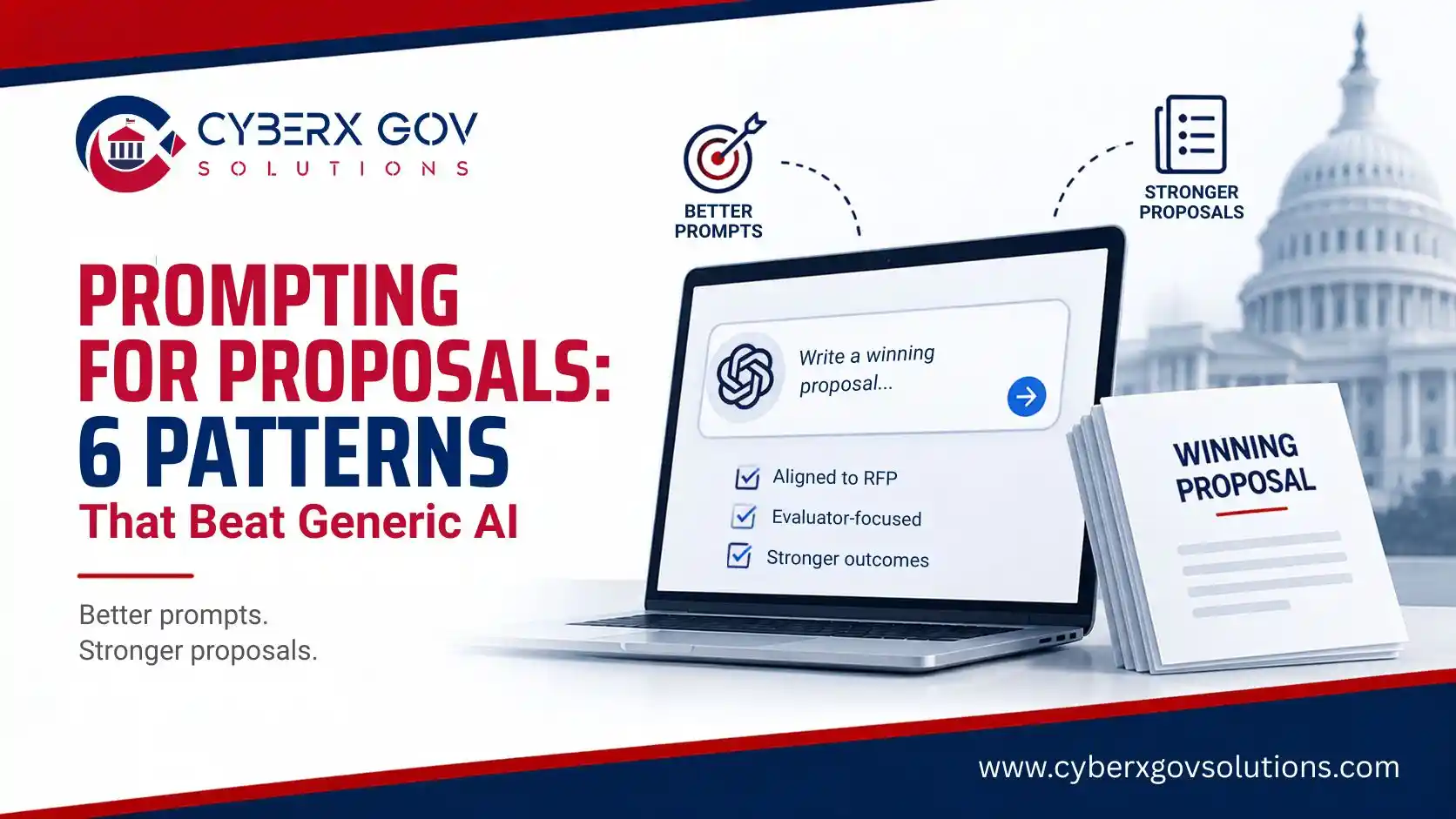
Walk into any proposal shop today, and you will see the same scene. A writer inputs the RFP into a chatbot, types write a response to this,’ and receives three paragraphs of confident, polished, but often forgettable text. This highlights how generic prompts lead to repetitive, uninspired proposals, making it clear why differentiation matters.
That is the trap. Generic prompts produce generic proposals, and generic proposals do not win. Evaluators score against specific criteria, so boilerplate lands in the middle at best. Recognizing this can motivate proposal teams to adopt better prompting strategies for more competitive results.
Here is the encouraging part: better output does not take a secret prompt or a pricey tool. It takes a few repeatable patterns. This guide breaks down six prompting patterns for proposals that proposal writers and business development teams can reuse on any solicitation. Each one comes with a weak version and a stronger version, so the difference is easy to see, helping you feel more confident in your approach.
Key Takeaways
- Patterns beat prompt lists. A reusable structure works on every RFP; a one-off prompt works once.
- Anchor the AI in your material. Feeding it the real solicitation and your past performance cuts both boilerplate and fabrication.
- Make the AI think like an evaluator, not a copywriter, so the output aims at what gets scored.
- Verification is a pattern, too. Have the AI surface its own unsupported claims before a human evaluator does. This focus on accuracy helps proposal teams feel responsible for integrity and reduces the risk of errors that could harm their chances.
- Never paste sensitive or controlled data into an unauthorized tool.
Why Generic AI Prompts Lose Proposals
A federal proposal is a scored competition. Evaluators read your response against the criteria in Section M of the solicitation and hand out ratings. Nothing else decides the award.
Generic AI output flunks that test on two counts. First, it does not aim at the evaluation criteria, so it reads as broad capability talk rather than a scored answer. Industry analysts have pointed out that undifferentiated, AI-generated boilerplate reads the same as the competition and earns no scoring edge.
Second, AI makes things up. It can produce confident text carrying fabricated past performance numbers, invented metrics, or regulatory citations that do not exist. Inside a proposal, an unverified claim can turn into a binding commitment or an integrity problem. Speed without control is a liability.
The six patterns below solve both.
The 6 Prompting for Proposals Patterns
Each pattern is a reusable structure. Drop in your solicitation details, and it carries to the next bid.
1. The Evaluator Role Pattern
Tell the AI who to be before you tell it what to do. Assigning a role pulls the output toward the standard you actually care about.
Rather than “write a technical approach for this requirement,” hand the model the evaluator’s seat.
Pattern: ‘You are a government source selection evaluator scoring proposals against these Section M criteria: [paste criteria]. Draft a technical approach for [requirement] that would earn the highest rating. After the draft, list what an evaluator would still mark as a weakness.’
This role assignment guides the AI to produce targeted, score-focused content, demonstrating how role prompts shape effective proposals.
Now the output stops being a description and becomes an argument aimed at a score. The self-critique at the end gives you a ready-made list of improvements.
2. The Grounding Pattern
An AI with no source material invents. An AI handed your material works from facts.
Before requesting a draft, paste the real inputs: the exact RFP language, Section L instructions, your win themes, and past performance. Then tell the model to use only what you provided. This grounding step significantly reduces hallucinations, ensuring the AI’s output remains factual and aligned with your proposal materials.
Pattern: “Using only the information below, draft [section]. Do not invent facts, numbers, or references. If something is missing, mark it [NEEDS INPUT] rather than guessing. Sources: [RFP text, win themes, past performance].”
This one move cuts down on hallucinations and kills boilerplate at the same time, because the model now writes from your solicitation rather than its imagination.
3. The Compliance Extraction Pattern
Building a compliance matrix by hand is slow and easy to botch. AI is genuinely strong at this task, and it is one of the safer ways to use it, since you verify every line against the source anyway.
Pattern: “Extract every requirement from the Section L and Section M text below. Return a table with columns: requirement ID, exact ‘shall’ statement, section reference, and proposal volume where it will be answered. Do not paraphrase the requirement text.”
Analysts report that this kind of extraction can shrink matrix-building from days to under an hour. Treat the output as a first pass and check each row, but the head start is real.
Expert tip: Ask for the exact requirement wording, not a summary. A paraphrased matrix hides the very details an evaluator checks against.
4. The Win-Theme Injection Pattern
Generic drafts list capabilities. Winning drafts prove discriminators. The dividing line is whether your win themes actually land in the words.
Hand the model your themes and make it weave them in, with proof.
Pattern: “Rewrite the section below so each paragraph advances one of these win themes: [list]. For every claim, add a specific proof point from the past performance provided. Remove any sentence that states a capability without evidence.”
What comes back reads like your firm, not a template, and it gives evaluators a reason to score you above the field.
5. The “Sound Like Us” Pattern
AI defaults to a flat, corporate voice that vanishes into the pile. A couple of examples fix that fast. The technique is called few-shot prompting, which means showing the model samples of what good looks like before asking for more.
Pattern: “Here are two excerpts from proposals we have won: [paste]. Match this voice, structure, and level of specificity. Now draft [section] in the same style.”
You are teaching the model your standard in a single step. The output lands closer to submission-ready and stands apart from competitors leaning on out-of-the-box phrasing.
6. The Red-Team Verify Pattern
The last pattern turns the AI loose on your own draft. Before a human reviewer or a government evaluator finds the holes, make the model find them.
Pattern: “Review the draft below as a skeptical Red Team reviewer. Flag every claim that lacks a cited proof point, every requirement from the compliance matrix that is not clearly answered, and any statement that sounds fabricated. Return findings as a numbered list, most serious first.”
This surfaces weak claims and possible hallucinations while you still have time to fix them. It pairs naturally with a real color team review, where independent people score the proposal the way the government will.
The One Rule That Outranks All Six
Every pattern here assumes a human stays in charge. AI drafts. People decide, verify, and sign.
Two guardrails are not up for debate:
- Verify every fact. Check AI-generated past performance, numbers, and citations against approved sources before anything lands in the proposal. A confident sentence is not a true one.
- Protect controlled data. Never paste Controlled Unclassified Information (CUI) or other sensitive material into a tool that is not authorized for it. For federal work, that means confirming alignment with standards like NIST SP 800-171 and CMMC before you upload anything sensitive.
Get those two wrong, and no prompt pattern will rescue the bid.
Quick Reference: Which Pattern, When
| Pattern | Use It When | What It Beats |
| Evaluator Role | Drafting any scored section | Vague, capability-talk prose |
| Grounding | Before any first draft | Hallucination and boilerplate |
| Compliance Extraction | Kicking off a new RFP | Slow, manual matrix building |
| Win-Theme Injection | Turning a draft competitive | Generic, evidence-free claims |
| Sound Like Us | Matching your winning voice | Flat, template-sounding text |
| Red-Team Verify | Before every review gate | Weak claims caught too late |
How CyberX Gov Solutions Can Help
Prompts speed up the writing. Winning still takes people who understand federal source selection, and that is where a specialist partner earns its place.
CyberX Gov Solutions provides federal proposal development support that turns AI-assisted drafts into compliant, competitive submissions. Our team owns the work AI cannot: win theme strategy, compliance matrix development, past performance, and the reviews that lift your score. We treat every claim as something that has to be verified, because in federal work, it does.
For teams still building their pursuit process, our Get Fed Ready™ program helps put the readiness and proposal planning in place that make any tool, AI included, actually pay off.
Conclusion
AI is part of proposal work now, and that is fine. The problem was never the technology. It was the lazy prompt that treated a scored federal proposal like a blog post.
Prompting for proposals well comes down to a handful of habits: put the AI in the evaluator’s seat, anchor it in your real material, make your win themes earn their place, match your winning voice, and let the model Red-Team its own draft before a human does. Layer human verification over all of it, and you get speed without the risk.
Master these six patterns and your team will stop sounding like everyone else who pasted the same prompt. You start sounding like the bidder who understood the evaluation.
Want expert eyes on your next federal proposal?
CyberX Gov Solutions helps BD teams pair AI-assisted drafting with the win strategy, compliance, and review discipline that actually score.
Schedule a free consultation at cyberxgovsolutions.com/schedule-a-meeting and put a proven proposal team behind your prompts.
Frequently Asked Questions
What does “prompting for proposals” mean?
Prompting for proposals is the practice of writing structured instructions that guide an AI model to produce useful proposal content. Strong prompts anchor the model in the solicitation, assign it a role, and demand evidence, so the output aims at the evaluation criteria instead of generic capability language.
Can AI write a federal proposal on its own?
No. AI can draft sections, extract requirements, and speed up early writing, but it also invents facts with confidence. Because proposal claims can become contractual commitments, every statement needs human verification against an approved source. AI assists the writing; accountable people finalize and certify it.
What is the best AI prompt for a proposal?
There is no single best prompt, which is exactly why patterns matter more than one-off prompts. The most reliable approach anchors the model in your real RFP text and past performance, assigns it an evaluator role, and asks it to flag unsupported claims. Those habits carry over to any solicitation.
How do I stop AI from writing generic proposal boilerplate?
Feed the model your specific material and win themes, and require a proof point for every claim. Generic output usually means the AI had nothing concrete to work from. Once you anchor it in the solicitation and your past performance, the writing turns specific and competitive.
Is it safe to use ChatGPT or other AI tools for government proposals?
Only with the right tool and the right discipline. Never paste Controlled Unclassified Information or other sensitive data into a tool that is not authorized for it. For federal work, confirm the platform aligns with standards such as NIST SP 800-171 and CMMC before uploading anything sensitive.
Which proposal tasks are safest to use AI for?
Extraction and structuring are the safest, since you verify them anyway. Building a compliance matrix, outlining a response, and drafting a first pass are good fits. Strategy, win themes, pricing, and final compliance checks should stay with experienced people.
How much time can AI actually save on a proposal?
Reported gains vary, and the honest answer is that it depends on the task. Requirement extraction and first drafts see the biggest speed-ups. The smart move is to pour that saved time back into more review cycles, not fewer, so quality climbs along with speed.
Do I still need a proposal team if I use AI well?
Yes. AI is a drafting aid, not a strategist. Win theme development, evaluator alignment, compliance judgment, and past performance verification all take human expertise. The strongest teams use AI to move faster on the mechanical work so their experts spend more time on what actually wins.