
Plenty of losing proposals are fully compliant. They hit every requirement, landed on time, and still scored somewhere in the middle. The writing was rarely the issue. The real issue was that nobody graded the draft like a government evaluator until the government evaluator did, and by then, the score was locked.
Closing that gap is the entire job of color team reviews. A color team review is a scheduled checkpoint where independent reviewers grade your proposal against the solicitation, flag the weak spots, and give you time to repair them. Run them well, and your win rate goes up. Run them as a formality, and you learn nothing you did not already assume.
This guide walks through what each review does, when to hold it, how to grade it so the findings carry weight, and how a small shop can get the same payoff without standing up seven separate panels.
Key Takeaways
- A color team review is a scoring rehearsal, not a copy edit. The aim is to predict your evaluation score early enough to raise it.
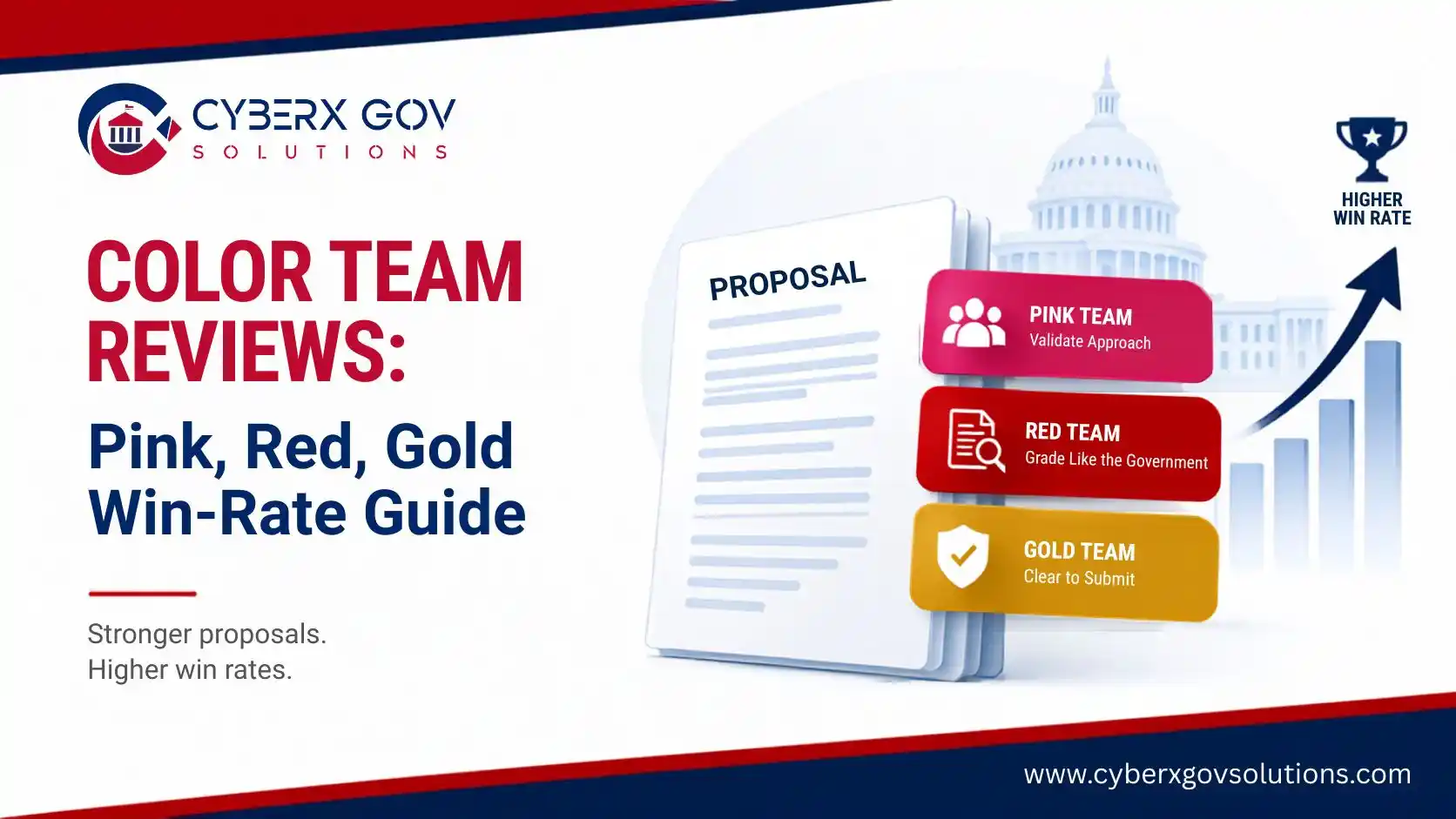
- Pink, Red, and Gold do the heavy lifting. Pink pressure-tests the approach, Red grades it like the government, Gold clears it to go out the door.
- Independence is the whole point. When your writers grade their own pages, the review only echoes back what they already think.
- Contracts are won in the findings, not the meeting. A tight process for turning findings into fixes is where the win rate is actually made or lost.
- Small teams can trim the model by combining early reviews while keeping the Red Team independent.
What Are Color Team Reviews?
Color team reviews are staged quality gates in the federal proposal process, each labeled by a color, where reviewers measure a draft against the solicitation and grade its odds of winning. Every color marks a different point of maturity and asks a different question, running from early strategy all the way to final submission.
The framework, originating from the Shipley proposal methodology, has become a standard across government contracting, helping teams adapt their review process effectively.
| Review | Stage | The Question It Answers |
| Blue Team | Before writing | Are our capture strategy and outline solid? |
| Black Hat | Capture phase | How are competitors likely to bid against us? |
| Pink Team | Early-to-mid draft | Is the approach compliant and on strategy? |
| Red Team | Near-final draft | Would the government grade this a winner? |
| Green Team | Alongside Red | Is our pricing realistic and competitive? |
| Gold Team | Final draft | Are we cleared to submit? |
| White Team | Pre or post-submission | Is production clean, and what did we learn? |
For win rate, the three that matter most are Pink, Red, and Gold. That is where this guide spends its time.
Why Color Team Reviews Decide Your Win Rate
Here is the link most articles gloss over. A federal award is a graded contest. Evaluators read your proposal against the criteria in Section M of the solicitation and hand out ratings. Being good is not enough. You win by outscoring the field.
Color team reviews work because they run that grading twice. Your own reviewers do it first, while you can still change the answer. The government does it second, when you no longer can. Every weakness your Red Team catches is a point you keep instead of handing it to a real evaluator.
The reviews lift your score in three concrete ways:
- They expose weaknesses early, when the fix costs an afternoon rather than the whole bid.
- They pull the content toward Section M, so your best material sits exactly where the evaluator is told to look.
- They break the author’s blind spot. Writers see what they intended to say. New reviewers see what is actually on the page.
Skip the reviews, or botch them, and none of that happens. The draft ships reflect what the team hoped it said.
The Pink Team Review: Your First Honest Look
A Pink Team review assesses an early-to-mid draft to ensure the proposal aligns with the win strategy, maintains compliance, and avoids costly detours before too much work is done.
Pink is about direction, not polish. Reviewers are not there to chase typos. They are there to settle one thing: is this the right approach, laid out the right way, and pointed at the right themes?
What the Pink Team Reviews
- Does the draft answer every requirement in Section L and track the compliance matrix?
- Is the technical approach sound and explained clearly?
- Do the win themes appear where they should, or are they lost in the body copy?
- Are the graphics and section concepts roughed in, even if unfinished?
Expert tip: Grade a Pink draft on substance, not surface. Bulleted sections and rough graphics are fine at this stage. Reviewers who fixate on typos now will miss the strategic problems that actually sink the award later.
The exit criteria stay simple. Walk out of the Pink review with a clear list of approach and compliance gaps, plus a plan to close them before the draft matures.
The Red Team Review: Score It Like the Government Will
A Red Team review mimics the government’s evaluation. Independent reviewers who had no hand in writing the proposal grade a near-final draft against Section M and predict how a source selection board would rate it.
This is the most crucial review you will run; if only one can be shielded from cuts, prioritize the Red Team to protect your proposal’s competitiveness.
The Red Team lives or dies on independence. Reviewers have to be people who did not write the proposal. The logic is plain: if your writers are your Red Team, the review confirms what the team already believes. Outside eyes catch the distance between what the draft says and what an evaluator will actually reward.
What the Red Team Scores
Red reviewers grade from a sheet that mirrors the solicitation’s evaluation factors and subfactors. They read the way an evaluator reads, then rate each section and log specific, usable findings. A finding earns its keep when it names the problem and points to the fix. “Weak past performance” helps no one. “Add a quantified past performance example under Factor 2 that shows on-time delivery” gives the writer somewhere to go.
The draft should be well along before Red, with real content in every section and graphics near final. Nobody can grade a half-written draft, and a Red Team with nothing to score burns your best reviewers for nothing.
The Gold Team Review: The Final Gate
A Gold Team review is the last check before submission. Senior approvers confirm the Red Team findings were closed, pricing lines up with the technical approach, and the proposal is compliant and ready to send.
Gold verifies. It does not revise. By now, the strategy is settled, and the fixes are in. Reopening the strategy at the Gold review is a red flag that an earlier review fell short.
Keep the Gold Team on a checklist: every requirement covered, format compliant, all Red findings closed, pricing consistent, signatures in place, acronyms defined, and no stray placeholder text. It usually runs inside the final 48 to 72 hours before the deadline.
When to Schedule Each Review
Competing blogs throw out very different draft percentages for each review, anywhere from 20% to 70% for Pink and 80% to 95% for Red. That spread creates more confusion than clarity.
The straight answer: the percentage matters far less than the state of the draft. Hold each review until the draft is mature enough to answer that review’s core question and early enough to act on what comes back.
| Review | Target Readiness | Practical Timing |
| Pink Team | Approach and outline visible, real content in most sections |
Once the draft can show direction, not sooner |
| Red Team | Well, along with graphics, are near final |
With enough runway to fix what surfaces |
| Gold Team | Final findings closed | 2–3 days before submission |
Expert tip: Plan backward from the due date. Set aside time after the Red Team for the recovery work its findings always create. A Red review with no room left to fix anything is just theater.
The most common scheduling mistake is holding a review too late to use it. Findings you cannot act on are a post-mortem written before the funeral.
How to Score a Review So the Findings Matter
Loose feedback breeds loose fixes. To keep grading consistent, borrow the government’s own vocabulary.
Color Team Review Rating Terms
Federal evaluators work from defined terms, and the current Federal Acquisition Regulation (FAR 15.001, effective March 13, 2026) spells them out:
- Deficiency: “a material failure of a proposal to meet a Government requirement or a combination of significant weaknesses … that increases the risk of unsuccessful contract performance to an unacceptable level.”
- Significant weakness: “a flaw that appreciably increases the risk of unsuccessful contract performance.”
- Weakness: “a flaw in the proposal that increases the risk of unsuccessful contract performance.”
Ask your reviewers to tag every finding with one of these labels, plus strength for content that beats a requirement and earns credit. That accomplishes two things. It sorts the findings by severity, so the team tackles deficiencies before nitpicks. And it teaches reviewers to think like the board that will actually grade the bid.
Insist on specifics. Every finding should name the section, state the problem in evaluator terms, and suggest a direction for the fix.
From Findings to Fixes: The Step Most Teams Get Wrong
A review that generates findings and no fixes changes nothing. This is where win rate quietly slips away, and where most guides stop writing.
Handle adjudication as its own process:
- Gather every finding in one place with an owner, a severity label, and a status. A shared tracker beats comments scattered across drafts.
- Adjudicate each finding. Accept it, reject it with a reason, or fold it into another. Not every reviewer’s opinion is correct, but everyone gets a ruling.
- Assign the fix to a named person with a deadline that fits the schedule.
- Verify that the fix actually closed the gap, rather than just confirming someone edited the section.
- Confirm all deficiencies and significant weaknesses are resolved before the draft moves to the next color.
Common Mistakes That Quietly Kill Your Win Rate
Even seasoned teams give away points to the same handful of errors:
- Reviewers who wrote the proposal. A Red Team made of authors is not a review. It is a mirror.
- No review criteria. Without Section M in front of them, reviewers default to personal taste, and personal taste does not grade the bid.
- Reviewers showing up cold. Send the compliance matrix, evaluation criteria, and win themes ahead of time, not at the top of the meeting.
- Reviews booked too late. Findings you cannot act on go to waste.
- Findings that never turn into fixes. The costliest mistake on this list.
- Blurring the roles. Pink reviewers rewriting prose, or Gold reviewers reopening strategy, breaks the sequence each review depends on.
Right-Sizing Color Team Reviews for a Small Team
Seven color teams assume a large shop with bodies to spare. Most small businesses and first-time bidders do not have that luxury. You do not need every color to capture the benefit.
A lean model that still works:
- Combine Blue and Pink into a single early session that checks strategy and the first real draft together.
- Never combine the Red Team. Guard its independence even if that means borrowing one outside reviewer, a teaming partner, or a trusted colleague who stayed clear of the writing.
- Roll Green into Red so pricing gets a look at the same time, if a standalone pricing review is out of reach.
- Keep Gold as a quick final gate, even when that is one senior person with a checklist.
For a small team, the rule is not “hold fewer reviews.” It is “hold the ones that move the score, and never trade away independence to save a day.”
Your Color Team Review Checklist
Run through this before every review:
☐ Reviewers got the compliance matrix, Section M criteria, and win themes in advance
☐ Red Team reviewers did not write the proposal
☐ The draft is mature enough to answer this review’s core question
☐ There is runway after the review to act on the findings
☐ Findings are labeled by severity using FAR-based terms
☐ Every finding has an owner, a ruling, and a deadline
☐ All deficiencies and significant weaknesses are closed before the next stage
How CyberX Gov Solutions Can Help
A strong color team review process needs independent reviewers who understand how the government grades. For a small or growing contractor, that expertise is not always sitting down the hall.
CyberX Gov Solutions builds proposal reviews and quality checks into its federal proposal development support. That covers compliance matrix development, win theme strategy, and an independent read of your draft against the solicitation- the kind of outside perspective a Red Team requires and an author cannot supply.
For companies still getting established in the federal market, the Get Fed Ready™ program helps put the bid readiness and proposal planning in place that make color team reviews worthwhile to begin with. The target never changes: a proposal that grades like a winner before the government ever opens it.
Conclusion
Color team reviews are not a box you tick on the way to submission. They are your one shot to grade the proposal the way the government will, while you can still change the answer. Pink confirms the approach. Red predicts the score. Gold clears the door.
Winning teams are not the ones that hold the most reviews. They are the ones who run honest reviews with outside eyes, then put in the unglamorous work of turning every finding into a fix. That discipline is what separates a compliant proposal from a winning one, and it is the surest way to raise a federal win rate.
Run your color team reviews to find the truth early, not to feel good late.
Ready to put an independent, government-minded read behind your next bid?
CyberX Gov Solutions helps small and growing federal contractors sharpen their proposals through expert proposal development and independent color team reviews.
Schedule a free consultation at cyberxgovsolutions.com/schedule-a-meeting and give your proposal a winning read before the evaluator gets to it.
Frequently Asked Questions
What is the difference between a Pink Team and a Red Team review?
A Pink Team review checks an early-to-mid draft to confirm the approach is compliant and on strategy. A Red Team review grades a near-final draft the way a government evaluator would, using independent reviewers. Pink asks whether you are on the right track. Red asks whether you would win.
Who should be on a Red Team review?
Independent reviewers who did not write the proposal. The best Red Team members understand federal evaluation, can read against Section M criteria, and will deliver honest findings. Many teams bring in outside experts, teaming partners, or colleagues from another pursuit to keep the perspective genuinely fresh.
When should you schedule a Red Team review?
Schedule the Red Team once the draft is well along with near-final graphics, and early enough to fix what it finds. Counting backward from the deadline, leave real runway for recovery afterward. A Red Team with no time to act on its findings delivers little value.
How many color team reviews does a proposal need?
It depends on the bid’s size and risk. Large pursuits may run Blue, Black Hat, Pink, Red, Green, and Gold. A small business can often win with a merged early review, an independent Red Team, and a short Gold gate. Above all, protect the Red Team’s independence.
Do color team reviews really improve the federal win rate?
Yes, when they are run with discipline. Color team reviews raise the win rate by catching weaknesses early, aligning content to the evaluation criteria, and forcing fixes before submission. The gain comes from acting on the findings, not from holding the meeting. Reviews that produce no fixes do not move the score.
What is a Gold Team review?
A Gold Team review is the final check before submission. Senior approvers confirm the Red Team findings were closed, pricing matches the technical approach, and the proposal is compliant and ready to send. It is a verification gate, not a place to revise strategy or rewrite content.
Can a small business run color team reviews without a big team?
Yes. A small business can merge the early Blue and Pink reviews, roll pricing into the Red review, and keep a short Gold gate. The one rule that cannot bend is Red Team independence. Borrow an outside reviewer rather than letting authors grade their own proposal.
What does a reviewer look for during a color team review?
Reviewers check compliance with the solicitation, alignment with the evaluation criteria in Section M, clarity of the technical approach, presence of win themes, and overall competitiveness. In a Red Team review, they also assign ratings and write specific findings that name the problem and point toward a fix.