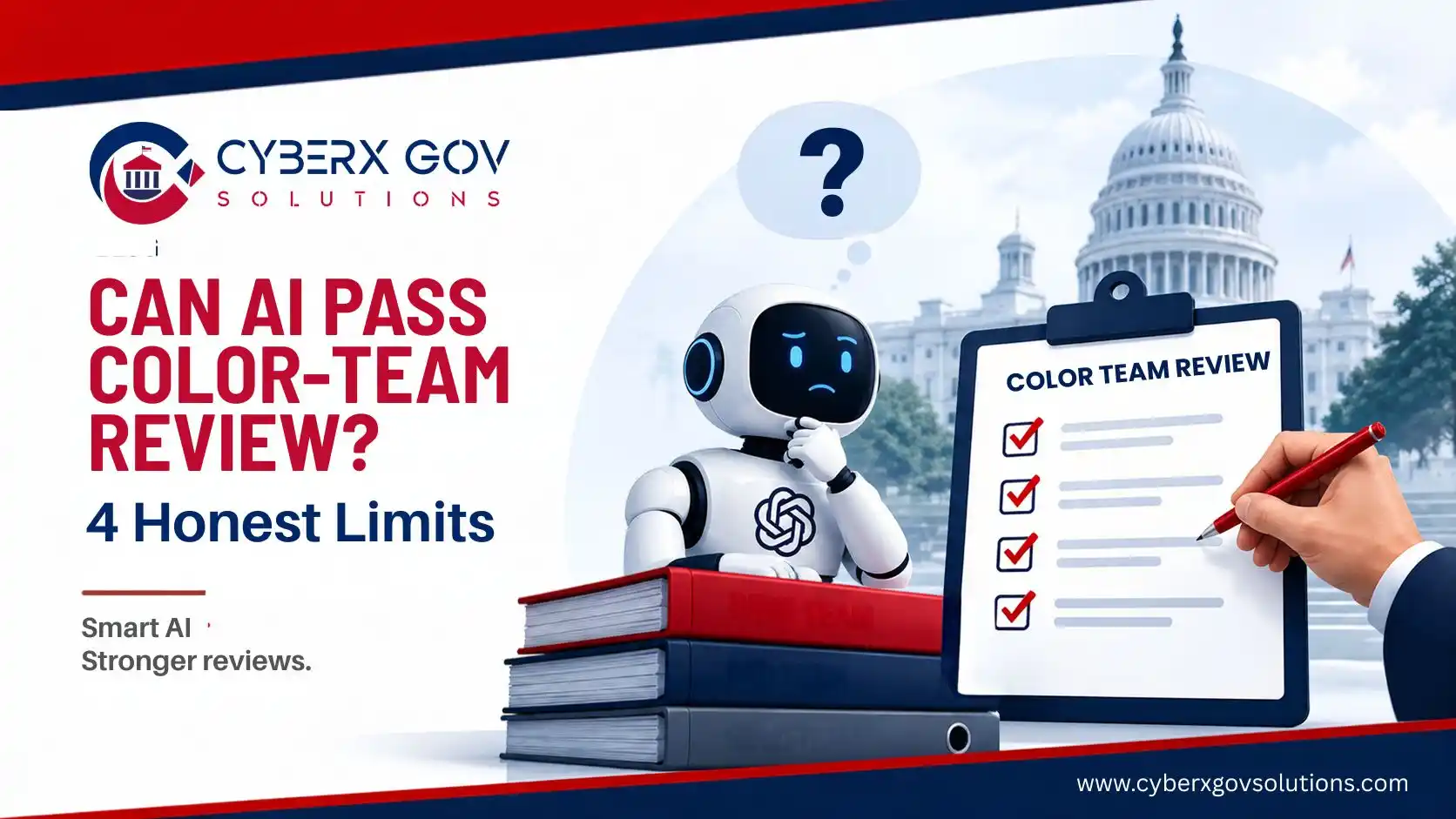
Ask a chatbot to grade your proposal, and it will cheerfully hand you a rating, a list of strengths, and a confident thumbs-up. It will look like a review. The real question is whether it would survive the review that decides the award, the one government evaluators run against Section M.
The honest answer: AI cannot pass a color team review on its own, and it cannot replace one either. That is not a shot at the technology. It is a description of what a color team review actually tests and where today’s AI runs out of road.
This piece is written for proposal managers and reviewers who want the real picture, not the sales pitch. Below are four honest limits, each tied to what a reviewer truly does, followed by where AI genuinely earns its place.
Key Takeaways
- AI cannot pass a color team review alone. It grades text, not competitiveness.
- It hallucinates. AI can invent facts and then vouch for them, which is the opposite of a Red Team’s job.
- It misses rigid compliance nuance, and those gaps surface late when they cost the most.
- It cannot judge win themes. Deciding whether a discriminator beats the competition is human work.
- The winning model is human plus AI, with AI as a fast first pass and people making the calls.
What a Color Team Review Actually Tests
A color team review is a staged quality gate where independent reviewers score a proposal against the solicitation and predict how a government source selection board would rate it. Pink checks the approach, Red simulates the evaluation, and Gold clears the proposal for submission.
The goal is not to polish prose. It is to answer one question: would this win? That takes strategic judgment, which proposal managers and reviewers bring, because AI cannot replace human insight in assessing strategy, competition, and agency reading.
The 4 Honest Limits of AI in a Color Team Review
1. AI Cannot Score Like a Government Evaluator
A real evaluator reads under time pressure, against Section M, with a mission in mind. They reward specificity, punish vagueness, and notice whether you ghosted the competition. That is strategic judgment, not text analysis.
AI grades what sits on the page. It cannot weigh whether your approach truly beats the other bidders or whether it aligns with the agency’s real priorities. Industry analysis is blunt on the point: human review focused on specificity, ghosting the competition, and mission alignment is still where proposals are won or lost.
What this means for reviewers: use AI to check coverage, not to predict your score. The score lives in the judgment AI does not have.
2. AI Hallucinates, So It Cannot Verify Its Own Work
A Red Team’s core job is to catch claims that are not true or not supported. AI cuts against that job in a specific way: it can produce confident, well-formatted text that is factually wrong, including invented past performance numbers, fabricated metrics, or regulatory citations that do not exist.
Worse, it will defend those inventions with the same confidence it uses for facts. An AI reviewer checking AI-written text can wave a fabricated claim straight through. In a federal proposal, an unverified statement can become a binding commitment or an integrity problem.
Expert tip: Treat AI as a claim generator that always needs a human fact-check, never as the final verifier. If a person cannot trace a number to an approved source, it does not ship, reinforcing the importance of human oversight for proposal integrity.
What this means for reviewers: verification stays human. AI can flag where a claim lacks a citation, but it cannot confirm the claim is true.
3. AI Misses Rigid Compliance and Format Nuance
Compliance is unforgiving. Page counts, fonts, margins, section ordering, and mandatory response structures are pass-or-fail, and Section L spells them out in ways that reward careful human reading.
General-purpose AI is inconsistent here. It can miss a formatting constraint or a buried instruction, and those gaps often surface at Red Team, when little time remains to restructure. A missed page limit found two days before submission is an expensive discovery.
What this means for reviewers: keep a human compliance check against the actual solicitation. AI can build the first draft of a compliance matrix, but a person confirms every line.
4. AI Cannot Judge Whether a Win Theme Actually Wins
This is the deepest limit. A win theme is only valuable if it truly differentiates your proposal in a way the competition cannot match and the customer values. Judging that requires experience with the pursuit, competitors, and customer, which AI cannot replicate.
AI knows none of those things, and it defaults to generic phrasing. Analysts note that AI-generated content leaning on generic language reads as undifferentiated from the competition, which is exactly what loses a scored bid. AI can restate your themes. It cannot tell you whether they are strong enough to win.
What this means for reviewers: win strategy and discriminator judgment stay with experienced people. AI helps you express a theme, not decide if it beats the field.
Where AI Genuinely Earns Its Place
Honesty cuts both ways. AI is not a reviewer, but it is a powerful pre-review tool that enhances the human review process. When used properly, it handles mechanical tasks so your experts can focus on strategic judgment.
- First-pass compliance extraction. AI can quickly generate a draft requirements matrix from Sections L and M, giving proposal teams a head start. A human verifies it, ensuring reviewers feel in control and confident in the process.
- Consistency and gap flags. AI can spot a requirement with no clear answer, an acronym used before it is defined, or a section that drifts off the outline.
- A self-critique dry run. Before the human Red Team meets, AI can flag claims that lack proof and questions an evaluator might ask, so reviewers walk in with a head start.
- Draft acceleration. AI speeds early drafting, which frees time for more review cycles, not fewer.
The rule is simple. AI prepares the work. People judge it.
Human vs AI in the Review Room
| Review Task | Best Owner | Why |
| Extracting requirements into a matrix | AI first, human verifies | Fast, mechanical, must be checked |
| Flagging unanswered requirements | AI first, human confirms | AI catches gaps; people judge severity |
| Verifying past performance and facts | Human | Fabrication risk is real and costly |
| Scoring against Section M | Human | Requires evaluator judgment |
| Judging win-theme strength | Human | Depends on the competitor and customer knowledge |
| Final compliance and format check | Human | Pass-or-fail details demand careful reading |
Why the Honest Answer Builds Better Proposals
Teams that expect AI to pass a color team review get burned at the worst time, right before submission, when a fabricated claim or a missed page limit shows up. Teams that treat AI as a first pass and keep humans on judgment move faster and submit stronger.
The credibility of your proposal rests on claims you can stand behind and a strategy that actually beats the field. AI cannot own either. It can help you get there sooner, with more time left for the human review that decides the outcome.
How CyberX Gov Solutions Can Help
At CyberX Gov Solutions, we use AI where it earns its place and keep people where they matter. Our federal proposal development support pairs AI-assisted drafting and extraction with expert human review, so the mechanical work moves fast, and the judgment stays sound.
That means win-theme strategy, compliance verification, past performance, and independent review led by people who know how the government scores. Every claim gets checked against an approved source because in federal work, it has to be. The result is a proposal that holds up under the review that counts, not one that only looks finished.
Conclusion
Can AI pass a color team review? No, and that is the honest, useful answer. AI cannot score like an evaluator, verify its own facts, catch every compliance rule, or judge whether a win theme actually wins. Those are the exact things a color team review exists to test.
The teams that win in 2026 are not the ones chasing an AI that reviews itself. They are the ones using AI to prepare the work and trusting experienced people to make the calls. Human plus AI, in that order, is how a proposal earns a passing review and a winning score.
Want a proposal that stands up to the review that counts?
CyberX Gov Solutions blends AI-assisted speed with expert human review to build compliant, competitive federal proposals. Schedule a free consultation at cyberxgovsolutions.com/schedule-a-meeting and put a proven method behind your next bid.
Frequently Asked Questions
Can AI pass a color team review on its own?
No. AI can produce content that looks review-ready, but it cannot score against Section M like a government evaluator, verify its own facts, or judge whether a win theme beats the competition. A color team review tests exactly those human judgments, so AI output still needs a full human review to hold up.
Can AI replace a proposal reviewer?
No. AI works well as a first pass for extraction, consistency checks, and flagging gaps, but it cannot own the judgment a reviewer applies to strategy, compliance, and competitiveness. The strongest teams use AI to prepare the review and keep experienced people making the decisions.
Why can’t AI verify facts in a proposal?
AI can generate confident text that is factually wrong, including invented past performance numbers and citations, and it will defend those inventions. Because proposal claims can become binding, every fact needs a human check against an approved source. AI can flag a missing citation, but it cannot confirm a claim is true.
What can AI actually do well in a proposal review?
AI is strong at mechanical, checkable tasks: drafting a compliance matrix from Sections L and M, flagging unanswered requirements or undefined acronyms, and running a self-critique before the human Red Team meets. Each output still needs verification, but it gives reviewers a faster, sharper starting point.
Does AI-written content hurt your evaluation score?
It can, when it is generic. Evaluators reward specificity, quantified experience, and clear discriminators. AI that leans on generic phrasing reads as undifferentiated from the competition and tends to score in the middle. Human refinement that adds proof and agency-specific context is what lifts the score.
Is it safe to use AI in the color team review process?
Yes, with discipline. Use AI for extraction and first-pass flags, verify every fact against approved sources, and never paste sensitive or controlled data into an unauthorized tool. Keep human reviewers in charge of scoring, compliance judgment, and win strategy, and AI becomes a safe accelerator rather than a risk.
What is a human-plus-AI proposal review method?
It is a workflow where AI handles the fast, mechanical preparation and people own the judgment. AI extracts requirements and flags gaps; humans verify facts, score against Section M, judge win themes, and confirm compliance. The approach saves time on the routine work and protects the decisions that determine whether a proposal wins.
Will using AI get a proposal flagged or penalized?
Using AI is not the problem; submitting unverified, generic content is. Evaluators focus on specificity, accuracy, and compliance, not on how a draft started. Keep documented human review, quantified proof, and tailored win themes, and an AI-assisted proposal reads as a strong, human-owned submission.