
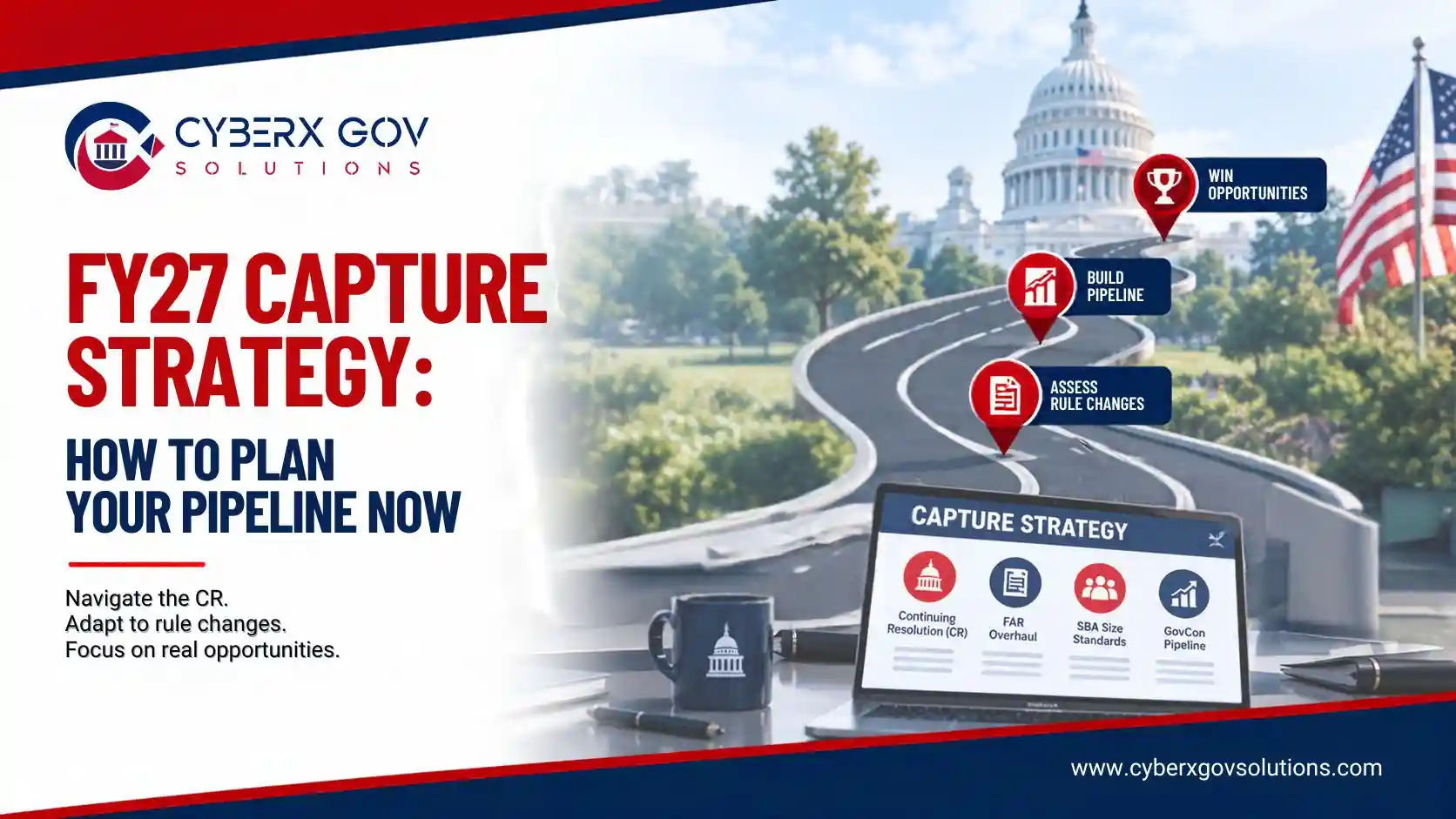
Fiscal year 2027 began on October 1 with no full-year budget in place. Rather than a complete appropriations package, Congress passed a stopgap, so agencies opened the year under a continuing resolution. That single detail shapes how dollars flow, which deals keep moving, and where your team should focus today.
A sound FY27 capture strategy is not a race to bid on every notice in SAM.gov. It comes down to spotting the signals early and lining up for the work that will truly get funded. And this year, three signals ring out together: a continuing resolution, the largest Federal Acquisition Regulation rewrite in a generation, and a proposed change to how the government even counts a business as small.
Below, you will see what each of these shifts does to your pipeline, plus a clear plan to act on them.
What a Continuing Resolution Means for Your FY27 Pipeline
A continuing resolution, or CR, is a temporary funding measure. It keeps federal operations running at roughly the previous year’s spending until lawmakers finish full appropriations.
For FY27, the CR became law as Public Law 119-103. It carries federal operations through December 11, 2026, at fiscal year 2026 levels. Both the Senate and the President signed off, so agencies dodged a lapse and opened the year on a stopgap.
Still, a CR does not put the whole market on hold. It reshuffles what advances and what sits.
During a CR, these items tend to stall:
- New-start programs that the prior year did not fund
- Big spending increases that hinge on the pending full-year bill
- Awards that lean on money an agency has not yet received
Meanwhile, this work generally stays in motion:
- Recompetes and follow-on contracts are already baked into the budget baseline
- Task orders placed under existing IDIQ and GWAC vehicles
- Option-year exercises on contracts you already hold
The takeaway for capture is clear. Aim your short-term effort at work that does not hinge on fresh money. During the CR window, the fundable action lives in recompetes, task orders, and option-year positioning. For a closer look at the funding mechanics, see our breakdown of the FY2027 continuing resolution’s impact on contractors.
Three Rule Changes Reshaping FY27 Capture
Funding tempo comes from the CR. Two separate rulemaking efforts are rewriting the rules beneath it, and both deserve a spot on your radar as you shape your FY27 capture strategy.
The Revolutionary FAR Overhaul
The FAR Council is rewriting the Federal Acquisition Regulation, the central rulebook for federal buying. In 2026, that effort entered formal rulemaking.
The first batch landed on June 23, 2026, with four proposed rules that touch 21 FAR parts. Public comments closed on July 23, 2026. More batches should follow through fiscal years 2026 and 2027.
One specific change in that first batch stands out. The dollar line for publicly announcing a contract award climbs from $4.5 million to $5.5 million, and announcing becomes optional instead of mandatory. Fewer large awards may surface in public announcements, so your market research will need to rely more on agency forecasts and direct relationships.
Two parts that everyone is watching did not make the first batch. Part 15, which covers contracting by negotiation, and Part 19, which governs small business programs, are held for a later round. Keep a close eye there, since edits to those parts hit proposal rules and set-aside strategy head-on.
SBA’s Proposed Size-Standard Overhaul
The Small Business Administration put forward a broad change to how it defines a small business. The agency published the proposed rule on August 20, 2026, and comments closed on September 21, 2026.
Under the proposal, today’s many standards would collapse into 338 size standards. The rule would also lean on employee counts, rather than annual revenue, in the industry groups where the SBA has room to decide.
The reach is wide. By the SBA’s own estimate, roughly 114,541 more firms would count as small under the new method. A far smaller group would drop out of small status.
For capture, that cuts both ways. Should the rule move forward, some firms that read as mid-sized today could requalify as small and reopen set-aside lanes. Others might age out of a category they count on. Before you commit to teaming roles for FY27, run your own size check against the proposed standards.
Build Your FY27 Capture Plan: A Step-by-Step Approach
A capture plan converts market signals into moves. Work through these steps to shape yours for a CR year.
- Step 1: Re-sort your pipeline around the CR. Mark which targets need new money and which are recompetes, task orders, or options. Promote the fundable ones.
- Step 2: Recheck your size status. Measure your receipts and headcount against the proposed SBA standards. Confirm which set-asides still fit you.
- Step 3: Track forecasts, not only postings. As the award-announcement threshold rises, draw your early signal from agency procurement forecasts and industry days.
- Step 4: Get on incumbents’ recompetes. Spot expiring contracts in your lane. Begin relationship and past-performance work well before the solicitation drops.
- Step 5: Sharpen proposal readiness. Refresh past performance records, capability statements, and compliance documents so you can move fast when a CR-funded recompete appears.
- Step 6: Settle teaming early. Pin down teaming partners and subcontractor roles while size status is still steady, so a rule change does not catch you mid-bid.
Common FY27 Capture Mistakes to Avoid
A handful of habits drain time and bids in a CR year.
One is holding out for the market to “get back to normal.” Right now, a CR year is the normal state, not a timeout. Teams that keep capturing through the stopgap pull ahead of teams that pause.
Another is hunting only for brand-new work. New starts are precisely the awards most likely to stall under a CR. Recompetes and task orders give you firmer footing.
A third is brushing past the size-standard proposal. A teaming call that fit last year may fall apart if your category, or your partner’s, moves.
A fourth is weak market intelligence. With fewer awards announced publicly, contractors who depend on public notices alone will see less. Agency forecasts and genuine relationships close that gap.
What to Keep Watching
A good FY27 capture strategy stays nimble because several of these pieces are still in motion.
The CR only funds the government through December 11, 2026. Lawmakers could pass full-year appropriations, stretch the stopgap, or rewrite the terms. Each path changes which programs get real dollars.
The FAR overhaul is landing in batches. The parts that weigh most heavily on proposals and small businesses, Parts 15 and 19, have not yet been published. And the SBA size-standard rule is still a proposal, not a final rule, so the figures could shift before it takes hold. Follow the Federal Register and agency forecasts, and revisit your plan every quarter.
How CyberX Gov Solutions Can Help
Converting these signals into wins takes consistent capture work and quick, compliant proposals. Focused support makes that easier.
CyberX Gov Solutions helps contractors get pipeline-ready through Get Fed Ready™, covering opportunity identification, fit analysis, and federal readiness planning. Once a CR-funded recompete lands, our proposal development team backs you on compliance mapping, win themes, and the full writing effort. And when a contract calls for cleared talent, our cleared recruitment team helps you staff quickly for pre-award and post-award needs.
The aim is straightforward: help you spend your FY27 energy on work that will actually fund, then answer it with a sharp, compliant proposal.
Conclusion
FY27 opened on a continuing resolution, and that fact alone changes how you plan. Dollars move at prior-year levels through December 11, 2026, so recompetes, task orders, and option years make the steadiest near-term targets.
At the same time, the FAR overhaul and the proposed SBA size standards are shifting the rules under your pipeline. Read those signals early, recheck your size status, and build your capture plan around the work that can fund now.
Capture runs all year, and the teams that start early tend to win more. If you want a hand shaping your FY27 pipeline or chasing a live opportunity, CyberX Gov Solutions can support you from readiness to submission.
Schedule a free consultation at cyberxgovsolutions.com/schedule-a-meeting/.
Frequently Asked Questions
What is capture planning in government contracting?
Capture planning is the work you do before a solicitation drops to research an opportunity and position yourself to win it. It spans customer relationships, competitor analysis, teaming, and win strategy. Solid capture work makes your eventual proposal quicker and more competitive.
When does the FY27 continuing resolution end?
The FY27 continuing resolution funds the government through December 11, 2026, under Public Law 119-103. After that date, Congress has to pass full-year appropriations or another funding measure to keep agencies open.
Can agencies still award contracts during a continuing resolution?
Yes. Agencies can still award recompetes, follow-on contracts, and task orders under existing vehicles because those usually sit in the prior-year budget baseline. New-start programs that were not funded before are the awards most likely to wait.
How do the proposed SBA size standards affect my business?
If the rule advances, it could change whether your firm counts as small in your industry. Some mid-sized firms may requalify as small, while others could lose small status. Check your size under the proposed standards before you commit to teaming roles.
What is the Revolutionary FAR Overhaul?
It is a major rewrite of the Federal Acquisition Regulation, the rulebook for federal buying. The FAR Council is releasing it in batches of proposed rules through fiscal years 2026 and 2027. The changes affect solicitation language, award announcements, and eventually proposal and small business rules.
Should small businesses wait until full appropriations pass to start capturing?
No. Waiting hands ground to competitors who keep working the pipeline. Point your capture effort at CR-funded recompetes and task orders now, and stay ready to respond when solicitations hit.