Congress just handed federal contractors a few more months of certainty and a few more months of uncertainty at the same time.
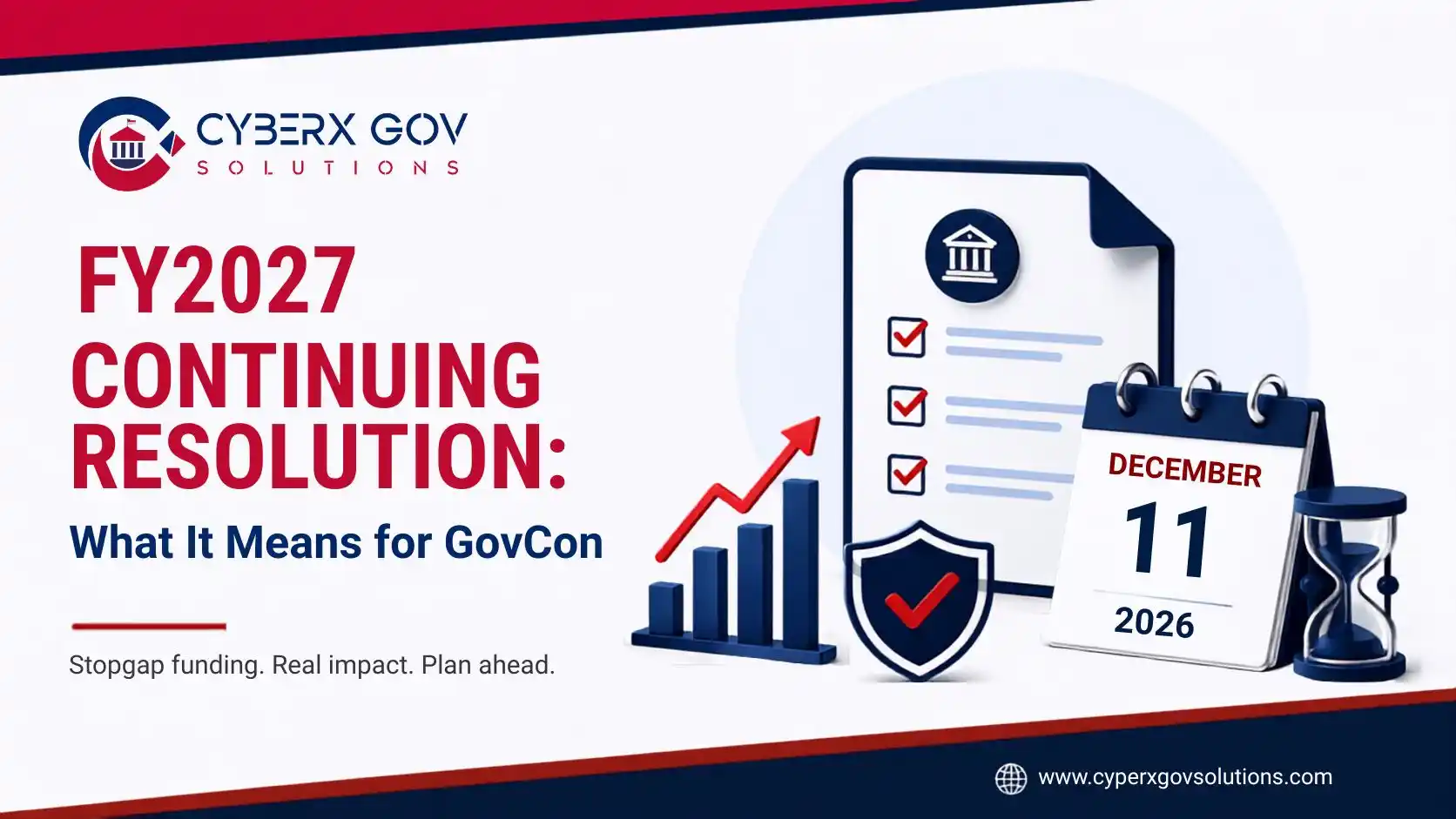
On September 1, 2026, the House passed a stopgap spending bill to keep the government open past the October 1 deadline. The Senate had already approved it, and the President signed it into law. A shutdown is off the table for now. But the deal only runs through December 11, 2026, and it keeps funding flat while full-year budget decisions stay on hold.
For small and mid-sized government contractors, understanding the FY2027 CR is crucial because it influences your pipeline and staffing strategies. While a shutdown is avoided, budget uncertainty persists, affecting how and when you can pursue new work. Here’s what the FY2027 CR actually does, how it impacts your pipeline, and what steps to take before the next deadline.
Key Takeaways
- The FY2027 continuing resolution (H.R. 6500) is now law and funds the government through December 11, 2026.
- The House passed it 370 to 48 on September 1, 2026, after the Senate cleared it 90 to 6.
- It extends current funding levels, so most new contracts stay on hold.
- The deal pushes the funding fight past the November 3 midterm elections.
- December 11 is the next critical date, so contractors should build a plan around a CR, not a normal budget, to stay prepared for potential funding changes.
What Is the FY2027 Continuing Resolution?
The FY2027 continuing resolution is a temporary funding law that keeps federal agencies open at existing spending levels until Congress passes full-year appropriations. Its formal name is the Continuing Appropriations and Extensions Act, 2027, or H.R. 6500.
It became law just before fiscal year 2027 began on October 1, 2026. Without it, most federal discretionary funding would have lapsed and triggered a shutdown. Instead, agencies keep operating through December 11, 2026.
Definition: A continuing resolution (CR) is a stopgap measure that funds the government at prior-year levels when full-year appropriations are not ready. It prevents a shutdown but limits new spending.
What the CR Actually Does
This stopgap is a roughly 10-week bridge, not a full budget. Here is what it includes.
- Keeps the government open through December 11, 2026.
- Extends current funding levels rather than setting new ones.
- Avoids a shutdown at the start of the fiscal year.
- Delays the fight past the November 3 midterm elections.
The bill also carries a few specific provisions. It blocks a proposed rule that would have subjected federal grants to political-appointee review, and it prevents transferring funds to Border Patrol from other programs. For most contractors, though, the headline is simpler: the doors stay open, but the money stays flat.
Why “No Shutdown” Does Not Mean “Business as Usual”
Here is the trap. Many contractors hear “shutdown avoided” and assume normal operations resume. Under a CR, they do not.
A continuing resolution keeps agencies running, but it comes with real limits on new spending. Those limits hit your pipeline directly.
- New starts stall. Under the Federal Acquisition Regulation (FAR) 32.702, a contracting officer cannot obligate money Congress has not appropriated. Brand-new programs with no prior-year funding wait until full-year appropriations pass.
- Option years get shaky. If the CR rate cannot cover a full option, the contracting officer may not have the authority to exercise it on schedule.
- Funding arrives in pieces. Agencies often shift to incremental funding, releasing money in smaller amounts instead of the full contract value.
- Awards slow down. Solicitations and new awards frequently pause while agencies wait for certainty.
So the government is open, but a lot of the new work you were counting on may sit still until Congress finishes the job.
The December 11 Cliff Is Closer Than It Looks
December 11 sounds far away. It is not, once you count the holidays and the slow pace of appropriations.
Congress still has a long way to go on full-year funding. The House has passed only 3 of the 12 required appropriations bills, and the Senate has passed none. That leaves a lot of work for a short window.
Two outcomes are likely at the deadline: another continuing resolution or a late scramble toward full-year bills. Either way, the pattern from last year should stay fresh. FY2026 saw two shutdowns, including the longest in modern history, before full funding finally landed. Planning for more turbulence is simply realistic.
Expert tip: Treat December 11 as a planning date on your calendar today; identify which pursuits depend on new funding and which can proceed under a CR to stay ahead.
What This Means for Your Pipeline
The CR reshapes timing across your business. Three areas deserve attention right now.
Pipeline timing. Opportunities that need new-start funding may slip past December. Recompetes and already-funded work are safer bets in the near term.
Award schedules. Expect some awards to bunch up once full-year money passes. That post-funding surge rewards contractors who prepared proposals in advance and punishes those who waited.
Staffing plans. Hiring tied to an anticipated award date carries more risk under a CR. Build flexibility into your staffing so a slipped award does not strand payroll.
Building flexibility into staffing plans now can reduce stress and help you stay resilient if awards are delayed or funding shifts unexpectedly. A CR window is your opportunity to prepare. Firms that proactively plan now will feel empowered and ready to capitalize when funding flows increase.
- Sort your pipeline by funding type. Separate new-start pursuits from recompetes and funded work so you know what can actually move now.
- Prioritize recompetes. Renewals of existing contracts often stay fundable because prior-year money is available.
- Advance capture work. Meet with agency contacts, respond to requests for information, and firm up teaming while solicitations are quiet.
- Pre-build proposal content. Draft past-performance write-ups, staffing matrices, and management sections now to move fast during the surge.
- Protect your cash. Keep a reserve to ride out incremental funding gaps without reactive cost cuts.
- Track the appropriations that fund your customer. Watch the specific bills tied to your agencies, not just the national headlines.
How CyberX Gov Solutions Can Help
Budget uncertainty rewards contractors who plan. The hard part is staying pursuit-ready when awards slow and timelines wobble.
CyberX Gov Solutions helps small and mid-sized contractors turn a CR window into an advantage. Through the Get Fed Ready™ program, we help you map your opportunity pipeline, track the appropriations that matter to your customers, and plan around funding timelines instead of reacting to them. When the surge comes, our proposal development support helps your team pursue more opportunities without adding headcount.
The Bottom Line
The FY2027 continuing resolution buys time, not certainty. It keeps the government open through December 11, 2026, and avoids a shutdown, but it freezes funding at current levels and leaves the full-year budget unfinished.
For small and mid-sized contractors, the smart move is clear. Do not treat “no shutdown” as “business as usual.” Build your pipeline, award, and staffing plans around a CR, keep an eye on December 11, and be ready to move the moment full-year money lands.
Want a pipeline that holds up under a CR?
Do not let budget uncertainty stall your growth. CyberX Gov Solutions can help your team track federal appropriations, prioritize the right opportunities, and build a pursuit strategy that works even when funding is on a stopgap.
Schedule a free consultation at cyberxgovsolutions.com/schedule-a-meeting/
Frequently Asked Questions
Is the government shutting down in October 2026?
No. The FY2027 continuing resolution (H.R. 6500) was signed into law and keeps the government open through December 11, 2026. It passed the House 370 to 48 on September 1, 2026, after the Senate approved it, avoiding a shutdown at the start of the fiscal year.
When does the current continuing resolution expire?
The FY2027 continuing resolution funds the government through December 11, 2026. That date is the next funding deadline. Before then, Congress must pass either full-year appropriations or another stopgap to keep agencies open.
Can new contracts be awarded during a continuing resolution?
Usually not for new programs. Under FAR 32.702, contracting officers cannot obligate funds Congress has not appropriated, so new starts without prior-year funding wait. Recompetes and contracts with existing funding can often continue during the CR.
What is H.R. 6500?
H.R. 6500 is the Continuing Appropriations and Extensions Act, 2027. It is the stopgap law that funds the federal government through December 11, 2026, at current levels, avoiding an October 1 shutdown and pushing the funding debate past the November midterm elections.
How does the FY2027 continuing resolution affect small contractors?
It removes near-term shutdown risk but keeps budget uncertainty in place. New-start awards may stall, option years can face delays, and funding often arrives incrementally. Small contractors should prioritize recompetes, protect cash flow, and prepare for a possible surge after full-year funding passes.
What happens at the December 11 deadline?
Congress will need to act again. The likely outcomes are another continuing resolution or a push toward full-year appropriations. Contractors should plan for continued uncertainty, since the House has passed only 3 of 12 spending bills and the Senate has passed none.
Why do continuing resolutions delay contract awards?
CRs extend prior-year funding and block most new spending, so agencies often pause new awards until they have full-year budgets. This protects agencies from overcommitting funds, but it pushes new opportunities and program ramp-ups later in the year.
How should contractors prepare for a CR period?
Sort your pipeline by funding type, focus on recompetes, advance capture activities, pre-build proposal content, and keep a cash reserve. Tracking the specific appropriations bills that fund your agencies helps you time pursuits accurately instead of guessing.