Most small business opportunities are not the big, headline contracts. They are commercial buys: the quotes and task orders that move fast and close quietly. Two developments just put a brighter spotlight on them.
A pending FAR overhaul proposal would spell out how the small business Rule of Two applies to commercial acquisitions. And a new GAO decision shows how hard protest judges will push when an agency skips the analysis.
Both point in the same direction. The small contractors who are visible to contracting officers and backed by solid documentation will gain the most.
What Is the Rule of Two?
The Rule of Two is a long-standing small business protection in federal acquisition. It is simple at its core.
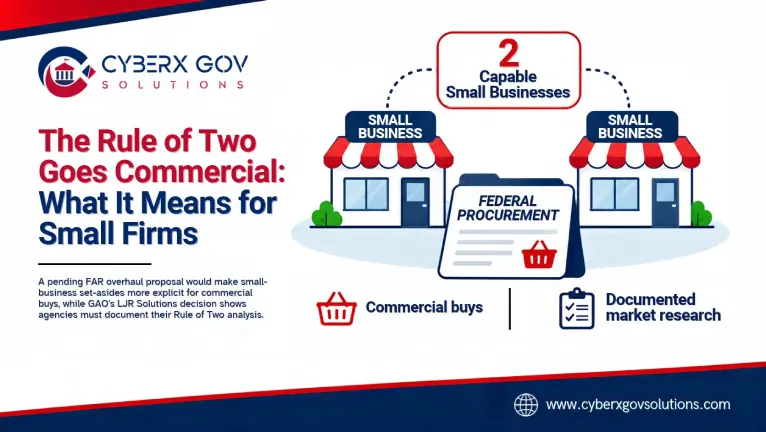
When a contracting officer reasonably expects that at least two responsible small businesses will submit offers at fair market prices, the acquisition must be set aside for small businesses. That is the test for buys above the simplified acquisition threshold.
For smaller purchases, above the micro-purchase threshold and up to the simplified acquisition threshold, a set-aside is the default. It stands unless the contracting officer finds no reasonable expectation that two or more responsible small businesses will compete at fair market prices.
Either way, the decision turns on a prediction about the market. If two capable small firms are likely to compete and deliver value, the work should be reserved for small businesses rather than opened to everyone.
That is why your visibility matters. The agency’s read of the market is built from what it can see, and what it can see is largely what you put in front of it.
What the FAR Overhaul Proposes for Commercial Buys
On September 18, 2026, the FAR Council published a second round of Revolutionary FAR Overhaul (RFO) proposed rules under FAR Case 2026-003. The package revises several FAR parts, including Part 12, which governs commercial products and services. The public comment period closed on October 19, 2026.
According to legal analyses of the proposal, the Part 12 changes would make the small business set-aside obligation explicit for commercial acquisitions above the micro-purchase threshold, tying them directly to the Rule of Two. The aim is to close a gap where set-asides for commercial buys between the micro-purchase threshold and the simplified acquisition threshold were not clearly spelled out.
The same analyses note that a contracting officer who decides not to set a commercial buy aside would have to document the reasons. The proposal is not final, and the text can change before it is, so treat the specifics as a direction of travel rather than a settled rule.
What GAO Just Enforced
You do not have to wait for the final rule to see the Rule of Two bite. A recent protest shows just how seriously GAO treats the analysis behind a set-aside decision.
In LJR Solutions, LLC, B-424487 (August 14, 2026), GAO sustained a protest against a National Institutes of Health (NIH) solicitation for professional, scientific, and technical services. Issued on March 26, 2026, the solicitation was run on a full and open basis with a small business reserve, under an HHS class deviation that mixed FAR and overhauled RFO terms.
GAO found the agency’s decision not to set the work aside was unreasonable and inadequately documented. The problems stacked up:
- The contracting officer appeared to first document the set-aside analysis on April 30, more than a month after the solicitation was issued.
- The record did not explain why three small businesses found capable in earlier 2024 market research were suddenly not capable.
- GAO rejected the reasoning that small businesses relying on subcontractors were not capable, since the solicitation allowed subcontracting and large firms would also need teammates.
- Nothing showed that the agency had considered a partial set-aside, which the overhauled text (RFO 19.112) requires before using a small business reserve.
GAO recommended new market research as appropriate and reimbursement of the protester’s costs, including attorneys’ fees. The message to agencies is clear: a set-aside decision needs a timely, consistent, documented basis.
Why Your Documentation Is Now Evidence
Here is the practical heart of both developments. The market research record is what decides whether a set-aside survives, and you help build that record, response by response.
Your capability statements, your sources-sought responses, and your teaming plans are evidence. When they are specific and on file, they show the agency that two capable small businesses exist. When they are vague or missing, the agency may conclude the opposite, and a protest may not save you.
In the NIH case, the fight turned on what the agency’s own research showed about capable small firms. That is a record you can influence, one response at a time.
Other Proposed Changes to Watch
The commercial-buy change does not travel alone. Legal analyses of the RFO package flag several other proposals worth tracking, all still in draft.
Rules for ordering under blanket purchase agreements (BPAs) and for combined synopsis and solicitation notices would shift, which would affect where and how smaller opportunities appear. In Part 15, “discussions” would be relabeled “negotiations,” and the chances to fix a weak proposal after submission would narrow. The takeaway is to submit complete, compliant proposals the first time, because the room to repair them later may shrink.
Because these are proposals, confirm the final language before you rely on any single detail in a bid.
A More Crowded Field Is Coming
There is a second-order effect to plan for. A separate SBA effort to revise small business size standards could expand how many firms qualify as small.
More qualifying firms likely mean more procurements set aside under the Rule of Two. It also means more competitors inside each set-aside. More set-asides help you only if you can stand out in them, which puts a premium on positioning and proposal quality.
What to Do Now
You cannot control the rulemaking calendar, but you can control how ready you are. A few moves put you in a stronger spot.
- Answer sources-sought notices and RFIs with specific capability statements that name relevant contracts, staffing, certifications, and reach.
- Document your teaming and subcontracting approach, including how you will meet the limitations on subcontracting. Our guide to small business teaming walks through it.
- Check each agency’s class deviation, since you may see the original FAR, deviation text, and final rules in different solicitations.
- Write proposals that are complete on first submission, because the proposed changes leave less room to fix problems later.
- Fold these signals into your bid or no-bid decision and your capture planning early, not after a solicitation drops.
How CyberX Gov Solutions Can Help
The firms that benefit from more set-asides are the ones agencies can see and trust on paper. Building that visibility is deliberate work.
CyberX Gov Solutions helps small businesses position for set-aside opportunities through capture strategy, sharper capability statements, and teaming support under Get Fed Ready™. When an opportunity lands, our proposal development team helps you turn it into a response that holds up under evaluation and under protest review.
The goal is simple: make your firm one of the two capable small businesses an agency can point to.
Conclusion
The Rule of Two is moving further into commercial buying, and GAO is holding agencies to the analysis behind it. For small contractors, that is an opening, but only for those who show up prepared.
Respond to market research with specifics, document your teaming, and keep your proposals clean on the first pass. Do that, and the shift toward set-asides becomes a tailwind instead of a missed chance.
This post is general information, not legal advice, and the proposed rules can change before they are final. Want help positioning for set-aside work? Talk to the CyberX Gov Solutions team or schedule a consultation at cyberxgovsolutions.com/schedule-a-meeting/.
Frequently Asked Questions
What does the Rule of Two require?
When a contracting officer reasonably expects at least two responsible small businesses to submit fair-market offers, the acquisition must be set aside for small businesses. It is a core small business protection in federal acquisition.
Does the Rule of Two apply to commercial purchases?
The existing rules already reach many commercial buys above the micro-purchase threshold. The pending FAR overhaul proposal would make that obligation more explicit for commercial acquisitions, though it is not yet final.
What happened in the LJR Solutions protest?
GAO sustained the protest on August 14, 2026, finding NIH’s decision not to set the work aside was unreasonable and poorly documented. GAO recommended new market research and reimbursement of the protester’s costs.
Can an agency skip a set-aside if small firms need subcontractors?
Not on that basis alone. In LJR Solutions, GAO rejected the idea that small businesses relying on subcontractors were incapable, noting that the solicitation allowed subcontracting and that large firms would also need teammates.
How do I help an agency find “two capable small businesses”?
Respond to sources-sought notices and RFIs with specific capability statements, name relevant past contracts, and show your staffing and teaming. That record is what agencies and the GAO weigh.
When do the FAR overhaul changes take effect?
They are proposed, not final. The comment period for this round closed on October 19, 2026, and final rules will follow later. Track the final text before relying on any specific provision.