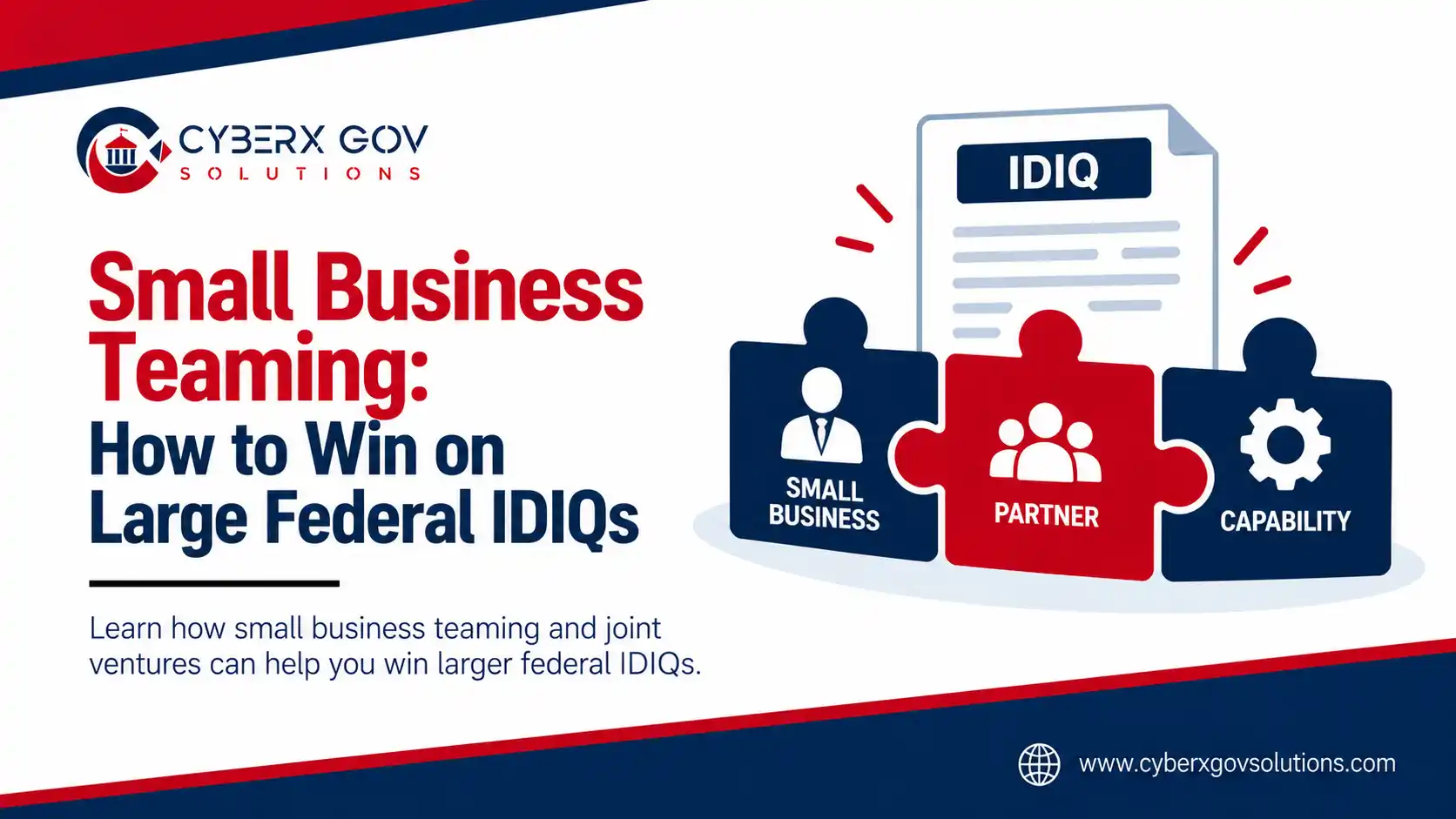
One company rarely wins the biggest federal contracts alone. The scope is too broad, the past performance bar sits too high, and the capacity demands are steep. Small business teaming is how you get around that.
Partner with the right companies, and a small business can bid on work it could never reach by itself. Federal rules protect that path, too. In 2026, the Army had to reopen its $50 billion MAPS vehicle after a small business challenged a ban on teaming. That case is below.
This guide covers how small business teaming works, the two main ways to do it, and how to pick a partner who strengthens your bid rather than sinking it.
What Is Small Business Teaming?
Small business teaming is when two or more companies join forces to chase a federal contract together. The government recognizes this under the Federal Acquisition Regulation, at FAR 9.601, which defines a Contractor Team Arrangement.
It takes two main forms. In the first, two or more companies form a partnership or joint venture that bids as a single prime contractor. In the second, one company serves as the prime and brings others on as subcontractors for a specific opportunity.
Either way, you combine strengths. One partner may hold the contract vehicle, another the past performance, and a third the specialized staff. Together, you look like a stronger, more complete offeror.
Prime-Subcontractor Teams vs Joint Ventures
The two structures behave very differently. Choosing the right one shapes your risk, your reward, and your eligibility.
In a prime-subcontractor team, the prime signs the contract and carries full responsibility to the government. Subcontractors work under the prime and get paid by the prime. It is simpler to set up and easy to scale across several partners.
In a joint venture, the partners build a shared entity that bids as the prime. They split control, profit, and risk more directly. A joint venture can also help a small business qualify for work it could not reach alone, which the next section covers.
| Feature | Prime-sub team | Joint venture |
| Who holds the contract | The prime | The joint venture entity |
| Setup effort | Lower | Higher |
| Control and profit | Prime leads | Shared by partners |
| Past performance credit | Mostly the prime | The JV and its partners |
| Best for | Clear lead, many partners | Equal partners, shared capability |
Reach for a prime-subcontractor team when one company clearly leads and others fill gaps. Reach for a joint venture when partners sit closer to equal and want to pool past performance and capacity.
How a Small Business Joint Venture Stays “Small”
Normally, when companies team up closely, the government may treat them as affiliated and add their sizes together. That could push a small business past the size limit. Joint ventures get an important exception.
Under SBA rules at 13 CFR 125.8, a joint venture can bid on a small business set-aside if each partner is small under the contract’s size standard, or if it qualifies under an affiliation exception. Partners are not automatically combined just for teaming through a proper joint venture.
The rules do come with conditions. A small business must be named the managing venture and run the day-to-day work. The joint venture needs a written agreement, and the profit has to track the work each partner performs.
The SBA Mentor-Protégé Route
A powerful exception exists for unequal partners. Through the SBA Mentor-Protégé Program, a small business protégé can form a joint venture with a larger, approved mentor and still compete for small business set-asides.
This lets a growing firm pair with an established partner and reach bigger work. The rules keep the small business in front. The protégé has to perform at least 40 percent of the work the joint venture does, and that work must be real, not administrative filler.
That 40 percent floor is the point. It keeps the small business building capability, rather than lending its status to a larger firm.
A Live Example: The Army MAPS Reopening
Teaming is more than a nice option. Sometimes the rules force the government to allow it.
In 2026, the Army released MAPS, the Marketplace for the Acquisition of Professional Services, a vehicle with a ceiling near $50 billion that consolidates the earlier RS3 and ITES-3S contracts. The original solicitation barred small business primes from teaming with other small business subcontractors.
A company called Intelligence Consulting Enterprise Solutions protested. On August 11, 2026, GAO sustained the protest in decision B-424433.3. GAO found that the Small Business Act gives the small business, not the agency, the right to choose whether to compete as a team of subcontractors or as a joint venture.
The Army then amended the solicitation to let small business teams bid, with a proposal deadline of November 12, 2026. Standalone small businesses could withdraw and resubmit as a team. The lesson outlasts this one deadline: your right to team is protected by law, and on consolidated vehicles, teaming is often the smartest way in.
How to Choose and Vet a Teaming Partner
The wrong partner can cost you a bid or a contract. Vet carefully before you sign anything.
- Check the gap you need filled. Match the partner to the exact past performance, clearance, or capability your bid lacks.
- Confirm their standing. Review their SAM.gov registration, size status, and any certifications the solicitation requires.
- Review real past performance. Ask for relevant projects and CPARS records, not just a capabilities deck.
- Agree on the work split early. Decide who does what, and for a joint venture, make sure the small business meets its work-share rules.
- Put it in writing. Sign a teaming agreement or joint venture agreement before proposal day, with clear roles and exclusivity.
Common Teaming Mistakes to Avoid
A handful of errors show up over and over.
The first is teaming too late. Strong teams form during capture, not the week the proposal is due. The best partners are often spoken for by then.
The second is a vague agreement. If roles, work share, and pricing are not clear on paper, the partnership can break down mid-proposal or after award.
The third is ignoring the work-share rules. On a set-aside, the small business has to perform its required share. A deal that leaves the small partner with token work can fail a review or draw a protest.
Key Takeaways
- Small business teaming lets you bid on work too large to win alone.
- Prime-subcontractor teams are simpler; joint ventures pool control and past performance.
- A proper joint venture, or an SBA mentor-protégé joint venture, can keep a small business eligible for set-asides.
- Form teams during capture, and put every role and work split in writing.
How CyberX Gov Solutions Can Help
Finding the right partner and building a compliant, teamed proposal takes time and judgment. That is where support pays off.
CyberX Gov Solutions helps contractors structure teamed bids and respond to complex solicitations. Our proposal development team handles compliance mapping, win themes, and the full writing effort for prime and subcontractor roles. For firms newer to the federal market, Get Fed Ready™ supports readiness and opportunity fit, so your team can start from a position of strength.
The goal is simple: to help you join the right team and submit a proposal that scores well and survives review.
Conclusion
The largest federal contracts reward companies that work well. Small business teaming turns a capability gap into a competitive bid, and the rules protect your right to use it.
Choose the structure that fits your partners, keep the small business in a real leadership role, and lock down the agreement early. The MAPS case is a reminder that teaming is not a workaround. It is a protected, proven path onto big vehicles.
Want help building a teamed bid or finding the right partner for your next pursuit? Talk to the CyberX Gov Solutions team or schedule a free consultation at cyberxgovsolutions.com/schedule-a-meeting/.
Frequently Asked Questions
What is the difference between a teaming agreement and a joint venture?
A teaming agreement sets up a prime-subcontractor relationship, where the prime holds the contract and subcontractors work under it. A joint venture creates a shared entity that bids as the prime, with partners sharing control, profit, and risk. Teaming agreements are simpler; joint ventures pool capability more deeply.
Can a small business team with a large business still win a set-aside?
Yes, through the SBA Mentor-Protégé Program. An approved mentor and a small business protégé can form a joint venture that competes for small business set-asides. The protégé must perform at least 40 percent of the joint venture’s work.
Will teaming make my company too big for small business work?
Not if you use a proper joint venture. Under SBA rules, partners in a qualifying joint venture are not automatically combined for size, so each small partner can keep its status. Always confirm the size standard for the specific contract.
When should I start building a team for a bid?
Start during capture, well before the proposal is due. The strongest partners commit early, and a late scramble usually means weaker options and a rushed agreement.
Who leads a small business joint venture?
A small business must be named the managing venture and run the day-to-day work and contract administration. The written joint venture agreement must spell out this role and tie profit to the work each partner performs.
Do I need a signed agreement before submitting a proposal?
Yes. Put a teaming agreement or joint venture agreement in place before proposal day. It should define roles, the work split, pricing approach, and exclusivity, so the partnership holds up through the bid and into performance.