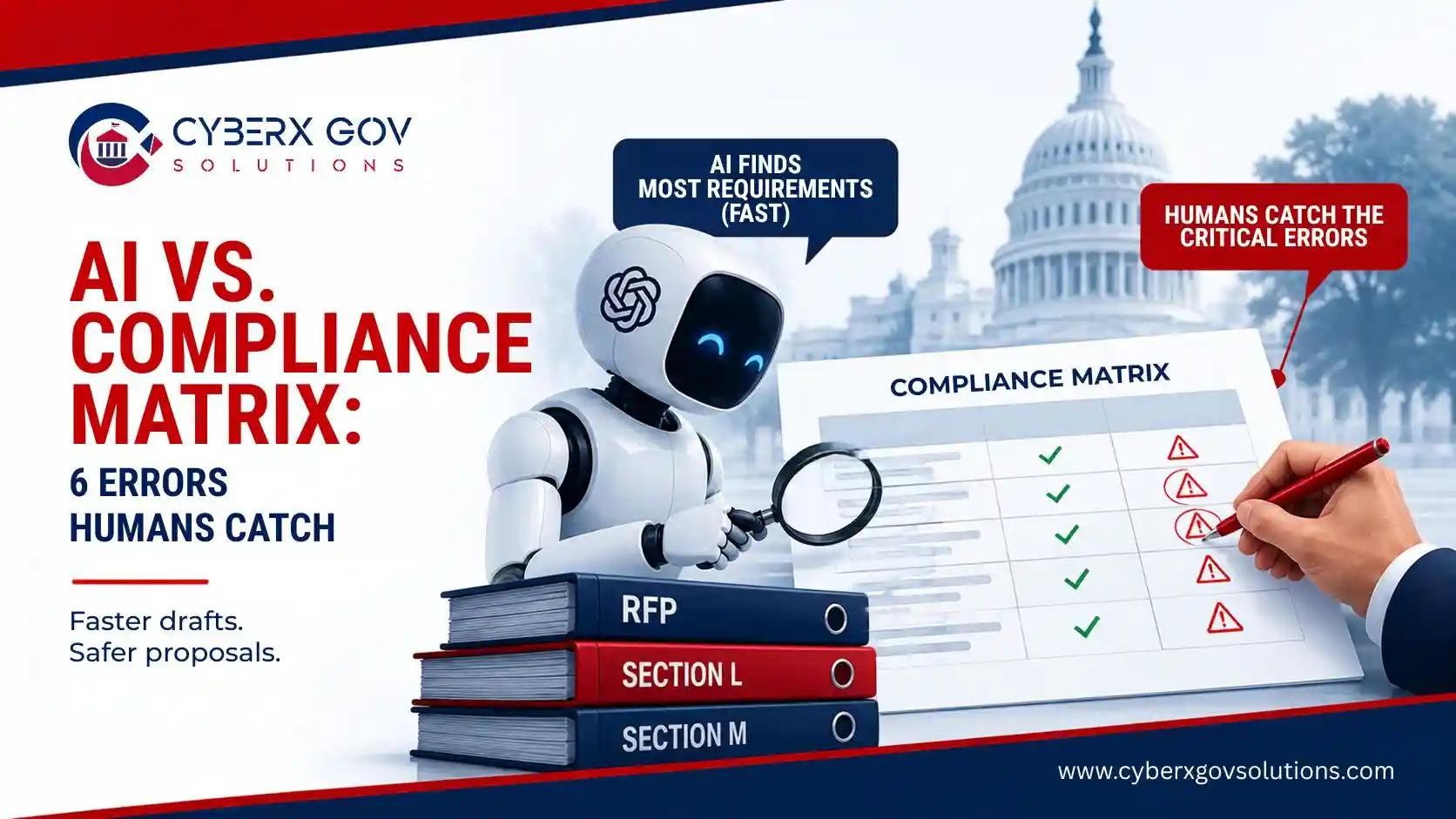
A compliance matrix is critical because it can determine bid success before evaluators see the proposal’s themes. Missing a requirement can lead to disqualification, so understanding AI’s role in building it is essential.
While AI is fast and generally accurate on well-structured RFPs, it can miss the high-stakes, complex requirements that truly determine compliance, which proposal teams must watch for.
This article is for proposal and compliance teams deciding how much to trust AI in the matrix. It highlights six errors AI makes that a human reviewer can catch and recommends a blended approach to ensure both speed and accuracy.
Key Takeaways
- AI is fast but not final. It extracts most requirements quickly and misses the hardest ones.
- The dangerous errors are subtle, not obvious, which is why they slip past an unverified matrix. Trusting your judgment ensures you catch these critical issues and feel in control of compliance accuracy.
- Implied and conditional requirements are where AI struggles most.
- Amendments and attachments routinely trip up automated extraction.
- Blended review wins. AI drafts the matrix; a human verifies every high-risk line. Your oversight is essential to maintaining compliance and securing bid success, fostering teamwork and shared purpose.
What a Compliance Matrix Does, and Why Errors Are So Costly
A compliance matrix maps every requirement in a solicitation to where your proposal answers it. It pulls obligations from Section L (instructions), Section M (evaluation criteria), and Section C (the work itself), then tracks a response location and owner for each one.
The matrix is your proof of compliance and your project plan rolled into one. When it is complete and accurate, nothing slips through. When it has a hole, you can answer everything you saw and still lose, because the requirement you missed was the one the evaluator checked first.
That is why the errors below matter. Each one is a gap that looks fine on the surface and costs you at the worst moment.
The 6 Errors AI Still Makes on a Compliance Matrix
1. Implied Requirements With No “Shall”
AI is trained to hunt for obligation words: shall, must, will. It is very good at that. The trouble starts when a requirement is described across a few sentences without ever using one.
When an RFP spends three paragraphs laying out a desired capability but never writes “the contractor shall,” AI can skip the obligation entirely. A human catches it by understanding what the agency actually wants, not just which keywords appear.
Why a human catches it: experience reads intent. Reviewers know that a described outcome is still a requirement, even without the trigger word.
2. Conflicting Requirements Across Sections
Sections do not always agree, and reconciling them takes judgment. A classic case: Section L asks for five past performance examples, while Section M awards points based on three.
AI extracts both and leaves them sitting side by side as separate requirements. A human resolves the conflict by cross-referencing the instructions against the evaluation criteria and deciding how to respond without tripping either one.
Why a human catches it: the fix is a decision, not an extraction. Someone has to choose the compliant path.
3. Requirements Buried in Attachments and Referenced Standards
Federal solicitations rarely live in one file. Requirements hide in exhibits, appendices, attachments, and referenced standards or clauses that the RFP only names by number.
Good AI tools pull from attachments, but they can only read what you feed them. A referenced specification or a DFARS clause that the tool never received will not show up in the matrix. A human confirms the full document set is in scope before trusting the output.
Why a human catches it: people track down what the solicitation points to. AI works from the files it was given.
4. Stale Amendments
Solicitations change. An amendment can add a requirement, move a due date, or rewrite an instruction, and every change has to flow into the matrix.
AI extracts from the version it was handed. It does not know that an amendment landed yesterday, and it will not reconcile the new language against the old. Teams that skip amendment tracking end up with a confident, tidy, out-of-date matrix.
Expert tip: Assign one person to own amendment tracking for every pursuit. A matrix built on the wrong version of the RFP is worse than no matrix, because it looks trustworthy.
Why a human catches it: amendment control is a process, not a parse. Someone owns keeping the matrix current.
5. Paraphrased Wording That Hides the Real Requirement
“Provide staffing” is not the same as “provide a minimum of three full-time staff with active Secret clearances within 30 days of award.” The details the AI smoothed over are the details that determine compliance. A human keeps the requirement verbatim, with its section reference and page number.
Why a human catches it: reviewers know the exact words are required. A summary is a paraphrase of the truth, not the truth.
6. Claiming Compliance You Cannot Actually Meet
This is the most dangerous error because the matrix looks complete. AI can extract a requirement like “offeror shall hold a Top Secret facility clearance” and, in some workflows, mark it as addressed based on the proposal text alone.
Only a person can confirm your organization actually holds that clearance, certification, or past performance before you claim compliance. Checking a box you cannot back up is not a formatting slip. It is a credibility and integrity problem.
Why a human catches it: compliance is about what is true, not what is typed. Validation against reality is human work.
Where the Errors Hide: AI Strengths vs. Human Checks
| Matrix Task | AI Strength | Human Check |
| Finding “shall/must” requirements | High | Confirm none were missed |
| Catching implied requirements | Low | Read agency intent |
| Reconciling Section L vs M | Low | Resolve the conflict |
| Pulling from attachments | Medium | Confirm full document set |
| Tracking amendments | Low | Own version control |
| Preserving exact wording | Medium | Keep it verbatim |
| Validating qualifications | None | Confirm against reality |
The Honest Balance: AI Is a Head Start, Not a Finish Line
None of this means AI has no place in compliance work; just the opposite. Manual extraction can take 8 to 16 hours and still fail due to an omission, a missed requirement nobody noticed. AI flips that failure mode: it tends to over-include, capturing duplicates or non-requirements that a reviewer can delete in minutes.
Over-inclusion is a safer error than omission, and that is the whole point. AI hands you a near-complete draft fast, so your experts spend their time verifying the hard 10 to 15 percent instead of typing out the easy 85. Reported human review time for an AI-drafted matrix is a fraction of that for full manual extraction.
How CyberX Gov Solutions Can Help
Smart teams do not pick between AI speed and human judgment. They blend the two, and that is exactly how we work.
CyberX Gov Solutions, based in New York, provides federal proposal development support that pairs AI-assisted requirements extraction with expert human review. We use AI to build the compliance matrix fast. Our team verifies the implied requirements, reconciles conflicting sections, tracks amendments, and validates every compliance claim against what your organization can truly deliver.
The result is a matrix you can stand behind: fast to build, complete, and accurate where it counts. That blend of speed and scrutiny is what keeps a proposal in the running long enough for its win themes to matter.
Conclusion
The AI vs. compliance matrix question is not really a contest. AI wins on speed and first-pass coverage. Humans win on the errors that disqualify a bid: implied requirements, conflicting sections, buried attachments, stale amendments, paraphrased wording, and compliance claims that do not hold up.
For proposal and compliance teams, the takeaway is reassuring. You do not have to fear AI on the matrix, and you cannot fully trust it either. Use it to move fast, then apply human judgment to the lines that decide the award. A blended review gives you both, and it is how a compliance matrix earns the confidence a federal bid demands.
Want a compliance matrix that is fast to build and safe to submit?
CyberX Gov Solutions blends AI-assisted extraction with expert human review to keep your federal proposals compliant and competitive.
Schedule a free consultation at cyberxgovsolutions.com/schedule-a-meeting and put a proven blended method behind your next bid.
Frequently Asked Questions
Can AI build a compliance matrix for a federal proposal?
Yes, and quickly. AI tools scan a solicitation and extract requirements in minutes, with reported accuracy around 85 to 90 percent on well-structured RFPs. The catch is the remaining share, which holds the trickiest requirements. AI gives you a strong first draft, but a human still verifies the high-risk lines.
What errors does AI make on a compliance matrix?
The common ones are missing implied requirements that lack a “shall,” failing to reconcile conflicting Section L and Section M instructions, overlooking requirements in attachments or referenced standards, using an outdated version after an amendment, paraphrasing exact wording, and marking compliance for qualifications the team cannot actually meet.
Is an AI compliance matrix accurate enough to submit as-is?
No. Even at high extraction accuracy, the requirements AI misses tend to be the ones that decide compliance. Submitting an unverified matrix risks a disqualifying gap. The safe approach is to treat the AI output as a draft and have a human confirm every requirement that carries risk.
Why do humans still need to review an AI compliance matrix?
Because the hardest errors need judgment, not extraction. A person reads agency intent, resolves conflicts between sections, tracks amendments, keeps requirement wording verbatim, and validates that the team truly holds the clearances or past performance being claimed. Those checks protect against the gaps that cause bids.
What is the difference between Section L, M, and C in a matrix?
Section L gives proposal instructions, Section M gives evaluation criteria, and Section C describes the work or performance requirements. A good compliance matrix pulls obligations from all three and can flag where they conflict, since instructions and evaluation criteria do not always line up.
How much time does AI save on a compliance matrix?
A lot, when used well. Manual extraction can take many hours, while AI produces a draft in minutes and leaves a shorter human review to catch edge cases. The saved time is best reinvested into verifying the hard requirements and improving the response, not into skipping review.
What is a blended human-plus-AI compliance review?
It is a workflow where AI builds the first-draft matrix, and people verify the risky lines. AI handles fast extraction and citation; humans read intent, reconcile conflicts, track amendments, and validate real qualifications. The approach keeps the speed of automation while protecting the accuracy that compliance demands.
Can an incomplete compliance matrix disqualify a proposal?
Yes. If a proposal fails to address a material requirement, an agency can rule it non-compliant before evaluating the substance. That is why a missed requirement is the most expensive matrix error, and why human verification of an AI-built matrix is worth the time it takes.