You win a contract that needs eight cleared engineers in 90 days. Your in-house recruiter has never sourced a Top Secret candidate. The clock is already running. What do you do?
This is the moment many federal contractors face. Hiring security-cleared talent is hard, slow, and unforgiving when a contract start date is at stake. So the question becomes practical: build the recruiting muscle in-house, or bring in a cleared RPO partner?
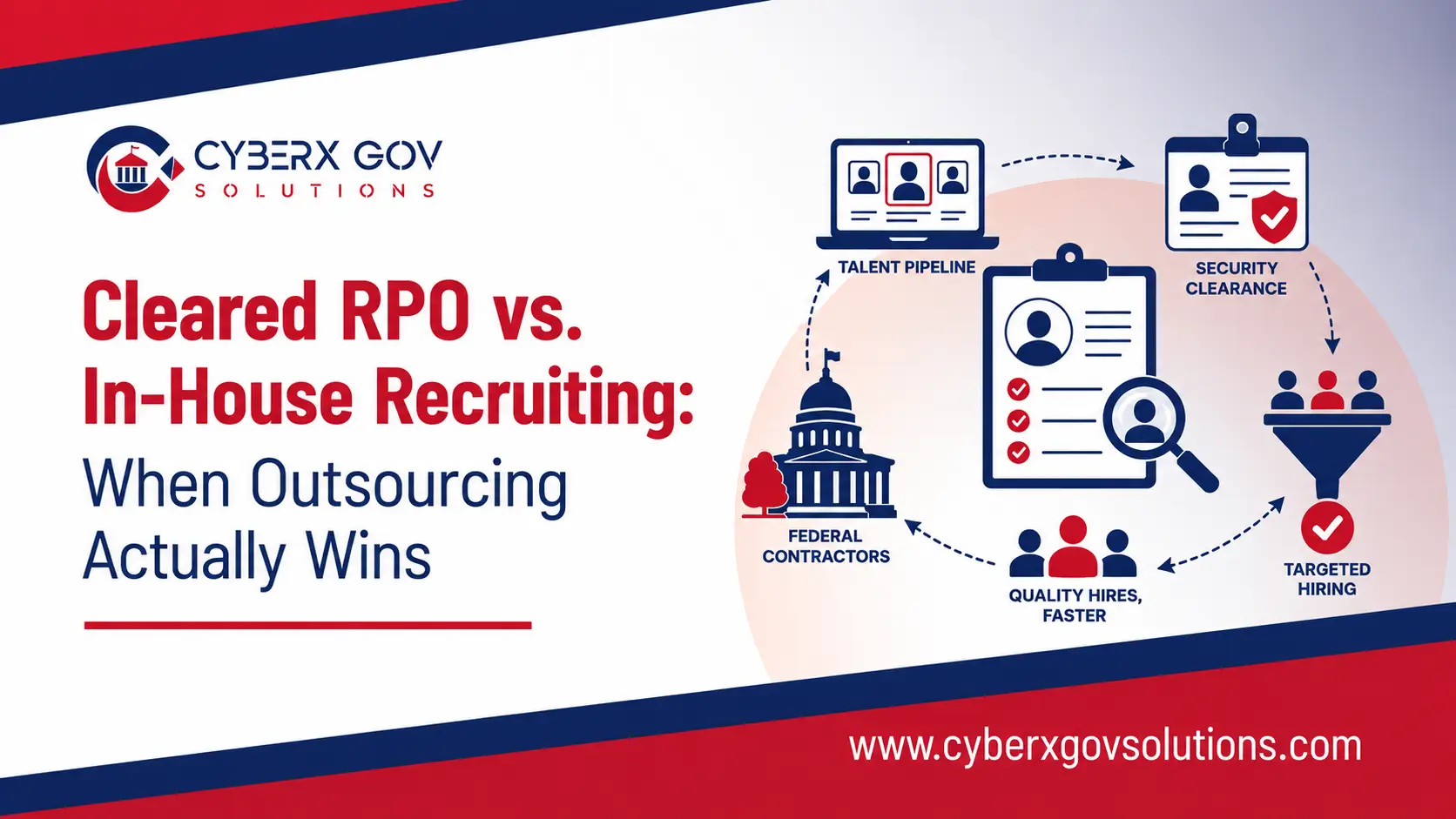
Recruitment process outsourcing (RPO) means handing all or part of your hiring function to an outside specialist who works as an extension of your team. Cleared RPO applies that model to security-cleared roles. This guide breaks down when each approach wins, what the numbers say, and how to decide without guessing.
Cleared RPO and In-House Recruiting, Defined
In-house recruiting means you hire and manage your own recruiters. They own sourcing, screening, interviews, and onboarding. You get full control and a team that lives inside your culture.
Cleared RPO is different from a staffing agency. A staffing agency fills one seat at a time and charges a markup, often 15% to 30% of the hire’s salary. An RPO partner runs your recruiting process under your brand, using your applicant tracking system, and is measured on outcomes like time-to-fill and quality of hire, not single placements.
In the cleared world, the partner also handles clearance-specific work: matching candidates to the right level (Secret, Top Secret, or TS/SCI, which stands for Top Secret/Sensitive Compartmented Information), screening for contract fit, and managing a pipeline of people who are already cleared.
What the Numbers Say About Cost and Speed
Hiring is expensive even before you add a clearance requirement. According to the Society for Human Resource Management (SHRM), the average cost per hire in the United States was about $5,475 for non-executive roles in its 2025 benchmarking, and roughly $35,879 for executive roles. Specialized and hard-to-fill positions sit at the higher end, and cleared roles almost always qualify as hard to fill.
RPO changes the cost structure. Instead of fixed recruiter salaries you pay all year, you shift to variable spending tied to hiring volume. Industry analyses in 2026 commonly report that RPO can lower recruitment costs by roughly 30% to 50% at sustained volume, though exact savings vary by provider and role.
There is a clear break-even point. Multiple 2026 pricing analyses agree that RPO tends to beat both agencies and in-house teams once hiring is sustained at about 15 to 25 roles per year. Below that, fixed setup and management fees can erase the savings. So volume matters more than almost any other factor.
When Cleared RPO Actually Wins
Outsourcing is not always the right call. But in specific situations, a cleared RPO partner clearly comes out ahead.
- You face a surge. A new contract award or a sudden recompete can require many cleared hires fast. RPO providers keep pre-built pipelines, so they scale more quickly than a small internal team can.
- You are bidding and need staffing credibility. Pre-award recruitment planning strengthens your proposal. A partner can show named or pipelined candidates before you win.
- Your hiring is uneven. If you hire in bursts tied to contract cycles, fixed in-house overhead sits idle between awards. Variable RPO cost fits that rhythm.
- You lack cleared-recruiting expertise. Sourcing TS/SCI talent takes networks and process knowledge that a generalist HR team usually does not have.
- A vacancy is costing you money. Every open day on a funded contract is lost revenue. Faster fills protect the contract and the schedule.
When In-House Recruiting Wins
In-house recruiting earns its keep when your hiring is steady and your team is mature.
If you fill only a handful of cleared roles each year and your HR staff already understands clearances, an internal team gives you control and a deep feel for your culture. Internal recruiters also build a private candidate database you can tap later, and they tend to work more proactively with hiring managers on roles months ahead.
Control matters for governance, too. Security clearance administration and compliance documentation sit close to your facility security officer. Some contractors prefer to keep that core capability fully in-house, even when they outsource surge hiring.
Quick Comparison
Here is how the two models stack up on the factors that matter most to federal contractors.
| Factor | Cleared RPO | In-House |
| Cost structure | Variable, tied to volume | Fixed salaries year-round |
| Best hiring volume | Roughly 30+ roles/year | Low, steady volume |
| Speed to scale | Fast (pre-built pipelines) | Slower to ramp |
| Cleared talent network | Broad, specialized | Limited to internal reach |
| Cultural fit & control | Strong | Strongest |
The Hybrid Model: Often the Real Answer
The choice is rarely all or nothing. Many government contractors land on a hybrid model, and for good reason.
In a hybrid setup, you keep a small internal core for governance, security administration, and culture-critical roles. Then you bring in a cleared RPO partner for surge hiring, hard-to-fill clearances, and proposal-stage pipelines. Industry analysis of cleared staffing in 2026 points to this blend as the best balance of speed, scale, and control for contractors that face surge cycles and tight clearance requirements.
Think of it as keeping the steering wheel while renting extra horsepower when the road demands it.
Common Mistakes Contractors Make
Whichever model you choose, a few errors show up again and again.
- Choosing by price alone. The lowest per-hire fee means little if the candidates leave in six months. Track quality and retention, not just cost.
- Hiring an RPO with no cleared experience. A generalist provider cannot fill TS/SCI roles. Ask for federal and clearance-specific proof.
- Treating recruiting as reactive. The strongest pipelines are built before the award, not after the kickoff meeting.
- Forgetting governance. Even with RPO, clearance compliance stays your responsibility. Keep that oversight close.
How CyberX Gov Solutions Can Help
Deciding between cleared RPO and in-house hiring is easier with a partner who understands both federal contracts and security clearances.
CyberX Gov Solutions supports federal contractors through its Cleared Recruitment service. That includes clearance level matching across Secret, Top Secret, and TS/SCI, role and contract fit screening, urgent and time-sensitive hiring support, and proposal and pre-award recruitment planning. CyberX also helps with workforce planning and ongoing pipeline management, so your cleared hiring keeps pace as your contracts grow.
The goal is simple: get the right cleared people onto your contracts on time, whether that means supplementing your team or running the search end-to-end.
Making the Right Call
There is no single winner here. Cleared RPO wins when you hire at volume, face surges, or lack cleared-recruiting expertise. In-house wins when your hiring is steady, and your team already knows clearances cold.
For most growing contractors, the smart move is the hybrid path: a lean internal core plus a cleared RPO partner for the moments that matter. Start by counting your annual cleared hires and your contract cycles. The numbers will point you toward the model that fits.
Not sure which model fits your next contract? CyberX Gov Solutions helps federal contractors recruit pre-screened, security-cleared professionals through its Cleared Recruitment service.
Schedule a free consultation at cyberxgovsolutions.com/schedule-a-meeting/ to talk through your cleared hiring needs.
Frequently Asked Questions
What is the difference between a cleared RPO and a staffing agency?
A staffing agency fills individual roles on a transactional basis and charges a markup per placement. A cleared RPO partner runs all or part of your recruiting process under your brand and is measured on long-term outcomes like time-to-fill and retention.
How many cleared hires do I need before RPO makes sense?
Most 2026 pricing analyses put the break-even at roughly 15 to 25 hires per year. Below that, the setup and management fees can make in-house or selective agency use more cost-effective.
Can a small business use cleared RPO?
Yes. Small businesses and new contract winners often use RPO during surges or proposal stages, when they need cleared talent fast but cannot justify a full internal team. A project-based engagement can match a single contract.
Does outsourcing recruiting mean giving up control?
No. A good RPO partner works as an extension of your team, under your brand and systems. You keep final hiring decisions and, importantly, your clearance compliance and security governance stay in-house.
What should I look for in a cleared RPO provider?
Look for proven federal and clearance-specific experience, not just general recruiting. Ask for examples of filling Secret and TS/SCI roles, evidence of compliant processes, and references from other government contractors.