Imagine losing a defense contract not because of your work, your price, or your past performance. Instead, you lose it because a lobbying firm you hired also represents a company on a government watch list. That is now a real risk.
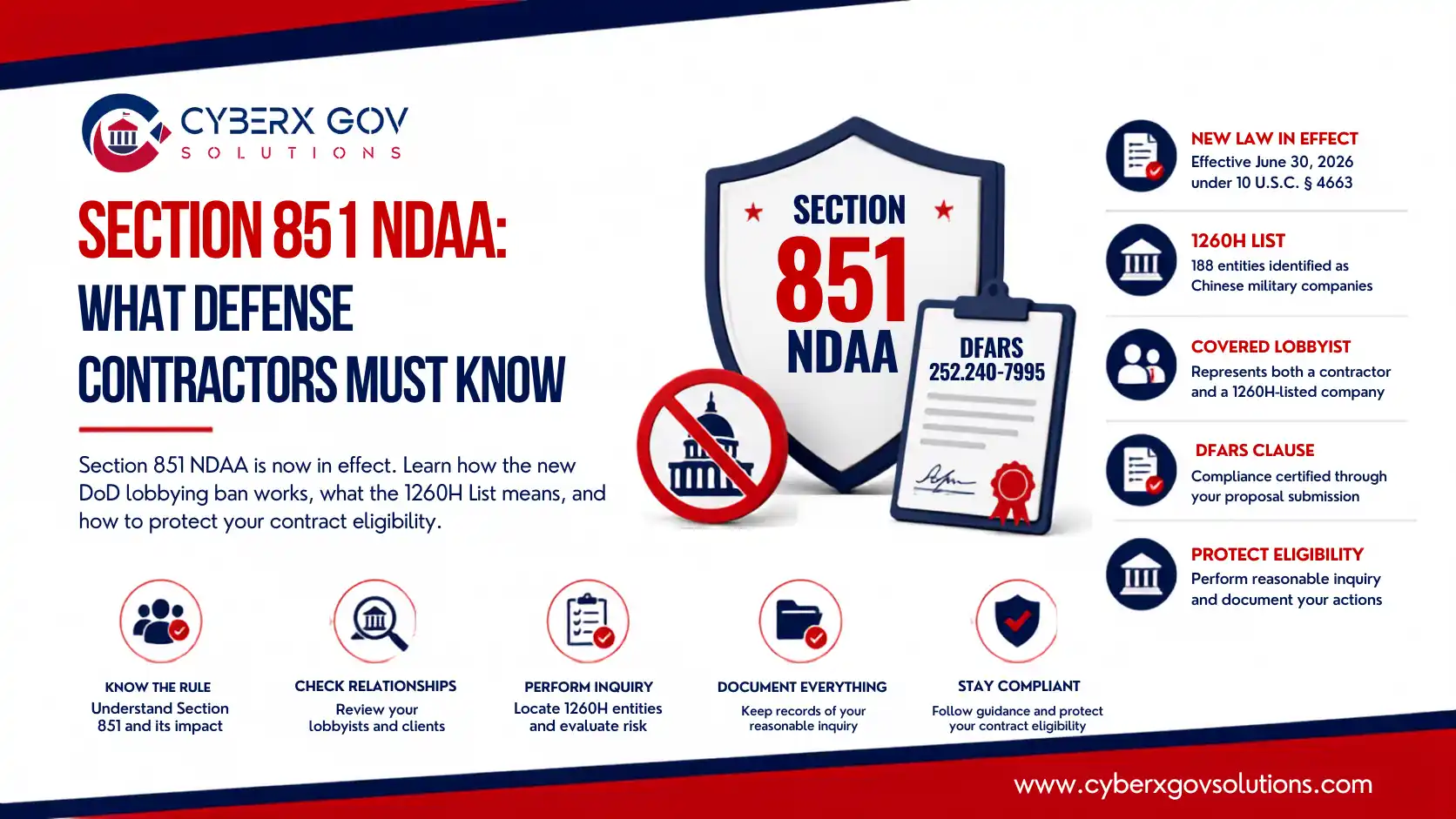
Section 851 NDAA is in effect as of June 30, 2026. It is a new rule that can affect whether your company can win, renew, or extend a contract with the Department of Defense (DoD), which now operates under the name Department of War (DoW).
This guide breaks down what the law says, who it covers, and the practical steps you can take to protect your eligibility. NDAA stands for National Defense Authorization Act, the yearly law that sets defense policy and spending.
What Section 851 Actually Does
Section 851 comes from the Fiscal Year 2025 NDAA. Congress passed it, and President Biden signed it into law on December 23, 2024. The rule then took effect on June 30, 2026.
The law is now part of the U.S. Code at 10 U.S.C. § 4663. Here is the core idea in plain terms.
The Department cannot enter into, renew, or extend a contract with a company if that company hires a “covered lobbyist.” The ban also reaches the company’s parent business and its subsidiaries. So a lobbying relationship at the corporate parent level can affect a subsidiary that bids on defense work.
The goal is to protect the defense supply chain from foreign influence. Congress wanted more transparency around who lobbies for whom.
The 1260H List Explained
Section 851 connects to a separate list called the 1260H List. This list comes from Section 1260H of the FY 2021 NDAA.
The Department maintains this list and updates it at least once a year. It names companies the government has determined to be “Chinese military companies” operating in the United States, either directly or indirectly.
The list grew sharply in June 2026. The Department expanded it to 188 entities, adding 65 companies and removing 10. Well-known names now appear on it, including Huawei, SMIC, BYD, CATL, DJI, and WuXi AppTec.
Being on the 1260H List does not, by itself, sanction a company. Instead, other laws like Section 851 use the list as a trigger. You can view the current list through the official Department resource at business.defense.gov/clear/1260h-list.
What Is a Covered Lobbyist?
This term sits at the center of the rule, so it helps to define it clearly.
A covered lobbyist is a lobbying firm that represents both of the following at the same time:
- A defense contractor, or that contractor’s parent or subsidiary, and
- A company named on the 1260H List.
The official framing is simple: same lobbyist, same fate. If one firm sits on both sides of that relationship, the contractor’s eligibility can suffer.
“Lobbying activities” follows the meaning in the Lobbying Disclosure Act. That definition is broad. It includes not just direct contact with officials but also the research, planning, and background work that supports lobbying. A firm can qualify even if it never files a public lobbying report.
One point surprises many contractors. The lobbying does not have to relate to your contract or your industry. Any qualifying lobbying for a 1260H company can trigger the rule.
How the Department Is Enforcing Section 851
The Department moved fast to put the law into practice. On June 29, 2026, it issued a DFARS class deviation. DFARS stands for Defense Federal Acquisition Regulation Supplement, the DoD-specific rulebook that adds to the main Federal Acquisition Regulation (FAR).
The deviation created a new clause, DFARS 252.240-7995. Under this clause, you confirm your compliance simply by submitting a proposal. There is no separate form to sign. Your bid itself acts as the certification.
That detail matters. A representation to the government that turns out to be false can create False Claims Act exposure. The False Claims Act allows the government to seek heavy penalties for inaccurate claims, and it can support suspension or debarment.
The Department also launched an outreach program called PROJECT CLEAR, short for Contractor Lobbying Evaluation for Adversarial Relationships. It offers guidance at business.defense.gov/clear and walks contractors through a five-step check: Confirm relationships, Locate any 1260H entities, Evaluate contracting impacts, Assess and document your reasonable inquiry, and Review official guidance.
One open question remains. Neither the law nor the deviation defines exactly what a “reasonable inquiry” requires. Contractors must set their own standard for now.
Steps to Protect Your Contract Eligibility
You do not need to panic. You do need a documented process. Here is a practical order of steps.
- Step 1: List every outside firm you work with. Include lobbyists, law firms, public relations firms, and consultants. Cover your parent company and subsidiaries too.
- Step 2: Check whether any of those firms also represent a company on the 1260H List.
- Step 3: Ask each firm for a written statement confirming they do not lobby for any Chinese military company.
- Step 4: Add a clause to new agreements that bars the firm from lobbying for 1260H companies.
- Step 5: Write down what you checked and when. This record supports your safe harbor position.
The safe harbor is your protection. The law does not penalize a contractor who made reasonable inquiries and concluded, in good faith, that a firm was not a covered lobbyist.
Common Mistakes to Avoid
A few errors show up often, and each one raises your risk.
Do not rely only on public lobbying databases. A covered lobbyist can qualify without ever registering under public disclosure rules.
Do not check names alone. The Department reads ownership and control broadly, so a subsidiary or affiliate of a listed company can still count.
Do not skip the paper trail. Without documentation, you cannot show you performed a reasonable inquiry.
How CyberX Gov Solutions Can Help
New compliance rules can slow down a growing federal business. That is where preparation pays off.
CyberX Gov Solutions helps companies get ready for the federal marketplace through the Get Fed Ready™ program. The program provides federal compliance guidance and documentation support, so you can build a clear, well-documented compliance process.
If you are preparing a bid, strong compliance work also protects your submission. CyberX offers proposal development support, including compliance and proposal review, to help your proposal hold up under scrutiny.
Conclusion
Section 851 NDAA changes one part of federal contracting that many companies overlooked: their lobbying and consulting relationships. The rule is active now, and the Department is enforcing it.
The good news is that the fix is within reach. Review your relationships, check them against the 1260H List, and document a reasonable inquiry. A small amount of due diligence today can protect years of contracting eligibility.
Compliance does not have to stall your growth. With the right process in place, you can keep bidding with confidence.
Want help building a federal compliance process that stands up to review? CyberX Gov Solutions supports contractors through the Get Fed Ready™ program. Schedule a free consultation at cyberxgovsolutions.com/schedule-a-meeting.
Frequently Asked Questions
When did Section 851 take effect?
Section 851 took effect on June 30, 2026. Congress passed it as part of the FY 2025 NDAA, and it was signed into law on December 23, 2024. The delay gave the Department time to prepare implementation guidance.
Does Section 851 apply to my existing contracts?
The law limits the Department from entering into, renewing, or extending contracts when a covered lobbyist relationship exists. So a covered relationship can affect renewals and extensions of current work, not just new awards. Review your relationships before any renewal.
What happens if I hire a lobbying firm without checking the 1260H List?
You may lose eligibility for new, renewed, or extended contracts if that firm also represents a listed company. You could also face False Claims Act risk if your proposal represented compliance inaccurately. A documented reasonable inquiry is your main protection.
Where can I find the current 1260H List?
The Department maintains the list and publishes it through its PROJECT CLEAR resource at business.defense.gov/clear/1260h-list. It also appears in the Federal Register. Check the current version, since the list changes at least once a year.
What does a “reasonable inquiry” mean under Section 851?
The law does not give an exact definition yet. In practice, contractors review their lobbying relationships, request written confirmations, and document the process. Consulting legal counsel can help you set a defensible standard.
Do small businesses have to comply with Section 851?
Yes. The rule applies to companies seeking Department contracts, and it reaches parent companies and subsidiaries. Small businesses should build a simple compliance process early to avoid surprises during a bid.