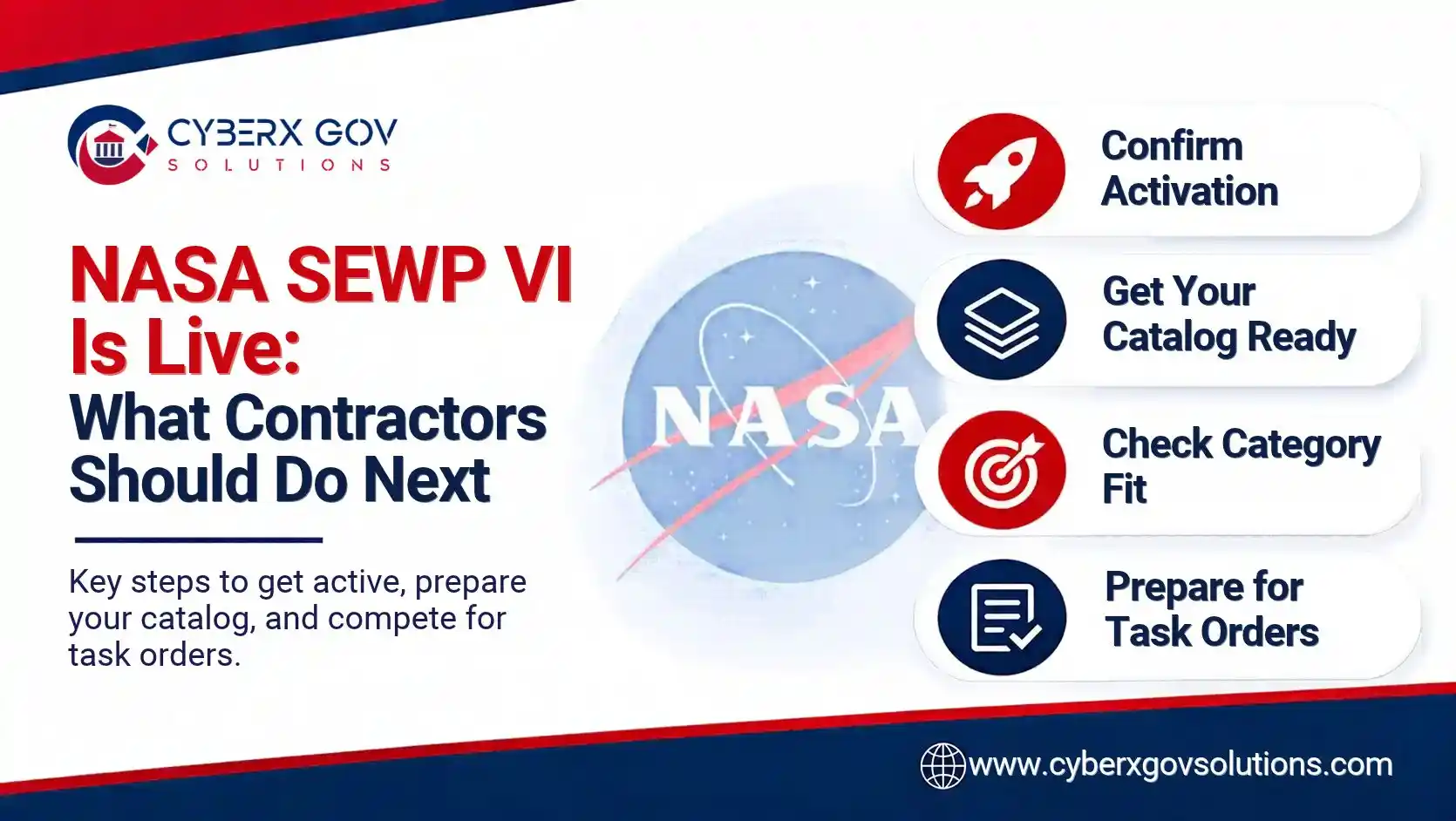
NASA SEWP VI is no longer a future opportunity. Ordering opened on November 1, 2026, and runs through October 31, 2036. For contract holders, the question has changed. It is no longer about winning a seat on the vehicle. It is about being ready to compete for the work.
Think of the SEWP VI launch as a starting line, not a finish line. An award proves you made the cut. It does not prove your company can quote on day one.
We covered the award announcement and the category structure in our NASA SEWP VI awards breakdown. This update looks at what comes next: activation, quote readiness, the SEWP V transition, and the steps to take before your next response.
What Changed When SEWP VI Opened
The headline change is simple. Ordering has started, and it will run for ten years with no options.
But a vehicle-wide launch and a single company’s readiness are two different things. Being on the contract does not automatically mean you can send a quote.
NASA’s onboarding guidance separates the contract’s effective date from the contractor’s active date. Both have to be completed before you can provide quotes or receive orders, and the active date depends on finishing your onboarding steps.
So the first question every awardee should answer is direct. Is our company active, or are we still treating the award as proof that everything is ready?
An Award Is Not an Active Contract
A SEWP VI award is a real milestone. It does not replace the work needed to go operational.
NASA’s guidance points to several pieces of that work, including program contacts, contract deliverables, a dedicated contractor webpage, and approved offerings in the SEWP database. Your contract, its modifications, and program-office instructions tell you what is still open.
Start with a short internal review:
- Confirm your active status with your SEWP program manager.
- Check access to the Contract Holder Only Page (CHOP).
- Verify that your program manager and deputy details are current.
- Clear any outstanding onboarding actions and deliverables.
- Confirm your SEWP VI webpage meets the requirements.
- Check that the products, services, and labor categories you plan to quote are on contract.
This is not busywork. NASA’s guidance says quoted offerings must be on contract and correctly priced. You can build a strong technical response and still stall over a catalog gap you could have caught early.
Your Catalog Is Part of Quote Readiness
Many teams treat catalog maintenance as separate from proposal work. Under SEWP VI, the two have to move together.
Offerings must be placed on contract through NASA’s Technology Refreshment process before you can quote them. That applies across the board, including services and labor categories, not just hardware.
The lesson is plain. Do not wait for a request to land before you find out whether you can even quote the solution you want to sell.
Before you chase a requirement, check a few things:
- Every proposed offering is under contract.
- Descriptions match the actual solution.
- Pricing is current.
- Proposed providers are approved and correctly named.
- Your delivery commitments are realistic.
NASA’s Quote Request Tool checks submissions for on-contract offerings and proper pricing. If an offering fails that check, the quote does not reach the customer. Catalog readiness is part of getting your response in front of the buyer.
Category Fit Decides What You Can Pursue
SEWP VI brings products and services into one framework, but it does not make every contract holder eligible for every requirement.
Each category has its own scope. Eligibility depends on your awarded category, the customer’s selected NAICS code, business-size rules, and other buyer-specific requirements.
| Category | General focus |
| Category A | IT, communications, and audiovisual products and product-based solutions |
| Category B | Enterprise-wide IT service solutions |
| Category C | Mission-based IT service solutions, made up of small businesses |
Per NASA, Category C consists of small businesses, and large businesses are not currently available under it. NASA also notes that Categories B and C share scope, which creates some overlap. Set-asides still happen at the order level, where the contracting officer decides whether an order is unrestricted or reserved for a socio-economic group such as 8(a), HUBZone, or Women-Owned Small Business.
Treat category and eligibility as an early bid decision, not something you sort out after drafting starts.
SEWP V Has Not Disappeared
The SEWP VI launch did not end SEWP V on November 1.
NASA has moved to extend SEWP V through January 31, 2027. That creates a transition window where you and your customers need to be clear about which vehicle you are using.
The two contracts are separate. NASA’s transition guidance makes the rules clear:
- SEWP V catalogs, BPAs, and related information do not carry over to SEWP VI.
- A requirement solicited under SEWP V must be awarded under SEWP V.
- A requirement solicited under SEWP VI must be awarded under SEWP VI.
- A quote under one vehicle has no standing under the other.
If you hold both contracts, do not assume your SEWP V setup follows you. Review your customer-facing materials, templates, and catalog references so your team and the buyer can see which vehicle supports each purchase.
Build a Response Process Before the Next Request
Once activation and catalog issues are handled, execution is the next test. NASA points to the Quote Request Tool as its recommended way for customers to request quotes, with responses submitted through the CHOP quote tool.
Clear ownership keeps a request from stalling while sales, pricing, and contracts decide who owns it. A repeatable process covers five moves:
- Make the bid decision early. Confirm category fit, eligibility, available offerings, delivery capacity, and a real business reason to compete. NASA does not ask you to quote everything.
- Turn the request into a checklist. Capture every attachment, instruction, requirement, pricing element, and deadline, and assign an owner to each.
- Check pricing and offerings before drafting ends. Confirm the solution can be quoted under the contract, and fix gaps while there is still time.
- Validate staffing and delivery. Match labor categories and personnel to the request. For cleared roles, confirm clearance and availability rather than assuming a pipeline.
- Review the full response. Check that the technical approach, pricing, staffing, attachments, and delivery dates all agree before you submit.
On security, NASA’s guidance notes that CMMC is not a SEWP VI contract-level requirement. Specific requirements can still appear in an issuing agency’s request and get checked at the quote level.
Didn’t Win a SEWP VI Seat?
Not holding a prime contract does not shut you out of the SEWP market. NASA separates prime contract holders from industry providers, a group that includes manufacturers and service providers supporting those primes.
NASA directs interested providers to contact current contract holders about adding offerings or partnering. For non-awardees, that is a clear next step: find primes whose categories, customers, and solution areas line up with what you offer. Our guide to small business teaming covers how to build those relationships.
NASA also says more contract holders may be added through a future on-ramp, which would be announced through SAM.gov. That is a possibility to watch, not an open door today.
What to Prioritize Now
The launch is a useful checkpoint. Before you add more opportunities to the pipeline, make sure your team can act on the ones you already qualify for.
- Verify activation and clear remaining onboarding actions.
- Confirm your offerings and labor categories are on contract and priced.
- Check category, NAICS, and size eligibility before committing proposal resources.
- Keep SEWP V and SEWP VI references, catalogs, and processes separate.
- Give each request an owner, a compliance lead, and a submission lead.
- Validate staffing and delivery against what the quote promises.
You do not need to pursue every request. You need a repeatable process for the ones you are positioned to win and deliver.
How CyberX Gov Solutions Can Help
The next stage of SEWP VI puts pressure on the work behind the response: reading requirements, building a compliant submission, validating staffing, and hitting the deadline.
That is where CyberX Gov Solutions fits. Our proposal development services help you prepare structured, compliant federal responses. Our cleared recruitment support helps teams fill specialized and cleared roles. And Get Fed Ready™ helps you strengthen your federal-market foundation and bid readiness.
The right support depends on the gap. A contract holder with an active catalog may need proposal capacity. A services team may need qualified people. A provider chasing prime relationships may need sharper positioning.
Conclusion
The SEWP VI launch rewards the companies that treat an award as the start of the work, not the end of it. Activation, catalog readiness, category fit, and a clean SEWP V handoff are what turn a seat on the vehicle into real orders.
Get those basics right, and your team can move fast when the right request lands.
Need help getting SEWP VI ready or responding to your next task order? Talk to the CyberX Gov Solutions team or schedule a consultation at cyberxgovsolutions.com/schedule-a-meeting/.
Frequently Asked Questions
Has NASA SEWP VI officially launched?
Yes. The ordering period began on November 1, 2026, and new orders will be accepted through October 31, 2036. It is a 10-year ordering period with no options.
Can every SEWP VI awardee submit quotes right away?
Not necessarily. Both the contract’s effective date and your company’s active date must be reached first, and the active date depends on completing your onboarding steps.
Do services and labor categories need to be on contract before quoting?
Yes. NASA requires quoted offerings, including services and labor categories, to be on contract and priced before the quote is submitted.
Is SEWP V still available?
NASA has moved to extend SEWP V through January 31, 2027. Follow the rules of the specific vehicle you are using, and do not assume SEWP V information transfers to SEWP VI.
Can a company take part without a SEWP VI prime contract?
Yes, through provider relationships. NASA directs interested manufacturers and service providers to contact current contract holders about adding offerings or partnering.
Which businesses can hold a Category C contract?
Category C consists of small businesses. NASA states that large businesses are not currently available under Category C, though small-business set-asides can appear at the order level across categories.