A polished proposal cannot rescue a bid your business never had a real shot at winning. That is the uncomfortable truth behind capture management vs proposal writing: by the time an RFP hits your inbox, much of the outcome is already decided.
Capture management is the work that happens before a solicitation exists. Proposal writing is the work that happens once it does. Confusing the two, or skipping the first one, is one of the most common reasons small businesses lose bids they were technically qualified to win.
This guide breaks down what each discipline actually covers, where the real work of winning starts, and how to connect capture and proposal writing instead of treating them as one rushed sprint.
Key Takeaways
- Capture management is a pre-RFP process focused on intelligence, relationships, and positioning.
- Proposal writing is the post-RFP process that turns that positioning into a compliant, scored response.
- The Federal Acquisition Regulation (FAR) requires agencies to conduct market research before many acquisitions, which is exactly the window capture activity should influence.
- Teams that treat capture and proposal writing as one last-minute task usually produce weaker, less targeted proposals.
- Small businesses without a dedicated capture function can still compete by strengthening the proposal phase and building capture habits over time.
What Capture Management Actually Means
Capture management is the process of identifying a specific government opportunity early, researching the customer’s needs, engaging stakeholders, and shaping your company’s position before the formal solicitation is released.
Capture management is proactive by design. It includes tracking upcoming opportunities through procurement forecasts, understanding an agency’s mission and budget, and building relationships with the people who will eventually evaluate a proposal. Under FAR Part 10, agencies must conduct market research before many acquisitions, which means they are actively seeking capable vendors during this exact window.
A capture manager owns this phase. Their job is to answer one question honestly: does our company have a real chance of winning this, and what do we need to do before the RFP drops to improve our chances?
Capture Management vs Proposal Writing: Who Owns Which Job
In larger firms, a dedicated capture manager runs this process full time. In small businesses, the same work often falls to a founder, business development lead, or program manager, who juggles it alongside other responsibilities. The job does not disappear just because no one holds the title. It just tends to happen in fragments, a conversation at an industry event here, a quick look at a procurement forecast there, instead of a documented, repeatable process.
What Proposal Writing Actually Means
Proposal writing is the process of responding to a released solicitation by producing a compliant, well-organized document that addresses all requirements and evaluation factors published by the agency.
Proposal writing starts once the RFP, RFQ, or RFI is public. It is deadline-driven, compliance-heavy, and focused entirely on the requirements in front of you. A proposal writer builds the compliance matrix, drafts the technical and management sections, and makes sure nothing in the solicitation goes unanswered.
Where capture management is exploratory, proposal writing is executional. The best proposal writers still make judgment calls about emphasis and framing, but they are working within a fixed set of rules the agency has already published.
Capture Management vs Proposal Writing: Timing, Goal, and Skill Set
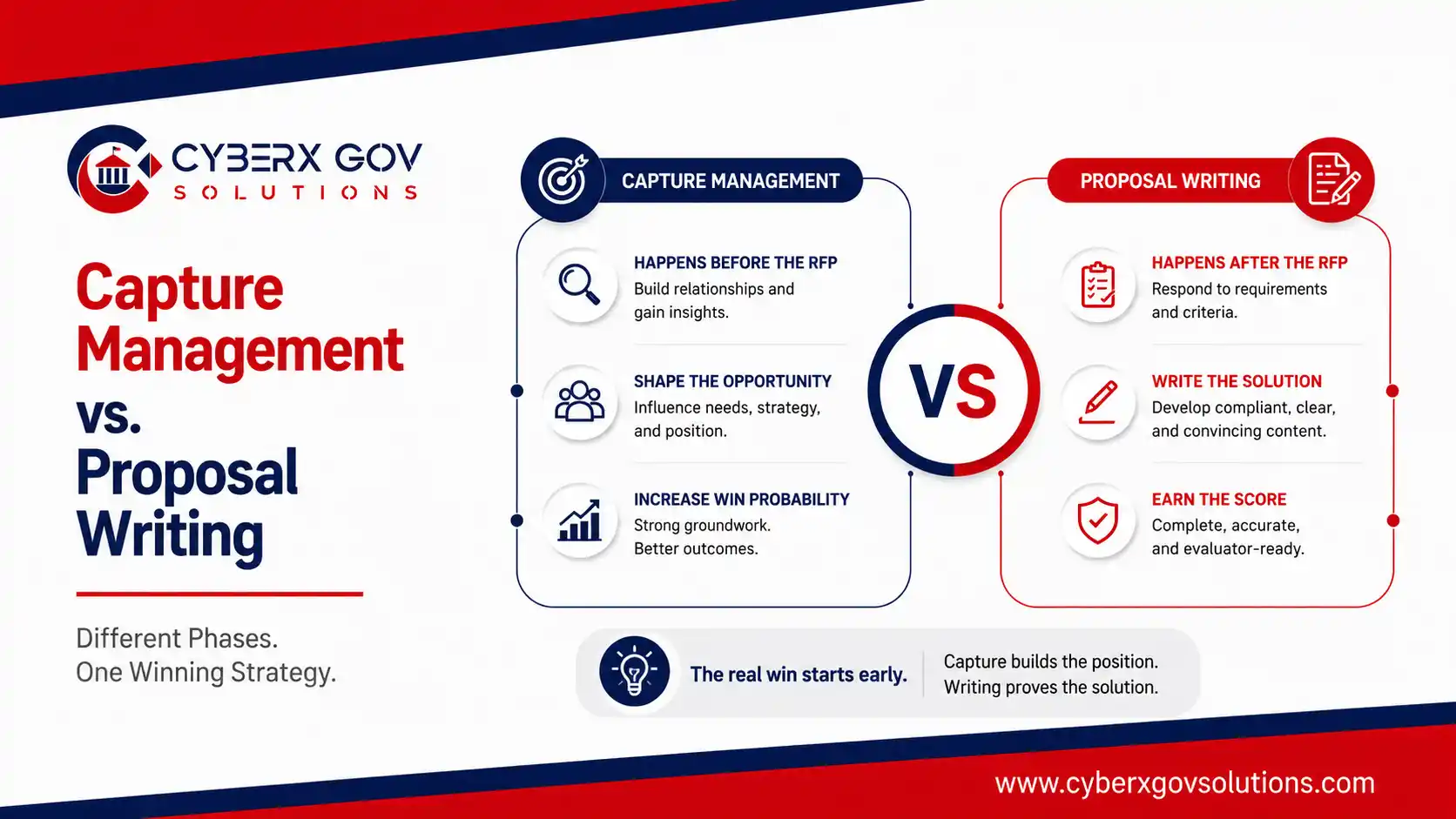
| Factor | Capture Management | Proposal Writing |
| When it happens | Before the RFP is released | After the RFP is released |
| Primary goal | Position the company to win | Prove compliance and value in writing |
| Key output | Capture plan, win themes, teaming decisions | Compliant technical, management, and pricing volumes |
| Driven by | Relationships, intelligence, strategy | Deadlines, requirements, evaluation criteria |
| Typical owner | Capture manager or business development lead | Proposal manager or proposal writer |
Neither column works well without the other. A capture plan with no proposal discipline behind it produces a great strategy that never gets written down correctly. A polished proposal built without capture input produces clean prose that answers the wrong questions.
Where the Win Actually Starts
Ask most experienced capture managers when a proposal is won, and they will tell you it is rarely during the writing phase. It is won or lost in the months leading up to it, when a company decides whether to pursue an opportunity, builds relationships with the customer, and lines up the right teaming partners.
Proposal writing still matters. A noncompliant or poorly written proposal can cause a well-positioned bid to lose. But strong writing cannot manufacture a win theme, a past performance match, or a customer relationship that was never built. The proposal documents the case that is already built.
Expert tip: If your team cannot describe the customer’s top priority for an opportunity before the RFP drops, that is a sign capture work started too late.
How Capture Feeds Into a Winning Proposal
The two functions work best as a handoff, not a merger. A strong capture effort typically produces:
- A clear win theme the proposal can build around instead of inventing one under deadline pressure.
- Validated past performance examples that map directly to the customer’s stated priorities.
- Teaming and subcontracting decisions made early enough to negotiate fair terms.
- Customer intelligence that shapes tone, emphasis, and risk areas in the technical volume.
- A realistic bid/no-bid decision made before resources go into drafting.
When capture hands off a documented plan instead of a verbal summary, the proposal team spends less time guessing and more time writing. That handoff does not need to be elaborate. Even a short written summary of the customer’s priorities and the agreed win theme saves hours once the compliance matrix work begins.
Common Mistakes When Capture and Proposal Are Treated as One Job
Compressing both jobs into the same deadline is where most of the damage happens.
- Starting customer research after the RFP is already released.
- Writing a win theme from scratch during the proposal phase instead of validating one built during capture.
- Skipping a bid/no-bid decision and drafting a proposal for an opportunity the company was never positioned to win.
- Assuming past performance write-ups will fall into place without early research into what the evaluator actually wants to see.
- Letting the same person juggle capture and proposal writing simultaneously on a tight deadline, with neither getting full attention.
Best Practices for Connecting Capture and Proposal Teams
A few habits make the handoff between the two functions far less painful.
- Document capture findings in a written capture plan, not just team memory.
- Hand off win themes and past-performance matches before the compliance matrix is built.
- Involve the eventual proposal writer in late-stage capture conversations so nothing gets lost in translation.
- Revisit the bid/no-bid decision one more time when the RFP is finally released, since requirements can shift from what capture expected.
- Track long-term customer relationships even for opportunities you do not win this cycle.
When Small Businesses Need Outside Proposal Support
Not every small business can staff a full-time capture manager, and that is normal. Many still compete successfully by applying more discipline to the proposal phase: building a real compliance matrix, writing targeted past-performance narratives, and coordinating pricing and technical content under a single strategy.
Outside proposal support becomes especially valuable when a solicitation is complex, the deadline is tight, or the business is bidding for the first time without a documented capture history to draw from. It also helps when internal staff are stretched between running current contracts and chasing new ones, which is common for growing contractors without a dedicated business development team.
How CyberX Gov Solutions Can Help
CyberX Gov Solutions supports the proposal side of this equation through its Proposal Development services, including proposal strategy and win theme development, compliance matrix creation, and writing across technical, management, and past performance sections. That strategy work picks up wherever your capture research leaves off and turns it into a compliant, submission-ready proposal.
If your business is still building the fundamentals for federal work, from SAM.gov registration support to capability statement development, the Get Fed Ready™ program helps lay that groundwork before your next pursuit.
Conclusion
Capture management and proposal writing solve different problems on the same timeline. Capture shapes whether you have a real chance to win. Proposal writing proves that case on paper once the rules are set. Comparing capture management vs proposal writing is not really a competition. Both have to work together, in the right order, for either one to pay off.
Businesses that build even a lightweight capture habit before the RFP drops give their proposal team a real story to tell, rather than a blank page and a deadline.
Ready to Strengthen Your Proposal Strategy?
Whatever side of capture management vs proposal writing your business needs help with, a strong proposal has to carry that positioning across the finish line. CyberX Gov Solutions helps small businesses turn strategy into a compliant, competitive submission. Schedule a free consultation at cyberxgovsolutions.com/schedule-a-meeting/ to talk through your next opportunity.
Frequently Asked Questions
What is the main difference between capture management and proposal writing?
Capture management happens before a solicitation is released and focuses on positioning, relationships, and intelligence. Proposal writing happens after release and focuses on producing a compliant, well-organized response to the published requirements. One shapes your chances; the other documents your case.
Does a small business need a dedicated capture manager?
Not necessarily. Many small businesses handle capture informally through a founder or business development lead rather than a dedicated hire. What matters more is that the work happens consistently, even without the title, so the proposal team is not starting from zero.
Can a great proposal make up for weak capture work?
Rarely. A well-written proposal can present a case clearly, but it cannot invent a customer relationship, a validated win theme, or a past performance match that was never developed. Strong writing supports a good position; it does not create one.
When should capture management start for a new opportunity?
Capture should start as soon as an opportunity is identified through procurement forecasts or agency engagement, often months before a formal RFP is released. FAR Part 10 requires agencies to conduct market research before many acquisitions, which creates the exact window capture work should target.
What does a capture plan usually include?
A capture plan typically documents the customer’s mission and priorities, competitive landscape, teaming or subcontracting decisions, win themes, and a bid/no-bid recommendation. Handing this document to the proposal team saves significant time once the RFP is released.
Is capture management the same as business development?
No. Business development is the broader, ongoing effort to build relationships and identify opportunities across an entire pipeline. Capture management is opportunity-specific, focused on a single pursuit once it has been identified as worth chasing.