Every government contractor has lived some version of this. You win the contract. You celebrate for about a day. Then the clock starts.
Now you have 30, 60, maybe 90 days to fill cleared roles the government spent months funding and your team spent weeks winning. And somewhere between the offer letter and the start date, it stalls.
That stall isn’t just annoying. It costs you real money, and most contractors quietly eat that cost instead of fixing it. So let’s break down what slow clearance hiring actually costs you, why it keeps getting worse, and how the right approach fixes the speed problem.
Slow Clearance Hiring Costs More Than a Delayed Start Date
When cleared hiring drags, the damage rarely shows up where you’d expect. It hides.
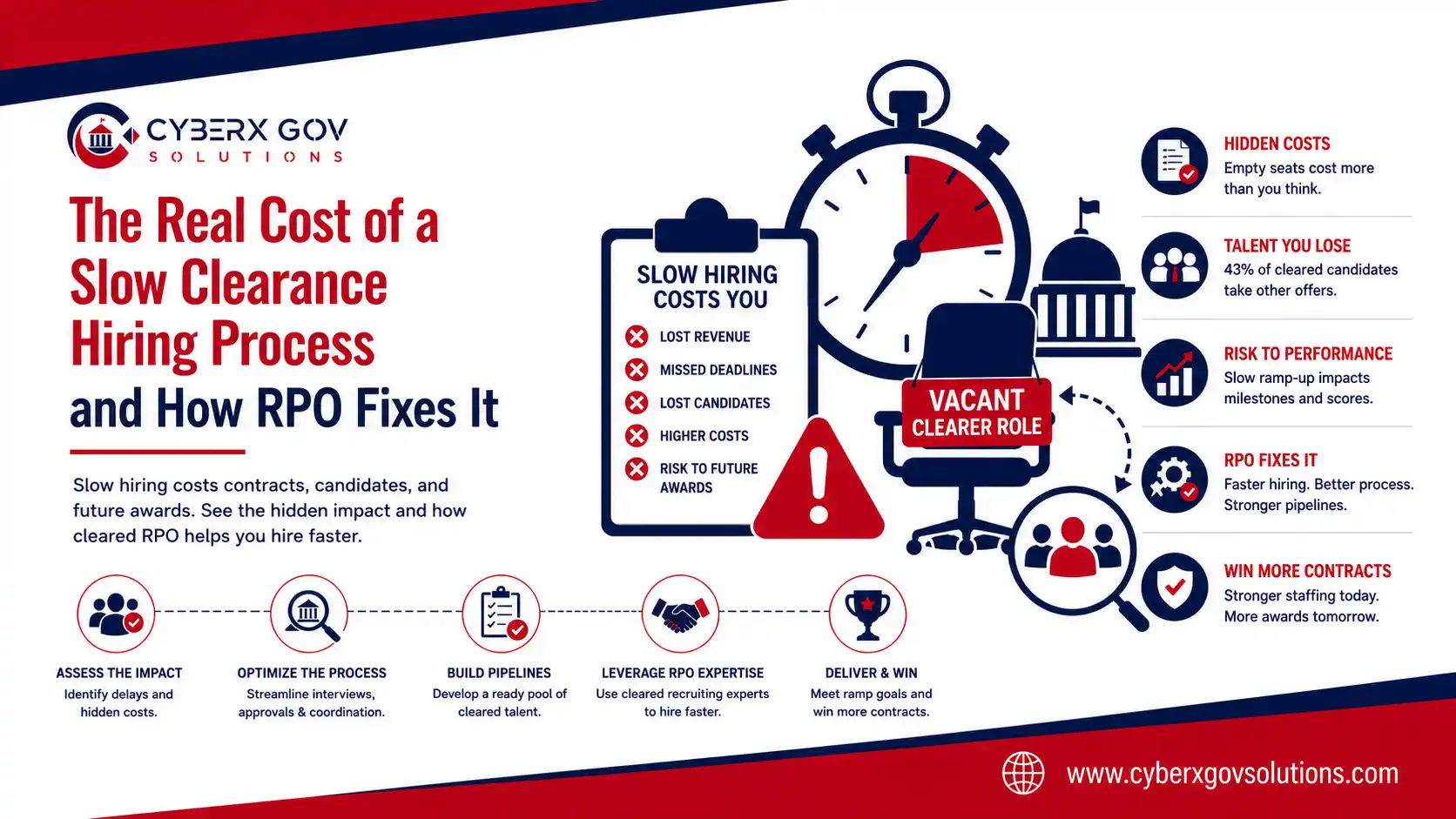
It puts contract performance at risk. Your staffing plan promised a certain ramp-up speed back at proposal time. When real hiring falls behind that promise, your program managers are the ones explaining empty seats to a government customer. That customer doesn’t care why the seat is open. They care that it is.
It costs you candidates. Cleared professionals in cybersecurity, cloud, and DevSecOps aren’t sitting around waiting through a six-week interview cycle. The numbers prove it. In the 2025 ClearanceJobs Cleared Recruiting Guide, recruiters said 43% of their offer rejections came from people who took a competing offer instead. Move slow, and you hand your best candidates to a faster competitor.
It snowballs. Every role that blows past its fill date rolls into the next hiring cycle, right on top of whatever new requirements just landed. Before long, your recruiters aren’t working a plan. They are putting out fires.
It follows you into your next bid. A reputation for slow ramp-up sticks. Under Federal Acquisition Regulation (FAR) 15.305, the rulebook agencies use to score proposals, reviewers weigh your staffing plan, key personnel, and past performance. Past performance alone can drive 20% to 30% of a best-value score. So slow staffing today can quietly cost you points on tomorrow’s award.
None of this ever shows up on a P&L line labeled “cost of slow hiring.” It shows up as missed milestones, tense client calls, and burned-out recruiters chasing people who already moved on.
The Hidden Math: What One Empty Seat Really Costs
Let’s put an actual number on it. According to the U.S. Bureau of Labor Statistics, a typical information security analyst earned a median $124,910 in 2024. Spread that over roughly 260 working days and a single seat is worth about $480 a day in salary alone.
On a billable contract, the real hit is bigger. An empty seat isn’t just unspent salary. It’s revenue you can’t bill. Now stack that across a task order that needs a dozen cleared analysts. A 30-day slip stops being a scheduling headache. It turns into a five- or six-figure hole in your quarter.
That’s the cost almost nobody calculates. It’s also the one that hiring speed controls directly.
Why Clearance Hiring Keeps Getting Harder
This isn’t a bad month that passes. A few things are working against you at once.
There aren’t enough cleared people. The number of folks holding active clearances sits well below its 2013 peak of about 5.1 million, and it hasn’t kept up with demand. That same ClearanceJobs research found 56% of recruiters call the shortage of cleared candidates their single biggest challenge.
Cyber roles are booming. BLS expects jobs for information security analysts to grow 29% between 2024 and 2034. Compare that to 3% for the average job. A big chunk of that growth lives inside cleared programs.
Cleared pros compare you to Big Tech. They expect quick decisions, strong pay, and a smooth process. A slow, form-heavy interview cycle reads like a warning sign before they even start.
Clearance timelines are a moving target. This is the piece most contractors get wrong, so it’s worth slowing down on.
Clearance Processing Is Not the Same as Time-to-Fill
These two clocks get mashed together, and that confusion is exactly where slow hiring hides.
The government clock covers the background investigation and adjudication. The Defense Counterintelligence and Security Agency (DCSA) reported investigations running about 243 days start to finish in mid-2025. You don’t control that clock, and you never will.
The contractor clock covers everything else: sourcing, scheduling interviews, internal sign-offs, and getting the offer out. ClearanceJobs puts the typical time to fill a cleared IT role at 41 to 60 days. You control that clock completely.
So when someone blames “the clearance process” for a slow hire, they are usually blaming the government clock for delays that actually sit on the contractor clock. That’s the fixable time. That’s where you win or lose.
How RPO Fixes the Speed Problem
Here’s the good news: most of what slows cleared hiring is fixable. Recruitment process outsourcing (RPO) isn’t just “staffing, but outsourced.” Done right, it goes straight at the things that bog cleared hiring down. A real partner works inside your process from day one, not as a vendor you call once a requisition has already gone cold.
In practice, that looks like:
- Pipelines built before you need them. Instead of starting from zero on award day, a good partner keeps warm relationships with cleared candidates in the labor categories you hire for again and again. Sourcing turns into activating.
- Sorting roles during capture, not after. The sharpest contractors flag roles as speed-critical or flexible while they are still writing the proposal. Cyber, cloud, and intel roles get the fast lane. Roles that can wait get a longer runway. Bring that partner in early and your staffing plan becomes something you can actually run, not a document you rediscover at award.
- A dedicated bench, not a scramble. RPO recruiting means a team that knows your labor categories, your clearance needs, and your customers cold. It isn’t one generalist juggling a dozen unrelated searches.
- Faster internal handoffs. A lot of delay has nothing to do with candidates. It’s scheduling, offer approvals, and onboarding paperwork, all the stuff that piles up inside your own walls. An experienced partner brings a process that has already been tested across other cleared programs.
The payoff is simple. Move people from interested to hired in days instead of weeks, and you protect your delivery timeline, your reputation, and your next award all at once.
What This Looks Like in Practice
Picture a mid-size contractor that just landed a task order. It needs a dozen cleared cybersecurity analysts in 60 days.
From a cold start, that’s a gamble. But with a partner who already has a warm pipeline of cleared cyber talent, a proven interview-to-offer workflow, and a team focused on that exact labor category? Sixty days turns into a plan you can trust.
That’s the whole point. Not just filling seats, but filling them fast enough that speed becomes your edge instead of your recurring headache.
How CyberX Gov Solutions Can Help
CyberX Gov Solutions is a cleared recruitment partner built for this exact problem. We keep active, pre-screened, security-cleared pipelines across the labor categories federal contractors need most, and we match candidates to the clearance level your contract calls for, whether that’s Secret, Top Secret, or TS/SCI.
We work as an extension of your team, not an outside vendor. We handle time-sensitive hiring, pre-award recruitment planning, and ongoing pipeline management, so you aren’t kicking off a search the day a requisition already went cold.
If you’re staffing under contract pressure, prepping a proposal that lives or dies on staffing speed, or just tired of watching good candidates slip away during a slow interview cycle, we can help you fix it before it costs you the next contract.
The Bottom Line
Slow clearance hiring isn’t a paperwork problem. It’s a business problem with a price tag: revenue lost to empty seats, candidates lost to faster competitors, and a weaker hand on your next proposal.
Here’s the encouraging part. Most of that delay lives on the clock you control, not the government’s. And that’s exactly the clock a strong cleared recruitment strategy can reset.
Want to see what faster cleared hiring actually feels like? Let’s talk through where your hiring gets stuck and how a dedicated cleared recruitment partner can clear the bottleneck.
Schedule a free GovCon consultation at cyberxgovsolutions.com/schedule-a-meeting/
Frequently Asked Questions
How long does it take to get a security clearance?
It depends on the level and your background. As of early 2026, ClearanceJobs reported Secret clearances averaging around 156 days and Top Secret around 227 days, though tough cases can stretch past a year. If a contract needs someone sooner, an interim clearance can sometimes come through in days to a few weeks.
Can a company hire someone who doesn’t have a clearance yet?
Yes. A contractor can make a contingent offer and sponsor the candidate through the clearance process. The catch is that the company must hold a facility clearance and the role has to genuinely require access to classified information. Plenty of hires start exactly this way.
Can an employer sponsor a security clearance?
Yes, but it’s tied to a real need. You can’t apply for a clearance on your own. A government agency or a cleared contractor has to sponsor you for a specific role that requires access to classified information.
What is the difference between an active and a current clearance?
An active clearance means you’re in a role using it right now. A current clearance means you’ve left a cleared job but are still inside the roughly 24-month window to reactivate without a full new investigation. Miss that window and it expires.
How long does it take to fill a cleared position?
ClearanceJobs data puts a typical cleared IT role at 41 to 60 days to fill. That’s separate from the clearance investigation itself, which can add months. The hiring part is the piece you can actually speed up.
Is RPO different from a staffing agency?
Yes. A staffing agency usually places candidates one role at a time. A recruitment process outsourcing partner plugs into your team and owns the full pipeline, process, and candidate experience under your brand across many roles.
Why do cleared candidates decline offers?
Competing offers top the list. ClearanceJobs data shows roughly four in ten cleared offer rejections trace back to another employer moving faster, with pay the next biggest factor. Speed and a strong package both matter.
Does slow hiring really affect future contract awards?
It can. Federal evaluators look closely at your staffing approach and delivery track record under FAR 15.305. A history of slow ramp-up can weaken how a government customer scores your next bid.