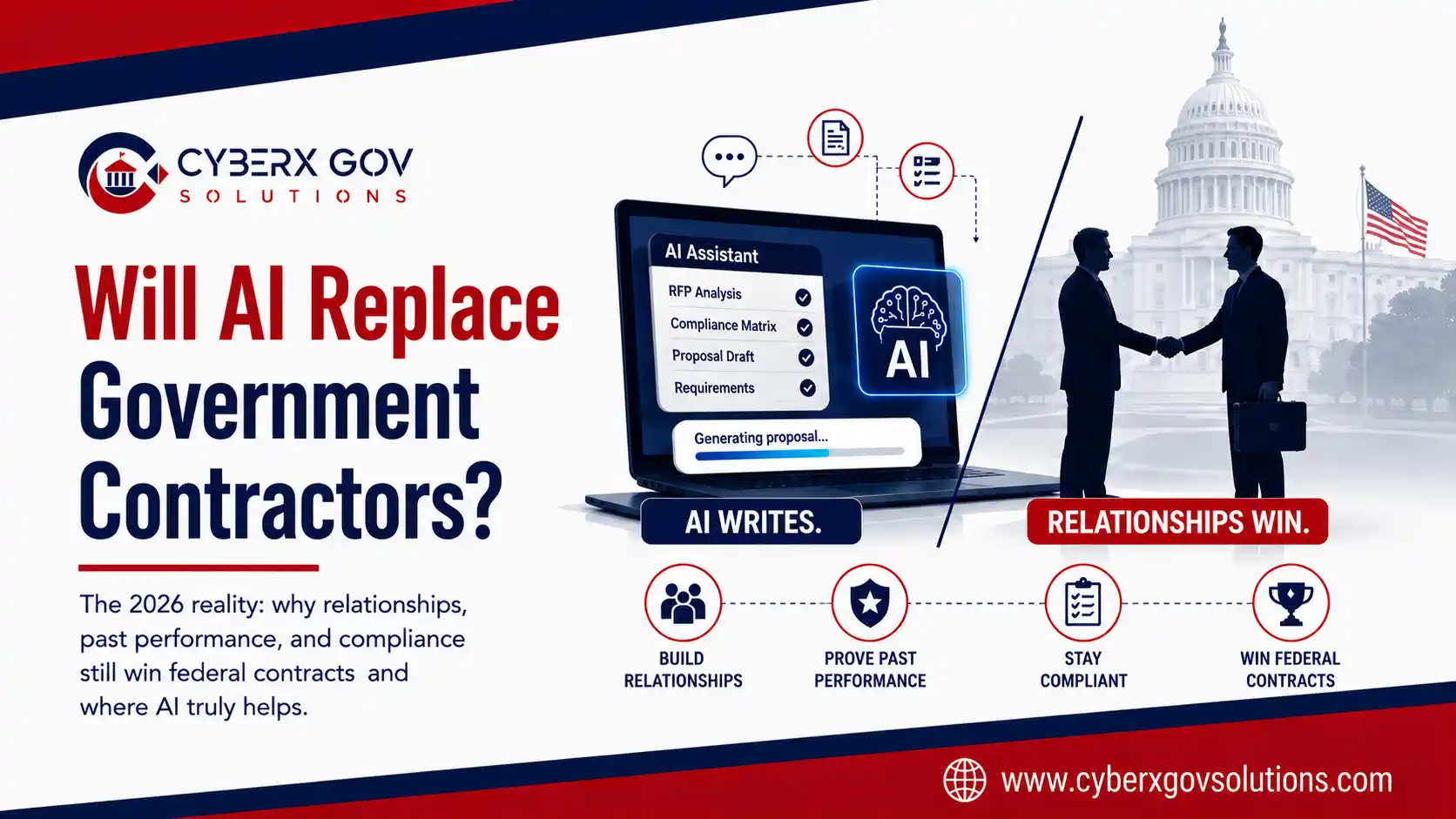
Paste a solicitation into an AI tool today, and you can have a clean, professional-looking proposal draft before lunch. That reality has a lot of people asking the same question: Will AI replace government contractors, consultants, and proposal writers in 2026?
The short answer is no. The longer answer matters more because AI is genuinely changing how federal contracting works. It is just not changing the part that decides who wins. Contracting officers do not award millions of dollars to the best-written document. They award it to the company they trust to perform.
This post breaks down what AI does well in federal contracting, why it cannot replace the work that wins contracts, and how smart contractors are combining both.
What AI Can Actually Do in Government Contracting
AI adoption in the federal market is real and growing fast. According to the 2025 Deltek Clarity GovCon Study, contractors spend more than seven hours developing the first draft of a single proposal, and 45 percent of contractors now use AI to streamline their operations.
Used well, AI is a genuine time saver. It handles the repetitive, mechanical parts of the bid process so your team can focus on strategy. Today’s tools can:
- Summarize a lengthy Request for Proposal (RFP) into a clear list of requirements and deadlines
- Draft a first-pass compliance matrix that maps every requirement to a proposal section
- Produce rough outlines and starting drafts for technical and management volumes
- Flag missing sections, formatting problems, or page limit issues before submission
- Speed up research on agencies, incumbents, and spending patterns
None of that is trivial. A small business without a dedicated proposal team can now produce cleaner, more compliant documents than it could five years ago. That is the honest upside.
The problem starts when contractors mistake faster writing for winning.
Why AI Will Not Replace Government Contractors
Think about the award decision from the government’s side. An evaluation team reviews your proposal, knowing that taxpayer money, mission deadlines, and their own accountability ride on the choice. A polished document generated by software answers none of their real questions. Can this company staff the work? Has it been delivered under similar conditions? Will it still be solvent in year three of the contract?
Text generation cannot answer those questions because they are not writing problems. There are credibility problems, and credibility gets built in three places that AI cannot reach.
1. Relationships built during market research
Agencies signal upcoming needs long before a Request for Proposal (RFP) appears. Sources sought notices, Requests for Information (RFIs), and industry days all exist so buyers can learn who is capable and shape their requirements accordingly. Contractors who show up at that stage get to influence how the opportunity takes shape and become a known quantity to the program office.
A software tool can draft your RFI response, but it cannot sit in the meeting, answer follow-up questions, or leave the buying office with a clear memory of your team.
2. Past performance that agencies can verify
The federal government keeps score through the Contractor Performance Assessment Reporting System (CPARS), which records how companies performed on prior contracts. Evaluation teams weigh that record heavily. On best-value awards, a bidder with a strong performance history can beat a cheaper competitor with a thin one, because a proven contractor represents less risk to the agency.
Agencies also verify references directly with previous customers, so padded or vague experience claims tend to surface during evaluation. AI can present your past performance well. It cannot create a record that does not exist.
3. Judgment on nuance and fit
Every solicitation is different. A template that won last quarter can lose this quarter because the evaluation criteria shifted, the incumbent situation changed, or the agency reorganized. Experienced consultants read those signals and make go or no-go decisions accordingly. Generic AI output tends to flatten exactly the details that evaluators score.
Early Positioning Beats Late Writing
Here is where many contractors get the AI question backwards. They worry about who writes the proposal, but the bigger factor is what happened in the months before it was due.
Federal procurement cycles often run from several months to well over a year. That long runway is your window to understand the requirement, meet the buying office, and shape your solution before the formal competition begins. Companies that only engage after the RFP is published are competing against firms that started positioning half a year earlier.
The practical sequence looks like this:
- Step 1: Identify which agencies and offices buy what you sell, and how much they spend
- Step 2: Respond to sources sought notices and Requests for Information (RFIs), then confirm receipt
- Step 3: Request meetings, attend industry days, and introduce your capabilities directly
- Step 4: Run a disciplined go or no-go review when the solicitation is released
- Step 5: Build a compliance matrix and write to the evaluation criteria, not around them
Notice where AI fits in that sequence. It can support steps 1, 4, and 5. It cannot do steps 2 and 3, and those are the steps where contracts are usually won or lost.
Common AI Mistakes That Cost Contractors Awards
AI misuse is now a real reason proposals lose. These patterns show up again and again:
- Letting a chatbot write the full proposal, producing generic text that ignores the agency’s stated evaluation factors
- Trusting AI summaries of the RFP instead of reading Sections L and M line by line
- Reusing one AI-polished template across different solicitations with different requirements
- Ignoring formatting instructions, such as font, point size, and page limits, which evaluators treat as a test of whether you can follow directions
- Pasting sensitive or proprietary pricing data into public AI tools that offer no data protection
The formatting point deserves emphasis. Solicitations spell out fonts, margins, page caps, and file structures, and evaluators enforce them. Pages beyond the limit can go unread, and non-compliant submissions can lose points or get set aside entirely. From the government’s side, the logic is simple. A company that cannot follow written instructions is a risky bet for complex contract work.
How CyberX Gov Solutions Can Help
CyberX Gov Solutions works on the human side of the equation that AI cannot cover. Our Proposal Development service takes companies through the full cycle: readiness assessment, compliance matrix and requirements mapping, win strategy, section writing, quality reviews, pricing narrative support, and final submission. We build each proposal around the specific solicitation, not a recycled template.
For businesses still preparing to enter the federal market, our Get Fed Ready program covers SAM.gov registration support, capability statement development, opportunity identification, and bid readiness planning, so you start the market research phase on a solid footing.
Conclusion
AI is a capable assistant, not a strategist. In 2026, it will keep shrinking the hours spent on drafts, outlines, and compliance checks. It will not attend your agency meetings, earn your CPARS ratings, or make your go or no-go calls. The contractors who win will be the ones who let AI handle the mechanical work while humans handle trust, relationships, and judgment.
If you treat AI as a replacement for that work, you become one more generic proposal in the pile. If you treat it as a force multiplier for a disciplined capture process, you gain real speed without losing what actually wins.
Thinking about your next federal bid? CyberX Gov Solutions helps small businesses and growing contractors build compliant, competitive proposals backed by a real capture process.
Schedule a free consultation at cyberxgovsolutions.com/schedule-a-meeting/.
Frequently Asked Questions
Can a contracting officer tell if AI wrote my proposal?
Often, yes. AI-generated text tends to be generic, repetitive, and loosely tied to the specific evaluation criteria. Even when it reads well, a proposal that lacks verifiable past performance and agency-specific detail signals risk to evaluators.
Is it against the rules to use AI on federal proposals?
There is no blanket ban, but some solicitations restrict or ask you to disclose AI-generated content, so read each RFP carefully. You remain contractually bound by every word you submit, whether a human or a tool wrote it.
What is a compliance matrix, and why does it matter?
A compliance matrix is a table that maps every requirement in the solicitation to the exact section of your proposal that answers it. It keeps your response complete and easy to score, and it is one of the strongest safeguards against disqualification.
Can a new business with no past performance win a federal contract?
It is difficult at the federal level, which is why many advisors suggest building experience through smaller state, local, and education contracts first. Subcontracting under an established prime is another proven way to earn a track record.
How long does it take to win a government contract?
Federal procurement cycles commonly run from six months to eighteen months or longer, depending on the agency and contract type. Companies that engage during the early market research phase see far better returns than those that appear only after the RFP is published.
Which proposal tasks are safe to hand to AI?
First drafts, requirement summaries, outline building, and formatting checks are low-risk uses when a human reviews the output. Strategy, pricing decisions, relationship building, and final compliance sign-off should stay with experienced people.