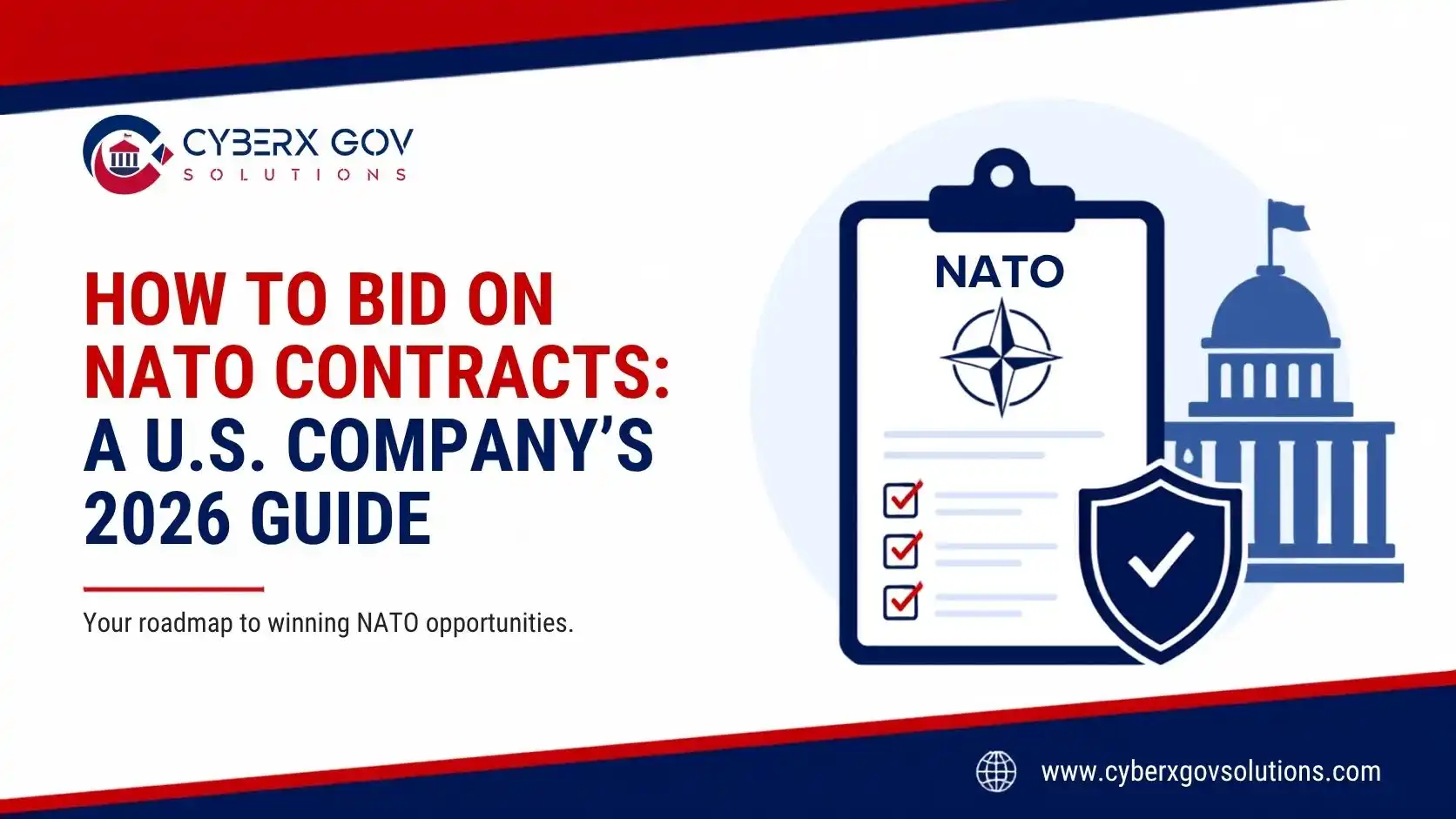
Think NATO only buys tanks, jets, and missiles? Think again. As this guide goes out, the alliance is actively hunting for commercial event management software from ordinary tech vendors.
And no, that is not a made-up example. Back in August 2026, NATO’s Allied Command Transformation posted a live bid, RFP-ACT-SACT-26-67, for a Commercial-off-the-Shelf event management platform. Bids closed on September 17, 2026. Any capable software firm could have gone after it.
So if you own a U.S. business and the question “how to bid on NATO contracts” has ever crossed your mind, stay with me. I will outline clear paths, show who qualifies, and walk through the steps to help you feel capable of winning these opportunities.
What “Bidding on NATO Contracts” Really Involves
This is where new bidders get lost. There is no single “NATO contracting” process. There are several of them, and they behave very differently from one another.
For a U.S. company, four main doors lead into NATO business.
First, NATO Competitive Procurement (NCP) and International Competitive Bidding (ICB): Think big, NATO-funded work: infrastructure, construction, major systems. Here, your own government has to put your name forward. For American firms, that nomination goes through the Department of Commerce.
Second, direct agency solicitations: NATO bodies such as Allied Command Transformation (ACT) issue their own Requests for Proposal, better known as RFPs. An RFP is simply the formal document an agency uses to invite bids. That COTS software opportunity I mentioned? It falls in this bucket, and you can reply to it yourself.
Third, registering as an NSPA supplier: The NATO Support and Procurement Agency, or NSPA, does most of the alliance’s buying for goods and services. Sign up as a vendor, and their tenders will start reaching you.
Fourth, selling through a GSA Schedule: Already hold a GSA Multiple Award Schedule contract? NATO buyers can pick up certain commercial products and services straight through it.
For most businesses, door two or door three is the natural starting point. Neither one asks for a government nomination.
Who Actually Qualifies to Bid
The headline rule is straightforward: your company must be based in a NATO member country and be legally cleared to operate where the work occurs. For U.S. firms, this is automatic, but understanding any additional requirements or restrictions can help you confirm eligibility confidently.
After that, understanding the eligibility details becomes crucial. Clarifying this helps you feel more confident and reduces confusion about the process.
The Declaration of Eligibility, without the mystery
Search around, and you will bump into the phrase “Declaration of Eligibility” again and again, usually with zero explanation attached. Let me fix that.
On NCP and International Competitive Bidding projects, the U.S. Bureau of Industry and Security (BIS) issues a Declaration of Eligibility. This document nominates your firm for specific procurements, and understanding how to obtain and use it can prevent missed opportunities. Not all NATO bids require it, so knowing when it applies is crucial.
Now for the part people miss. That declaration is not a universal requirement across NATO.
Plenty of direct agency solicitations skip it entirely. The live COTS software RFP proves the point nicely. It never asks for a Declaration of Eligibility. What it wants instead is a Compliance Statement, where bidders confirm they have read the paperwork and that their offer meets the terms, alongside the eligibility rules baked into the RFP itself.
So when an article tells you a NATO bid “does not require a Declaration of Eligibility,” do not read that as “eligibility does not matter.” It simply means the check happens somewhere else, most often inside the RFP.
Bidding on NATO Contracts, Step by Step
Here is the working path, from a standing start to a bid in the box.
Step 1) Pick the route that suits you. Software, IT, and commercial services tend to run through direct agency RFPs or NSPA registration. Heavy infrastructure runs through NCP and International Competitive Bidding.
Step 2) Going the NCP route? Start at BIS. Submit the one-time BIS-4023P application to the Bureau of Industry and Security and get yourself pre-approved. That puts you in line to be nominated when specific projects come up.
Step 3) Register with the agencies you want to serve. You can self-register with NSPA, the NATO Communications and Information Agency (NCIA), Supreme Headquarters Allied Powers Europe (SHAPE), and Allied Command Transformation. Once you are in their systems, future tenders find their way to you.
Step 4) To find live opportunities, regularly check the ACT contracting page for SACT solicitations, the NSPA vendor portal for tenders, and SAM.gov for NATO International Competitive Bidding projects. Setting up alerts and subscribing to updates can help your business stay ahead of upcoming bids.
Step 5) Before you submit a bid, thoroughly reading the entire RFP is essential. This step ensures you feel prepared and confident that your proposal meets all requirements, increasing your chances of success.
Step 6: File on time, in the format they demand. NATO deadlines do not bend, and they are precise. The COTS RFP, for one, called for bids by 0900 hours on the closing date, delivered to a named office.
A Live Example: The NATO COTS Software RFP
Steps in the abstract only take you so far. Let us pin it to a real opportunity so the pieces click into place.
In the summer of 2026, Allied Command Transformation released RFP-ACT-SACT-26-67, a call for a Commercial-off-the-Shelf Event Management Software Platform. The customer was the NATO Headquarters Supreme Allied Commander Transformation, headquartered in Norfolk, Virginia.
The clock ran fast, and the dates were exact. Clarification questions had to reach the Contracting Officers by August 31, 2026. Bids themselves were due by 0900 hours on September 17, 2026.
Look closely at what this tells you. A software contract. Open to commercial vendors. No separate Declaration of Eligibility in sight. A qualified U.S. SaaS company could have answered it directly, provided it satisfied the RFP’s own eligibility terms and turned in the Compliance Statement.
This is precisely the opening the typical NATO-contracting article walks right past. Those pieces fixate on infrastructure and defense hardware. The truth is broader: NATO buys commercial technology too.
What the Other Guides Leave Out
The fundamentals are all over the internet. These next realities are much harder to find.
Approval is not overnight. BIS pre-approval and agency registration both take time to clear, so get moving long before a specific bid drops. Then you are ready the moment one appears.
Security rules can kick in. Some NATO work touches classified material and calls for facility or personnel clearances. Check the security terms on every solicitation before you commit resources.
Winning is the opening act, not the finale. NATO contracts come loaded with delivery, reporting, and compliance duties. Read those clauses while you are bidding, not after the award lands.
Format counts toward your score. A brilliant technical answer can still lose if the proposal ignores the required structure. Follow the RFP’s instructions down to the letter.
Key Takeaways
| If you want to… | Do this |
| Bid on large NATO infrastructure projects | Apply to BIS (BIS-4023P), then get a Declaration of Eligibility per project |
| Sell software, IT, or services | Register with NSPA and relevant agencies; respond to direct RFPs |
| Find opportunities | Watch the ACT contracting page, NSPA portal, and SAM.gov |
| Avoid disqualification | Read the full RFP and submit every required form on time |
How CyberX Gov Solutions Can Help
CyberX Gov Solutions is a U.S. federal contracting services firm. Our focus is helping small businesses and growing contractors get ready to compete and win, chiefly inside the U.S. federal market.
Here is the thing worth remembering: the habits that win federal contracts are the same habits that set you up for international ones. A clean registration, a sharp capability statement, a proposal that meets every requirement- all of it counts whether the buyer sits in a U.S. agency or a NATO command.
Our Get Fed Ready™ program helps businesses build that federal foundation piece by piece, from SAM.gov registration support to capability statement development to figuring out which opportunities actually fit. From there, our proposal development team helps you turn a target solicitation into a compliant, competitive bid, right through from the compliance matrix to final submission.
If NATO sits on your horizon, getting your U.S. federal footing solid first is simply the smart order of operations.
Conclusion
Bidding on NATO contracts is far more accessible than most U.S. businesses expect. The alliance buys software, IT, and services, not just hardware, and several of the ways in ask for no government nomination at all.
The companies that come out ahead are the ones that prepare early. They register before they need to, they know which eligibility rules apply to their chosen route, and they treat every line of an RFP as something to honor, not skim.
Start by getting your own federal house in order. A contractor who is ready for U.S. agencies is a contractor who is ready to compete just about anywhere.
Not sure where your business stands today?
CyberX Gov Solutions can help you size up your readiness and map out a plan to compete. Grab a free consultation at cyberxgovsolutions.com/schedule-a-meeting/.
Frequently Asked Questions
Do I have to be a U.S. company to bid on NATO contracts?
No. You generally need to be based in any NATO member nation and legally able to operate where the work is performed. U.S. companies qualify because the United States is a NATO member.
How long does it take to get approved to bid?
It depends on the route. BIS pre-approval and agency registration can take weeks, so apply well ahead of a specific opportunity rather than waiting for one to show up.
Where do NATO contract opportunities get posted?
Direct solicitations appear on NATO agency sites, such as the Allied Command Transformation contracting page and the NSPA vendor portal. Many International Competitive Bidding projects also show up on SAM.gov.
Can a small business or startup bid on NATO contracts?
Yes. Size by itself does not rule you out. What counts is meeting the eligibility terms in the solicitation and submitting a fully compliant proposal before the deadline.
What is the difference between NSPA and Allied Command Transformation?
NSPA is NATO’s main procurement and logistics agency for goods and services. Allied Command Transformation is a NATO command that also issues its own solicitations, covering things like research, IT, and software.
Does bidding on NATO contracts cost money?
There is no fee to register as a vendor or to submit a bid. The real cost is the time and effort it takes to put together a strong, compliant proposal.