A cleared job post says “TS/SCI required,” and a strong candidate hesitates, unsure what that means or whether they qualify. Hiring managers hit the same wall from the other side. The clearance line on a req decides who can even be considered.
Security clearance levels are simpler than they look, once you separate three things: the level, the investigation behind it, and the access it grants. Get those straight, and both hiring and job searching get much easier.
This guide explains each clearance level in plain English, clears up the TS/SCI confusion, and covers what it takes to hire or be hired at each one.
What Are Security Clearance Levels?
A security clearance is permission to access classified national security information. The United States uses three levels, set under Executive Order 13526. Each one matches the damage that unauthorized disclosure could cause.
- Confidential: disclosure could cause damage to national security.
- Secret: disclosure could cause serious damage.
- Top Secret: disclosure could cause exceptionally grave damage.
A clearance is not a key to everything at that level. It is eligibility. To see specific information, a cleared person also needs a “need to know,” meaning the information is required for their job.
The Three Clearance Levels Explained
Each level comes with its own background investigation and its own weight in the hiring market.
Confidential
Confidential is the lowest level. It protects information whose release could damage national security. It relies on a Tier 3 background investigation, the same tier used for Secret.
In practice, confidentiality is the least common level in the contractor world. Most industry roles call for Secret or higher.
Secret
Secret is the workhorse of cleared hiring. It protects information whose release could cause serious damage to national security, and it also uses a Tier 3 investigation.
Most cleared contractor jobs ask for a Secret Clearance. If you are new to cleared work, this is the level you will see most often.
Top Secret
Top Secret is the highest standard clearance. It protects information whose release could cause exceptionally grave damage to national security. It calls for a deeper Tier 5 investigation, which reviews a longer history, foreign contacts, finances, and personal interviews.
Because the investigation digs deeper, Top Secret takes longer to process and carries more weight in the job market.
What Is TS/SCI?
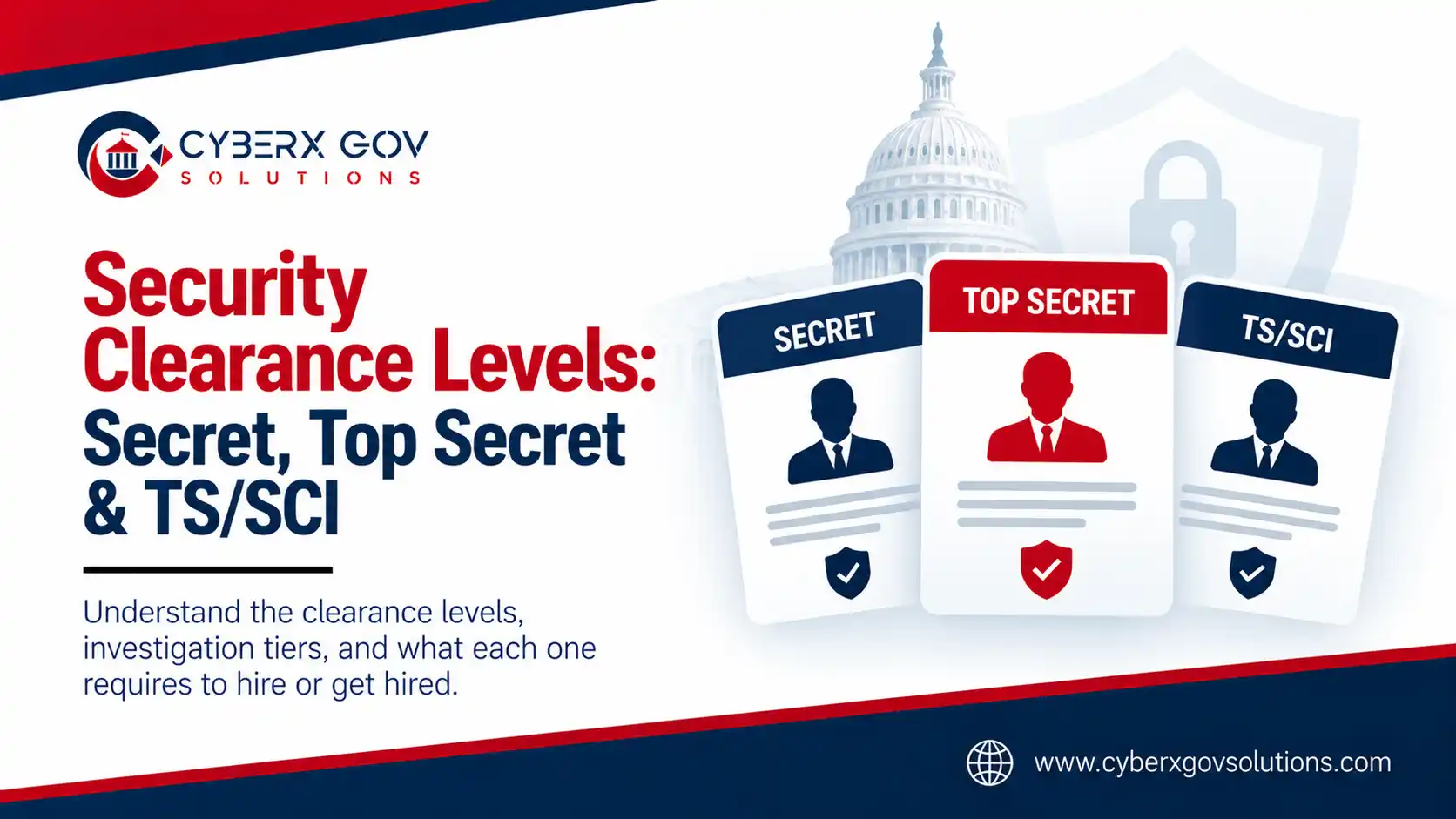
Here is the point that trips people up. TS/SCI is not a fourth clearance level. It is a Top Secret clearance plus access to Sensitive Compartmented Information.
SCI is highly protected information kept in separate compartments. To work with it, a person first holds a valid Top Secret clearance, then gets “read into” specific SCI programs by the office that controls them.
That access is program-specific. Being read into one compartment does not grant access to another. Each one carries its own need-to-know. Some SCI and special access roles also require a polygraph, which adds time and steps.
So when a posting says “TS/SCI,” it means two things at once: Top Secret eligibility and access to one or more compartments. A candidate with Top Secret alone is not automatically TS/SCI.
Clearance Levels at a Glance
This table sums up how the levels compare. Treat the timelines as general ranges, since every case differs.
| Level | Protects against | Investigation tier | Typical processing |
| Confidential | Damage to national security | Tier 3 | Weeks to a few months |
| Secret | Serious damage | Tier 3 | About 1 to 6 months |
| Top Secret | Exceptionally grave damage | Tier 5 | About 4 to 12 months |
| TS/SCI | Top Secret plus compartmented access | Tier 5 plus SCI read-in | About 6 to 18 months |
For a full breakdown of how long each one takes and what slows it down, see our guide to the 2026 security clearance timeline.
Clearance Levels vs Investigation Tiers
People mix up levels and tiers all the time, so it helps to pull them apart.
An investigation tier is the background check. A clearance level is the eligibility an adjudicator grants after reviewing that check. The tier does not grant the clearance by itself.
Two tiers matter for clearances. Tier 3 supports Confidential and Secret. Tier 5 supports Top Secret and SCI. Both start with the same form, the SF-86. What changes is how deep the investigation goes.
Hiring Requirements: What Each Level Takes
This is where the clearance level meets the real world of hiring. A few rules hold across all levels.
You cannot clear yourself. There is no way to apply for a clearance on your own. A cleared employer or a government agency has to sponsor you against a real position that requires access. No sponsor, no clearance.
Eligibility is not access. A granted clearance makes you eligible. Actual access still depends on need-to-know and, for SCI, a separate read-in. Employers should confirm both when they scope a role.
Adjudication follows set guidelines. After the investigation, an adjudicator weighs the file against the federal adjudicative guidelines in Security Executive Agent Directive 4. These cover areas like finances, foreign influence, and personal conduct.
Interim eligibility can start the clock sooner. Many candidates can begin work under interim eligibility while the full investigation continues, often for Secret and sometimes for Top Secret. Interim access is not available for SCI.
Already-cleared talent is the fastest hire. A candidate who already holds the right level, with a current investigation, can often transfer and start quickly. Clearances move between cleared employers through the Defense Information System for Security.
For employers, the lesson is simple. Match the clearance line on the req to the real access the job needs, then widen your pool with interim eligibility and already-cleared candidates where you can.
How Continuous Vetting Changed the Picture
The old model reinvestigated people on a fixed schedule, roughly every 15 years for Confidential, 10 for Secret, and 5 for Top Secret. That is changing.
Under Trusted Workforce 2.0, continuous vetting now runs ongoing automated checks instead of waiting years for a periodic review. An alert is a lead for follow-up, not an automatic loss of clearance.
Continuous vetting does not erase every periodic step. Under DCSA guidance issued in April 2026, cleared contractors still submit an updated questionnaire every five years. Enrollment also does not guarantee eligibility forever, so candidates should confirm their status with a security office.
Key Takeaways
- There are three clearance levels: Confidential, Secret, and Top Secret, set by Executive Order 13526.
- TS/SCI is not a separate level. It is Top Secret plus access to compartmented information.
- Tier 3 supports Confidential and Secret; Tier 5 supports Top Secret and SCI.
- You cannot self-apply. A clearance needs a sponsoring employer or agency and a need-to-know.
- Interim eligibility and already-cleared talent are the fastest ways to fill a cleared seat.
How CyberX Gov Solutions Can Help
Matching the right clearance level to the right role, fast, is its own skill. That is what our cleared recruitment service does.
CyberX Gov Solutions connects federal contractors with pre-screened, security-cleared professionals at the level the work requires, from Secret to Top Secret and TS/SCI. When a seat is funded and the clock is running, already-cleared talent is the fastest way to fill it, and we handle time-sensitive and urgent hiring built for that pressure.
The goal is simple: put the right cleared person in the right seat, without losing months to the wrong search.
Conclusion
Security clearance levels come down to three tiers of trust: Confidential, Secret, and Top Secret, plus the compartmented access that makes up TS/SCI. The level sets eligibility. Need-to-know, sponsorship, and the investigation behind it decide the rest.
Once you separate the level from the investigation and the access, cleared hiring stops being a guessing game. You can match the person to the role with confidence.
Need to fill a cleared role, or know what a req really requires?
Talk to the CyberX Gov Solutions team and get the right cleared person in the right seat, fast.
Schedule a Free Consultation →Frequently Asked Questions
What are the three levels of security clearance?
The three levels are Confidential, Secret, and Top Secret, set under Executive Order 13526. Each matches the damage that unauthorized disclosure could cause to national security, from damage at Confidential to exceptionally grave damage at Top Secret.
Is TS/SCI higher than Top Secret?
TS/SCI is not a higher clearance level. It is a Top Secret clearance combined with access to Sensitive Compartmented Information. The holder first earns Top Secret eligibility, then gets read into specific SCI compartments.
Can I get a security clearance on my own?
No. You cannot sponsor yourself. A cleared employer or a federal agency must sponsor you against a position that requires access to classified information.
What is the difference between a Secret and a Top Secret clearance?
Secret protects information whose release could cause serious damage and uses a Tier 3 investigation. Top Secret protects information whose release could cause exceptionally grave damage and uses a deeper Tier 5 investigation, so it takes longer to process.
Do security clearances expire?
A clearance stays active while you are in a role that needs it, and you remain enrolled in continuous vetting. The old fixed reinvestigation schedule is being replaced, but cleared contractors still submit an updated questionnaire every five years.
What is the fastest way to hire for a cleared role?
Hiring someone who already holds the right clearance level with a current investigation is fastest, since they can often transfer and start quickly. Interim eligibility can also let a candidate begin Secret or some Top Secret work while the full process continues.