Some of the fastest money in federal contracting changes hands without a single formal bid. A contracting officer or a cardholder buys what the agency needs, often on a government charge card, and the deal is done.
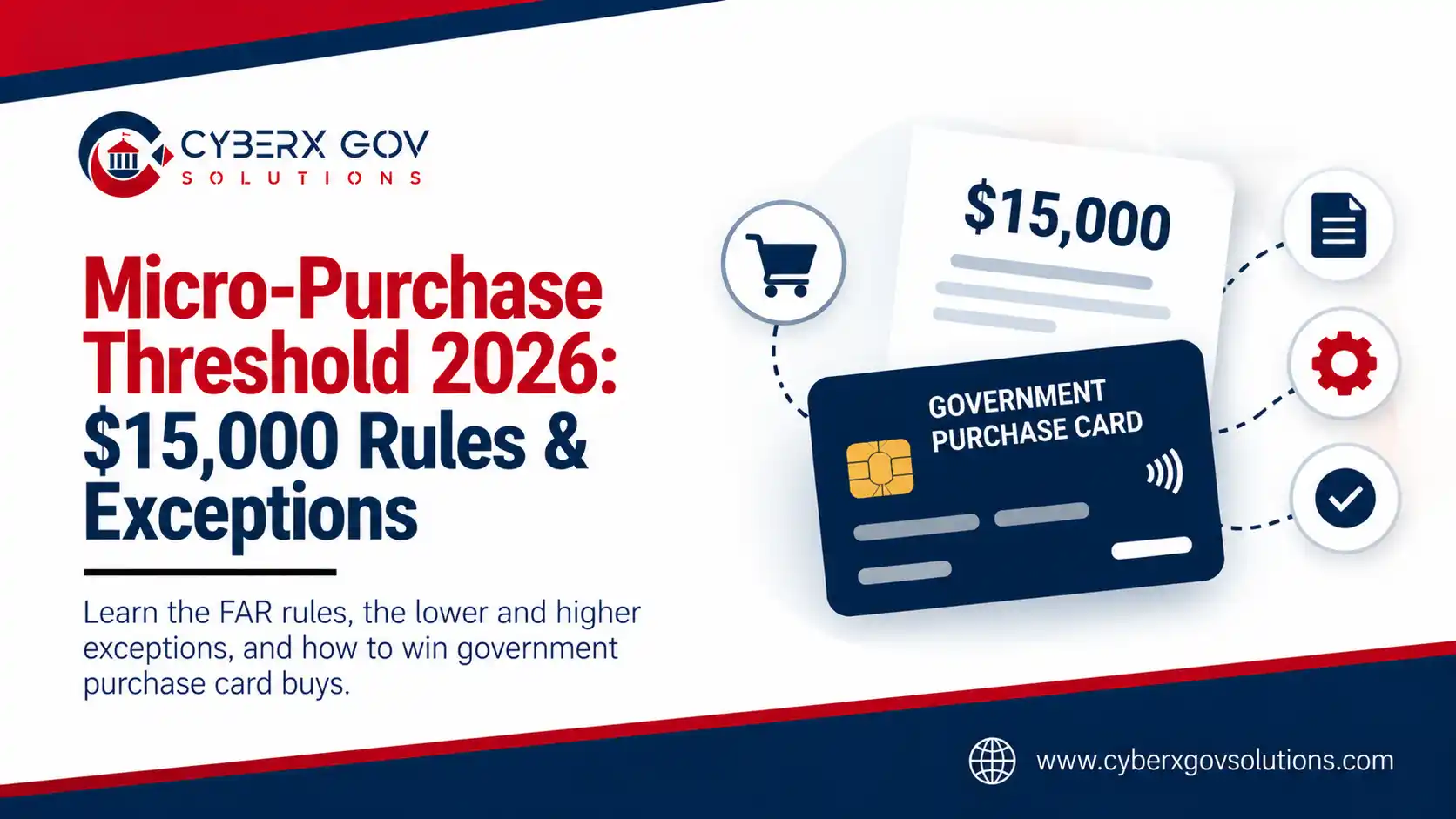
That lane is the micro-purchase threshold. As of 2026, it sits at $15,000. Purchases at or under that amount skip most of the red tape that slows larger contracts.
This guide covers what the micro-purchase threshold is, the exceptions that raise or lower it, the rules behind these buys, and how a small business can win more of them.
What Is the Micro-Purchase Threshold?
The micro-purchase threshold is the dollar limit below which agencies can buy goods and services with very little process. The Federal Acquisition Regulation defines it in FAR 2.101.
As of October 1, 2025, the general micro-purchase threshold is $15,000. It climbed from $10,000 that day, as part of a routine inflation adjustment the FAR Council makes every five years under 41 U.S.C. 1908. The Council issued the final rule on August 27, 2025, so any guide still citing $10,000 is a year out of date.
Below this line, buying is simple. No competitive quotes are required, as long as the price is fair. There is no small business set-aside to apply. And the purchase usually happens fast, often on a card.
Micro-Purchase Threshold Exceptions
The $15,000 figure is the general rule. FAR 2.101 sets several exceptions, some lower and some higher. Knowing them keeps you from quoting the wrong number.
| Situation | Micro-purchase threshold |
| General purchases | $15,000 |
| Construction subject to Davis-Bacon (Wage Rate Requirements) | $2,000 |
| Services subject to Service Contract Labor Standards | $2,500 |
| Contingency, emergency, or disaster response, inside the U.S. | $25,000 |
| Contingency, emergency, or disaster response, outside the U.S. | $40,000 |
| Institutions of higher education and nonprofit research organizations | $15,000, or higher if the agency head approves |
The two lower limits matter most in daily work. If a job involves construction covered by federal wage rules, the line drops to $2,000. If it involves services covered by labor standards, it drops to $2,500.
The higher limits apply in narrow cases, such as a declared emergency or a qualifying research institution. Always check the specific situation before you rely on a number.
How Micro-Purchases Work
Micro-purchases follow the streamlined rules in FAR Part 13. A few points define how they operate.
First, competition is light. Under FAR 13.203, a micro-purchase may be awarded without asking for competitive quotes, as long as the buyer considers the price reasonable. The buyer only has to check pricing when something looks off or no comparison is handy.
Second, the government purchase card is the preferred tool. FAR 13.201 names the Governmentwide commercial purchase card as the first choice to buy and pay for micro-purchases. That is the GSA SmartPay card you may have seen agencies use.
Third, the work has to be spread around. Under FAR 13.203, micro-purchases should be distributed equitably among qualified suppliers, to the extent practical. No single vendor is supposed to get every small buy.
Fourth, splitting is not allowed. FAR 13.003 bars breaking a requirement into smaller pieces just to stay under the threshold or to dodge rules that apply above it. A $40,000 need cannot be chopped into three $13,000 card buys.
Finally, micro-purchases sit below the small business reserve. The automatic set-aside, often called the Rule of Two, applies above that threshold and up to the simplified acquisition threshold. Micro-purchases fall under that band, so they are not formally reserved for small businesses. In practice, that is not a barrier for small vendors, since equitable distribution still steers plenty of these buyers their way.
A Quick Example
Picture an agency office that needs ten ergonomic chairs. The total comes to about $9,000. That sits under the $15,000 line, so a cardholder can buy the chairs outright.
No formal solicitation goes out. The cardholder finds a reasonable price, places the order, and pays with the government purchase card. If the same office later needs $9,000 in chairs and $9,000 in desks for one project, the buyer cannot split that into two card buys to stay under the limit. The combined need is one requirement.
For a vendor, the lesson is clear. If your chairs are easy to find, fairly priced, and quick to deliver, you can win that $9,000 order this week, with no proposal at all.
Micro-Purchase vs Simplified Acquisition Threshold
These two thresholds work together, and people mix them up often.
The $15,000 micro-purchase threshold is the floor for simple card buys. The simplified acquisition threshold, now $350,000, is the ceiling for the streamlined procedures that still involve quotes and a light competition.
In short, $15,000 and under is the micro-purchase zone. Above that, up to $350,000, is the simplified acquisition zone, where small business set-asides kick in. For a full breakdown of that higher band and the pending proposals to change it, see our guide to the simplified acquisition threshold in 2026.
How to Win Micro-Purchase and Purchase Card Buys
Micro-purchases are one of the best entry points for a new federal vendor. The buys are small, fast, and often repeated. Here is how to earn them.
- Accept the government purchase card. Agencies pay for micro-purchases by card. If you take card payments, you are easy to buy from.
- Be easy to find and buy. List your products on GSA Advantage and the commercial online marketplaces that agencies use for small buys. Visibility wins quick purchases.
- Build relationships with cardholders. The people making these buys are program staff and cardholders, not just contracting officers. A reliable contact often becomes a repeat customer.
- Keep your price fair and your quote fast. Buyers can skip competition when the price looks reasonable. A clean, quick quote removes any reason to look elsewhere.
- Deliver well, every time. Because buys should spread among qualified suppliers, being dependable keeps you on the short list for the next one.
- Register in SAM.gov. Even when a micro-purchase does not require it, an active SAM.gov registration makes you a credible, ready vendor for larger follow-on work.
The goal is simple. Make yourself the low-risk, low-effort choice for a busy cardholder, then turn one small buy into many.
Key Takeaways
- The 2026 micro-purchase threshold is $15,000, effective October 1, 2025.
- Lower limits apply to construction (2,500); higher limits apply in emergencies.
- Micro-purchases need no competitive quotes when the price is fair and are usually made on a purchase card.
- Agencies cannot split a requirement to stay under the threshold.
- Taking the purchase card and being easy to buy from are how small vendors win these deals.
How CyberX Gov Solutions Can Help
Winning small federal buys still takes real readiness. You have to be registered, findable, and set up to sell the way agencies buy.
CyberX Gov Solutions helps through the Get Fed Ready™ program, which covers federal readiness, SAM.gov registration support, capability statement development, and opportunity identification. We help you position for micro-purchases now and build toward larger contracts next.
The goal is simple: get you ready to sell to the government, from your first card buy to your first full proposal.
Conclusion
The micro-purchase threshold is the easiest door into federal spending. At $15,000 or under, buyers move fast, skip the heavy process, and often land on a government card.
Learn the number, respect the exceptions, and make yourself the simplest choice for a cardholder. Small, repeat buys build the past performance that opens bigger contracts later.
Want help getting ready to win federal buys at any size? Talk to the CyberX Gov Solutions team or schedule a free consultation at cyberxgovsolutions.com/schedule-a-meeting/.
Frequently Asked Questions
What is the micro-purchase threshold for 2026?
The general micro-purchase threshold is $15,000, effective October 1, 2025. It rose from $10,000 as part of the FAR Council’s five-year inflation adjustment under 41 U.S.C. 1908.
Do micro-purchases require competition?
No. Under FAR 13.203, a micro-purchase can be awarded without soliciting competitive quotes, as long as the buyer considers the price reasonable. The buyer verifies pricing only when a price looks unreasonable or no comparison is available.
Can an agency split a large purchase to stay under the threshold?
No. FAR 13.003 prohibits breaking a requirement into smaller buys just to use simplified procedures or to avoid rules that apply above the micro-purchase threshold.
Are micro-purchases set aside for small businesses?
Not automatically. The small business set-aside applies above the micro-purchase threshold and up to the simplified acquisition threshold. Still, micro-purchases should be spread equitably among qualified suppliers, which gives small vendors real access.
What is the micro-purchase threshold for construction or services?
It is lower. Construction subject to federal wage rules has a $2,000 micro-purchase threshold, and services subject to labor standards have a $2,500 threshold. Confirm which rules apply before you quote.
How do small businesses get paid for micro-purchases?
Usually, the government purchase card is the preferred payment method under FAR 13.201. Accepting card payments and listing on platforms agencies use makes you easy to buy from.