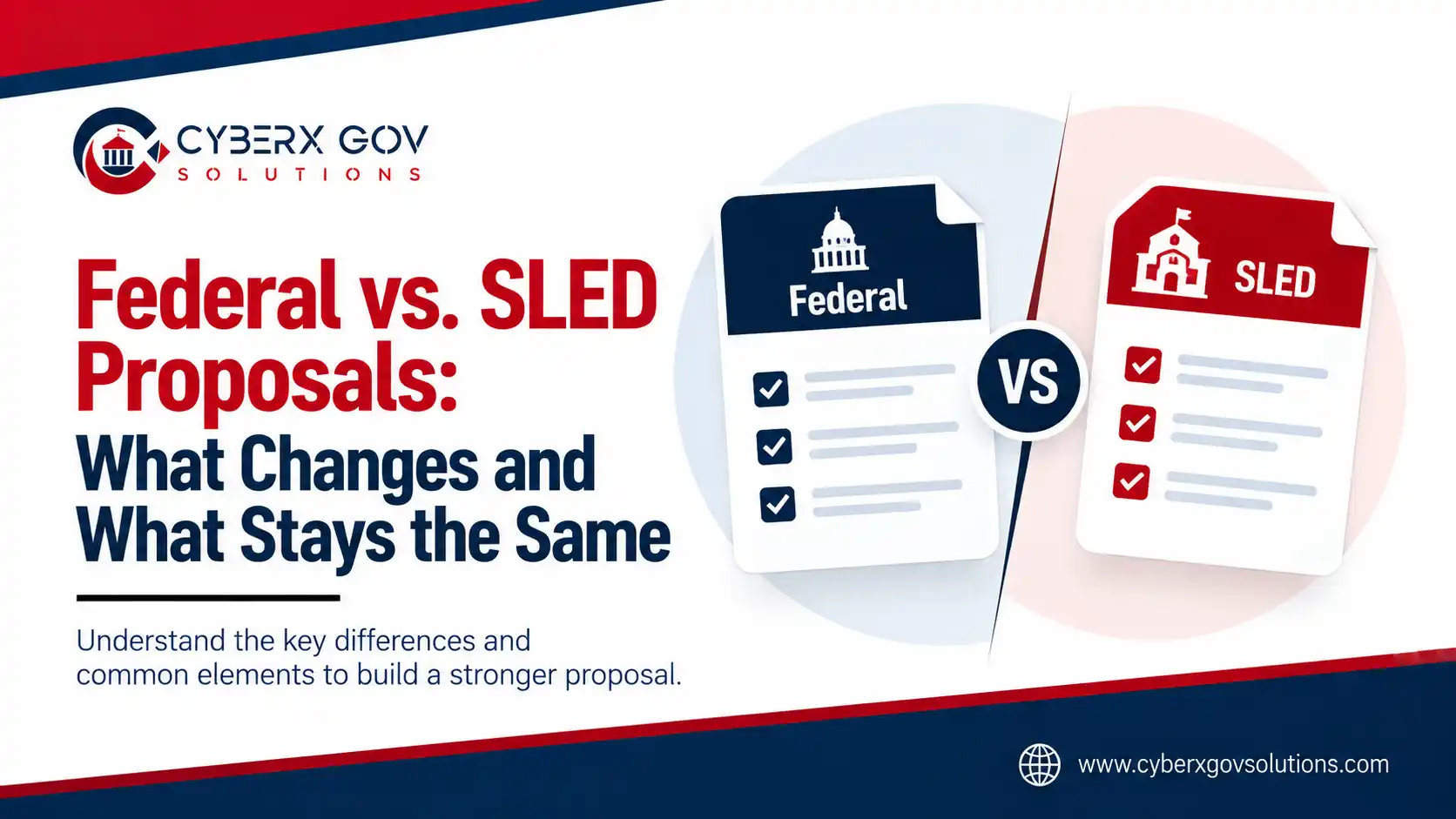
Contractors experienced in federal contracting often look to state, local, and education (SLED) opportunities to expand their business. Their experience with federal proposals gives them a useful starting point. However, federal and SLED procurements have different processes, requirements, and evaluation methods.
Reusing an existing federal proposal may save time, but copying it without adapting the content can weaken a response. State and local agencies may use different forms, procurement portals, evaluation criteria, and contract vehicles. A proposal that meets federal requirements may still miss important instructions in a SLED solicitation.
The key is to understand what changes between the two markets and which proposal development practices remain valuable in both.
Understanding the Federal and SLED Markets
Federal contracting involves opportunities issued by U.S. federal agencies. These procurements generally follow federal acquisition regulations, including the Federal Acquisition Regulation (FAR), along with agency-specific requirements and solicitation instructions.
SLED contracting covers opportunities from state governments, counties, municipalities, school districts, public universities, and other local public entities. These buyers follow their applicable state and local procurement laws, regulations, policies, and solicitation requirements.
The SLED market is also highly fragmented. According to the U.S. Census Bureau’s government organization data, the United States had 91,438 local government units in 2025. These included counties, municipalities, townships, special districts, and independent school districts.
This figure illustrates the scale of the market, but it does not represent the number of active procurement offices or available contracts. Each government unit may have different purchasing needs, procedures, and levels of procurement activity.
For contractors, the main takeaway is straightforward: federal experience can provide a strong foundation, but every SLED opportunity requires its own research and compliance review.
1. Proposal Requirements and Compliance
One of the biggest differences between federal and SLED proposals is how contractors must respond to each solicitation’s requirements.
Federal proposals
Federal solicitations generally specify submission instructions, evaluation factors, required volumes, page limits, representations, certifications, and other compliance requirements. Depending on the procurement, contractors may also need to address requirements related to cybersecurity, small business participation, staffing, past performance, and contract-specific clauses.
The solicitation determines what the contractor must submit and how the proposal will be evaluated.
SLED proposals
SLED requirements vary by jurisdiction and purchasing organization. One agency may require a detailed technical response, while another may emphasize specific forms, local certifications, insurance documentation, or pricing schedules.
Some solicitations may also request notarized documents, local preference declarations, or other jurisdiction-specific information. These requirements should never be assumed to apply universally. Contractors must confirm the actual instructions for each opportunity.
An incomplete form, missing signature, or incorrect submission format can create compliance problems. Depending on the solicitation and applicable rules, such an omission may result in rejection.
What should contractors do?
Build a separate compliance checklist for every solicitation. Do not rely entirely on a checklist developed for a previous federal bid.
Before submission, confirm:
- Every required form and attachment is included.
- Signatures, dates, and certifications are complete.
- Page limits and formatting instructions are followed.
- The proposal is uploaded through the correct portal.
- Required pricing and technical documents are submitted in the requested format.
- All mandatory requirements have been addressed.
A structured compliance process remains valuable in both markets. The specific requirements, however, must come from the solicitation being pursued.
2. Procurement Channels and Cooperative Purchasing
Federal contractors are familiar with contract vehicles, government-wide acquisition contracts, and other established procurement arrangements. SLED buyers also use purchasing arrangements that can help agencies acquire products and services.
One important example is cooperative purchasing.
How cooperative purchasing works
Under a cooperative purchasing arrangement, a contract established through a competitive process may be available for use by multiple eligible public agencies. This can give participating buyers access to an existing purchasing arrangement instead of requiring each one to conduct a separate procurement.
Common examples in the SLED market include:
- OMNIA Partners
- Sourcewell
- NASPO ValuePoint
Eligibility, contract scope, participation rules, and purchasing procedures depend on the specific arrangement and agency.
Sourcewell reporting cited in SLED market research placed contract sales at approximately $5.85 billion for the fiscal year to date through November 30, 2024. This is a historical year-to-date figure, not a full-year total or a measure of the entire SLED market.
What changes for contractors?
A federal contract vehicle does not automatically provide access to SLED buyers. Contractors need to identify the purchasing arrangements available to their target agencies and determine whether their offerings fit the relevant contract scope.
Similarly, holding a cooperative contract does not guarantee sales. Contractors still need to communicate their capabilities, understand individual agencies’ needs, and follow the applicable purchasing process.
The practical lesson: Treat cooperative purchasing as an additional route to market, not as a replacement for business development.
3. Proposal Timelines and Preparation
Trend reporting from Contragenix highlights shorter response windows in some SLED categories. However, this should not be interpreted as a universal rule that every SLED proposal is due within days.
The important point is that contractors may encounter opportunities with limited preparation time.
Why preparation matters
A team that starts developing its proposal only after receiving a solicitation may struggle to gather the necessary information, coordinate subject-matter experts, confirm pricing, and complete compliance reviews.
A more prepared team maintains reusable content and supporting documentation before an opportunity appears.
Useful materials include:
- Company capability statements
- Service and technical descriptions
- Staff qualifications and resumes
- Relevant past performance examples
- Security and compliance documentation
- Standard pricing information, where appropriate
- Approved case studies and customer references
- Draft responses to frequently requested questions
These resources can shorten the drafting process, but they must be reviewed and adapted for each solicitation.
A federal response should not be treated as a finished SLED proposal. Reusable content should support the new response, not replace opportunity-specific writing.
4. Evaluation Criteria and Pricing
Federal and SLED evaluations share a common objective: determining which response best meets the buyer’s stated requirements under the applicable procurement rules.
However, evaluation procedures can differ between individual opportunities.
Federal proposal evaluation
Federal solicitations identify the applicable evaluation factors and explain how the agency will assess proposals. FAR 15.305 addresses proposal evaluation under the federal negotiated procurement framework.
Depending on the solicitation, evaluation may consider technical approach, past performance, price, staffing, management plans, and other stated factors.
Contractors should organize their responses around the actual evaluation criteria rather than relying on a generic proposal structure.
SLED proposal evaluation
SLED agencies use different evaluation frameworks. Some solicitations provide detailed scoring rubrics, while others describe evaluation criteria in a different format.
Price may carry significant weight in some procurements. Other opportunities may place greater emphasis on technical capabilities, implementation, experience, service quality, or a combination of factors.
Some solicitations use defined pricing formulas or scoring methods. Contractors should not assume that the lowest price automatically wins, or that every SLED agency uses the same evaluation model.
How to adapt your proposal
Read the evaluation section before drafting the response.
Identify each criterion and determine what evidence the buyer needs to see. Then structure the proposal so evaluators can easily locate the relevant information.
For pricing, confirm the requested format, evaluation method, contract period, optional items, and any assumptions the solicitation permits.
The technical and cost proposals must also remain consistent. For example, if the technical approach promises a specific staffing level or implementation schedule, the pricing should reasonably support that commitment.
5. Past Performance and Local Relevance
Past performance matters in both federal and SLED contracting. The key difference is how contractors select and present their experience for each opportunity.
What federal contractors can reuse
Federal contractors may already have performance records, project descriptions, customer references, and examples of successful delivery.
These materials can be useful when pursuing SLED opportunities, provided the experience is relevant and the solicitation permits their use.
Federal contractors should not assume that every SLED buyer evaluates past performance using the same standards as a federal agency.
Why local relevance matters
A SLED buyer may find experience with a similar organization particularly useful. For example, a school district evaluating an IT services proposal may want evidence that the contractor understands educational environments, student data considerations, implementation challenges, and limited technology resources.
A county seeking infrastructure support may value experience with comparable public-sector projects and operational requirements.
When selecting references, consider:
- Similarity of the customer or agency
- Comparable project scope and complexity
- Relevance to the requested services
- Evidence of successful delivery
- Measurable outcomes, where documented
- The contractor’s actual role in the project
Avoid presenting an impressive but unrelated project as the strongest example simply because it involved a large contract value.
SLED experience can also strengthen federal proposals
FAR 15.305(a)(2)(ii) addresses the consideration of relevant past performance information, including performance for federal, state, and local government customers and private customers, when applicable to the evaluation.
This is a useful reminder that experience gained in one public-sector market may support a future proposal in another. Its value depends on relevance, the solicitation’s requirements, and the applicable evaluation framework.
6. Cybersecurity and Technical Requirements
Cybersecurity is another area where contractors should expect both similarities and differences.
Federal opportunities may include specific cybersecurity requirements, contract clauses, and information-handling obligations. SLED agencies also increasingly address cybersecurity in their solicitations, although the precise requirements vary.
A contractor should not assume that a federal certification, policy, or compliance statement automatically satisfies a SLED buyer’s requirements.
Before reusing cybersecurity content, confirm:
- Which security standards or frameworks does the solicitation reference
- Whether specific certifications or assessments are required
- What types of data will the contractor handle
- Whether the agency specifies incident reporting or security documentation
- Whether subcontractors must meet additional requirements
- Whether the proposed solution meets the buyer’s technical specifications
Use precise language when describing your security posture. Do not claim certification or compliance unless it can be supported with current evidence.
This approach helps contractors avoid unsupported claims and gives buyers a clearer understanding of their capabilities.
7. What Stays the Same in Both Markets?
Although procurement rules and submission processes differ, several proposal development principles remain consistent.
Understand the buyer’s problem
A strong proposal explains how the contractor will address the buyer’s needs. Generic descriptions of company capabilities are rarely enough on their own.
Follow the solicitation
Every response should address the stated requirements, submission instructions, and evaluation criteria. The compliance process may differ, but careful requirement tracking remains essential.
Provide credible evidence
Use relevant project examples, qualified personnel, documented results, and realistic delivery plans to support your claims.
Make the response easy to evaluate
Clear headings, direct answers, logical organization, and appropriate evidence help evaluators find the information they need.
Review the complete proposal
A structured review should check compliance, technical accuracy, consistency, pricing, and document quality. A reviewer who was not involved in drafting may identify gaps that the original team overlooked.
These practices are not unique to federal or SLED contracting. They are foundational elements of a disciplined proposal process.
8. A Practical Checklist for Adapting Federal Proposals to SLED
Before using an existing federal proposal as the starting point for a SLED response, complete the following checks.
1. Review the new solicitation.
Identify the issuing agency, contract scope, eligibility rules, submission deadline, evaluation criteria, and required documents.
2. Replace federal-specific references.
Remove agency names, acronyms, clauses, and process descriptions that do not apply to the SLED opportunity. Retain only information that is relevant and accurate.
3. Confirm every compliance requirement.
Check forms, signatures, insurance documentation, certifications, local preference declarations, page limits, and submission procedures where required.
4. Adapt the technical approach.
Explain how the proposed solution addresses this buyer’s specific environment, objectives, constraints, and expected outcomes.
5. Select relevant past performance.
Prioritize projects that demonstrate experience comparable to the new opportunity.
6. Recheck pricing.
Follow the buyer’s pricing format and evaluation instructions. Confirm that the proposed price supports the technical approach.
7. Verify cybersecurity claims.
Ensure that all statements about certifications, controls, and compliance are current and supported by evidence.
8. Conduct an independent review.
Ask someone who was not involved in drafting to read the proposal from the buyer’s perspective and identify missing requirements or unclear answers.
Following this process allows contractors to reuse valuable material without carrying unsuitable federal language or assumptions into an SLED proposal.
Key Takeaways
- Federal and SLED proposals share core principles, but their procurement requirements and evaluation processes can differ.
- SLED buyers operate across many jurisdictions, each with its own applicable rules and solicitation requirements.
- Cooperative purchasing can provide access to additional public-sector buyers, but it does not guarantee orders.
- Short response windows in some SLED categories make proposal readiness and reusable content valuable.
- Relevant past performance, clear technical responses, accurate pricing, and strong compliance reviews matter in both markets.
- Reuse federal proposal content as a starting point, then adapt it to the specific SLED buyer and solicitation.
How Cyberx Gov Solutions Can Help
Moving between federal and SLED contracting requires more than changing agency names in an existing proposal. Contractors need to understand the buyer, verify the requirements, and present their capabilities in a way that aligns with the opportunity.
Cyberx Gov Solutions supports government contractors with proposal development and related consulting. Our approach focuses on adapting proposal content to the target market while maintaining a clear, compliant, and evidence-based response.
Planning to pursue federal and SLED opportunities? Schedule a free consultation at cyberxgovsolutions.com/schedule-a-meeting/
Frequently Asked Questions
What is the main difference between federal and SLED proposals?
Federal proposals generally follow the applicable federal acquisition framework and agency solicitation requirements. SLED proposals follow the relevant state or local procurement rules and the issuing organization’s instructions. Forms, portals, deadlines, and evaluation methods can differ.
Can a federal proposal be reused for a SLED opportunity?
Yes, relevant content can be reused as a starting point. However, contractors should update the technical approach, references, compliance documents, terminology, pricing, and other details to match the SLED solicitation.
What is cooperative purchasing in SLED contracting?
Cooperative purchasing allows eligible public agencies to purchase through an established contract arrangement, subject to the contract’s terms and applicable rules. Examples include Sourcewell, OMNIA Partners, and NASPO ValuePoint. Participation does not guarantee sales.
Does the lowest-priced proposal always win a SLED contract?
No. Evaluation methods vary by solicitation. Price may be a major factor, but buyers may also evaluate technical capabilities, past performance, implementation plans, and other stated criteria.
Does SLED past performance count in federal proposals?
It can. FAR 15.305(a)(2)(ii) addresses relevant past performance from federal, state, and local government and private customers under the applicable federal evaluation framework. Contractors should select examples that demonstrate experience relevant to the opportunity.
Why should federal contractors consider SLED opportunities?
SLED contracting can expand a contractor’s potential customer base beyond federal agencies. However, success requires research into individual buyers, procurement procedures, contract vehicles, and the requirements of each opportunity.