One incomplete form can stall your security clearance for weeks before an investigator reviews a single real detail. That form is the SF-86, and it is the longest, most detailed questionnaire most people ever complete for a job.
Here is the good news: most delays are self-inflicted and easy to prevent. Gaps in your history, guessed dates, and missing details send a case back for rework before it ever moves forward.
This SF-86 checklist walks you through what the form is, the records to gather first, how far back it reaches, and the exact mistakes to avoid so your clearance keeps moving.
What Is the SF-86?
The SF-86 is the Questionnaire for National Security Positions. It is the background form you complete when you need a security clearance, and it feeds the investigation that decides your eligibility.
You submit it through eApp, the online system that has replaced e-QIP for the SF-86. Any guide that tells you to log in to e-QIP is out of date. Your sponsoring agency or employer sends you an invitation to start.
The form asks for a detailed history of where you have lived, worked, and studied, plus questions on foreign contacts, finances, and conduct. Investigators then verify what you reported. For a full picture of how long the process takes and the levels involved, see our guide to the 2026 security clearance timeline and the security clearance levels.
Before You Start: Gather Your Records
The single best way to avoid errors is to collect your history before you open the form. Working from memory is how gaps and wrong dates creep in.
Pull these together first:
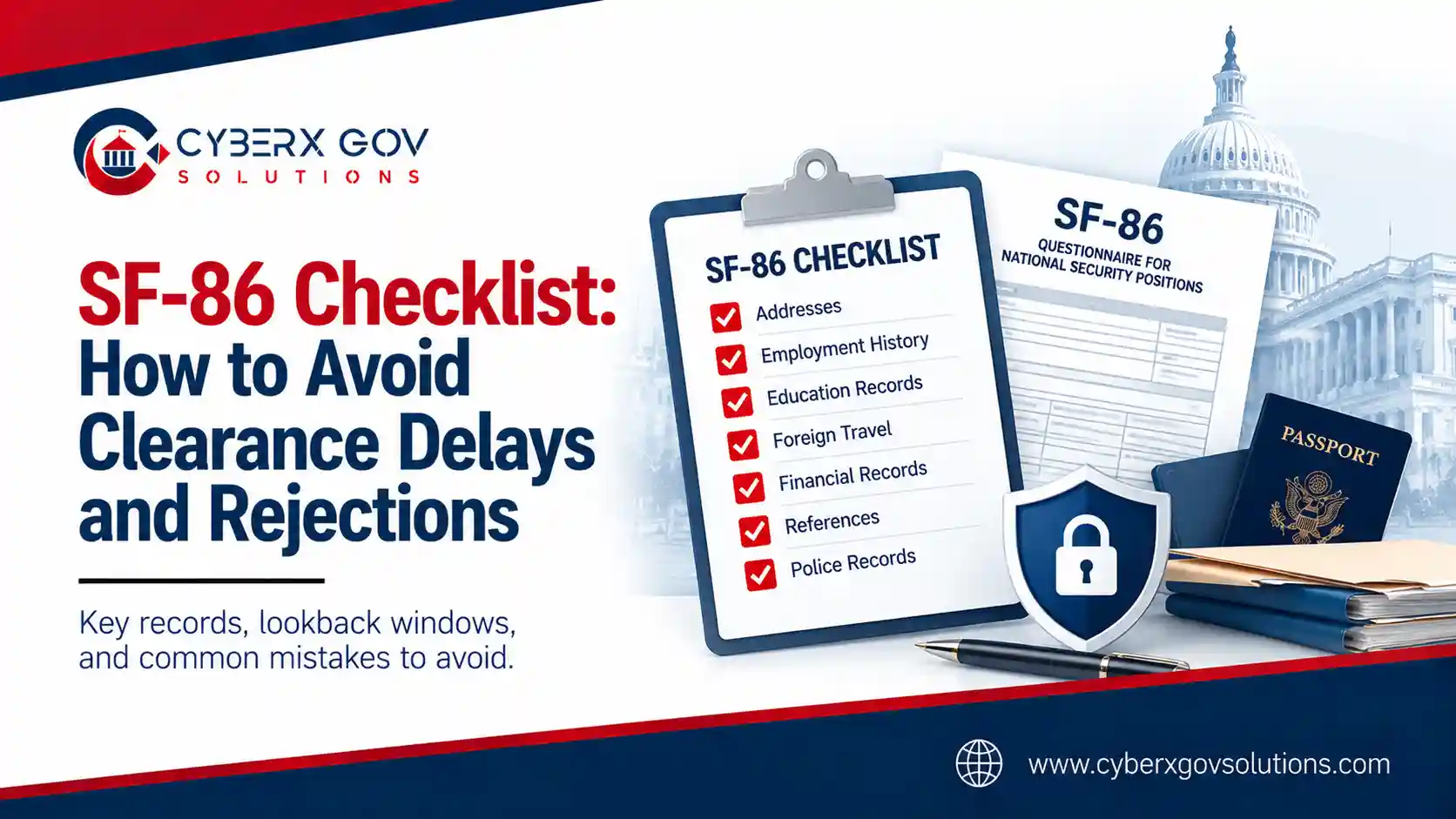
- Every address where you have lived, with exact move-in and move-out months and years.
- Every job and every gap, with employer names, addresses, supervisors, and contact details.
- Schools you attended and any degrees earned.
- Three people who know you well and their current contact information.
- Your foreign travel, with dates and countries.
- Any foreign contacts, relatives abroad, or foreign financial interests.
- Financial records, including any bankruptcies, liens, or delinquent debts.
- Any police or court records, even old or minor ones.
A recent credit report helps you catch financial items you may have forgotten. Old leases and tax returns help you rebuild an accurate address and job history.
Set aside real time for this step. An hour spent confirming dates and contacts up front saves weeks of back-and-forth once the investigation begins. The applicants who stall are almost always the ones who filled the form from memory in a single rushed sitting.
How Far Back Does the SF-86 Go?
Different sections reach back different distances. Reading the window wrong is a common and costly mistake, so check the time frame printed on each question.
As a general guide, the current SF-86 uses these windows.
| Area | Typical lookback |
| Residence history | About 10 years |
| Employment history | About 10 years |
| People who know you well | About 7 years, combined |
| Foreign travel and foreign contacts | About 7 years |
| Financial record | About 7 years |
| Police record (routine) | About 7 years |
| Serious items (certain felonies, domestic violence, drug or firearm charges) | Ever, no time limit |
| Drug and alcohol use | About 7 years |
Treat this table as orientation, not gospel. Each question states its own exact time frame, and eApp can adjust what it asks based on your answers. Always follow the window shown on your form.
The SF-86 Checklist: Avoid the Errors That Cause Delays
This is the heart of it. Work through these before you submit.
- Account for every month. Your residence and employment history must have no unexplained gaps. A blank stretch stops the case until you fill it in, so list periods of unemployment or school as their own entries.
- Use real dates, not guesses. Wrong dates clash with the records an investigator pulls. Use actual months and years, and mark a date as estimated when you truly cannot confirm it.
- Keep names and dates consistent. The same employer or address should read the same way everywhere it appears. Small conflicts create extra verification work.
- List reachable references. Your references must be people who actually know you, not relatives, with current phone numbers and emails. Investigators contact them, and a dead number slows everything.
- Disclose all foreign travel and contacts. Report personal trips, including side trips taken during official travel, and any close or continuing foreign contact. Leaving these out raises questions later.
- Handle finances head-on. List the debts, bankruptcies, or delinquencies the form asks for. Unreported money problems are a leading cause of delay, and they look worse when hidden.
- Do not carry over stale data. If you reuse a prior SF-86, remove old jobs and addresses that fall outside the window, and update every contact detail.
- Report old or minor records. Include police matters even if the case was dismissed, sealed, or expunged when the question calls for it. Follow each question exactly.
Get the SF-86 Pre-Submission Checklist
A one-page, printable checklist of the records to gather, the lookback windows, and the mistakes that delay a clearance. Enter your email and we'll unlock the download.
Disclose, Don’t Conceal
The most damaging mistakes are not the issues themselves. They are the omissions.
Adjudicators expect real people with real histories. A past debt, a foreign relative, or an old mistake can often be mitigated. A deliberate omission is much harder to recover from because it raises doubt about your honesty.
When you are unsure whether something belongs on the form, the safer move is to disclose it and explain it. Concealment turns a manageable issue into a trust problem.
Picture two applicants with the same old, resolved debt. The first lists it, adds a short note that it was paid, and moves on. The investigator sees an honest record and closes the item. The second leaves it off; the investigator finds it anyway, and now the file carries two concerns instead of one: the debt and the omission. Same history, very different outcome, decided by what each person chose to report.
Common SF-86 Mistakes to Avoid
A few patterns cause most of the delays.
The first is unexplained gaps in your timeline. The second is guessed or inconsistent dates that do not match official records. The third is leaving out foreign travel, foreign contacts, or financial issues. The fourth is listing references with outdated contact information.
Avoid these, and you remove the most common reasons a clearance stalls before it starts.
Key Takeaways
- The SF-86 is submitted through eApp, which replaced e-QIP. Ignore any guide that still says e-QIP.
- Gather your full history before you start, so you report exact dates and no gaps.
- Each section has its own lookback window. Residence and employment generally reach back about 10 years, and many other sections about 7 years, but always follow the form.
- Disclose and explain issues. Concealment causes far more harm than the issue itself.
How CyberX Gov Solutions Can Help
A clean SF-86 gets your clearance moving, but the fastest path to cleared work is often the role itself.
CyberX Gov Solutions runs a cleared recruitment service that connects security-cleared professionals with federal contractors, matched to the right clearance level and role. If you already hold a clearance, we can help you find your next position. If you are hiring, we help you fill cleared seats without losing months to the process.
The goal is simple: keep good people and good contracts moving, instead of stalling on avoidable delays.
Conclusion
Your SF-86 is the first test of your clearance, and it is one you control. The form is long, but the errors that delay it are predictable and preventable.
Gather your records, account for every month, follow each question’s window, and disclose rather than hide. Do that, and you hand investigators a clean file that keeps your clearance on track.
Looking for your next cleared role, or trying to fill one? Talk to the CyberX Gov Solutions team or schedule a consultation at cyberxgovsolutions.com/schedule-a-meeting/.
Frequently Asked Questions
What is the SF-86 used for?
The SF-86, the Questionnaire for National Security Positions, is the form you complete to apply for a security clearance. It gives investigators the history they verify to decide your eligibility for access to classified information.
Do I still use e-QIP to submit the SF-86?
No. The SF-86 is now submitted through eApp, which has replaced e-QIP. Your sponsoring agency or employer sends you an invitation to begin in eApp.
What happens if I make a mistake on the SF-86?
A small error can usually be corrected, but gaps, wrong dates, and missing details send your case back for rework and delay the investigation. A deliberate omission is far more serious and can lead to denial.
How many references does the SF-86 require?
You generally list three people who know you well and who are not relatives. Together, they should cover the recent years the form asks about, and each needs current contact information.
Should I report a debt or an old arrest on the SF-86?
Yes, when the question calls for it, even if the matter is old, minor, dismissed, or resolved. Disclosing and explaining an issue is almost always safer than leaving it off.
Can I start work before my clearance is final?
Sometimes. Many roles allow a start under interim eligibility while the full investigation continues. Our post on interim clearances explains how that works.