You just landed a cleared job offer. For a lot of people, the first worry is simple: do I have to sit through the whole clearance process all over again?
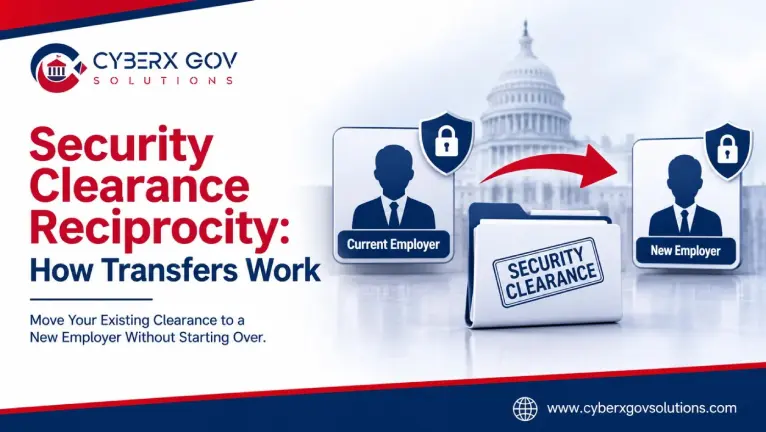
Usually, no. A rule called reciprocity lets your existing clearance move with you to a new employer, contract, or agency, with no fresh investigation in most cases.
This guide explains how security clearance reciprocity works, what it requires, and the situations that can still slow or block a transfer. If you are cleared and job hunting, or hiring cleared talent, this is the part of the process that saves the most time.
What Is Security Clearance Reciprocity?
Reciprocity is the government’s rule that one agency should accept another agency’s completed background investigation and favorable eligibility decision, rather than starting over.
It is set by Security Executive Agent Directive 7 (SEAD 7), “Reciprocity of Background Investigations and National Security Adjudications,” along with a series of executive orders. The goal is a cleared workforce that can move where it is needed without repeating work that is already done.
Reciprocity applies broadly. It covers federal civilian employees, members of the military, and contractor personnel. If you hold current eligibility and move to a role at the same level, the gaining employer should generally accept it.
Eligibility vs. Access: Why You Do Not “Own” Your Clearance
Here is the idea that clears up most of the confusion. Your clearance is not a personal credential you carry around in your wallet. It belongs to the government.
There are two separate things to track. “Eligibility” is the government’s determination that you can be trusted with classified information. “Access” is being read into actual classified material for a specific job. An employer sponsors your access while you work a cleared role.
When you leave that role, your access ends. Your eligibility does not automatically disappear. It stays on record, which is exactly what makes a future transfer possible. For a refresher on what the levels mean, see our guide to security clearance levels.
What Reciprocity Requires
Reciprocity is not automatic in every case. A few conditions generally have to line up for the gaining employer to accept your eligibility.
- Your eligibility was granted on a full, favorable basis, not on an interim or temporary one.
- Your most recent background investigation is still current and covers the scope the new position needs.
- No new information of security concern has surfaced since your last adjudication.
- The new position does not require a higher level of eligibility than you already hold.
When those hold, the new employer can usually accept your clearance without a new investigation. When one is missing, extra steps may follow. If the role sits a level above your current eligibility, for example, that is an upgrade, not a transfer.
Breaks in Service and Reinstatement
A question that comes up constantly is what happens after time away from cleared work. The answer depends on the length of the gap and on whether your investigation is still in scope.
For Department of Defense employees, reciprocity generally still applies as long as there is no break in federal service longer than 24 months and the investigation remains within scope. For contractor personnel, the rules are in the National Industrial Security Program (32 CFR 117.10), and your employer’s security officer confirms whether your eligibility can be reinstated.
The practical takeaway: a shorter gap with a current investigation is the easiest case. A long break, or an investigation that has aged out of scope, is more likely to trigger a new look. Your Facility Security Officer is the right person to confirm your exact status.
What Reciprocity Does Not Guarantee
Reciprocity moves your baseline eligibility. It does not carry every type of access with it.
| Reciprocity usually covers | Reciprocity may not cover |
| Your existing Secret or Top Secret eligibility | Access to Sensitive Compartmented Information (SCI) |
| A move to a role at the same level | Access to a Special Access Program (SAP) |
| A new employer sponsoring the same clearance | An upgrade to a higher clearance level |
SCI and SAP access often require their own review by the gaining program, so holding a collateral clearance does not guarantee you get back in. Some positions also add requirements, such as a polygraph, that your prior clearance never included. Treat those as separate hurdles from the basic transfer.
How a Clearance “Transfer” Actually Works
Nothing physically moves. A transfer is really the new employer sponsoring you and verifying your eligibility in the government’s systems.
The gaining employer’s security office looks up your record in the system of record, such as the Defense Information System for Security (DISS), and for SCI, Scattered Castles. If your eligibility is current and clean, they re-establish sponsorship and grant access for the new role.
In most cases, you will not need to fill out a brand-new SF-86 just to move. The investigation already exists.
Picture an analyst with an active Secret clearance who leaves one contractor for another. On her last day, her access is switched off. Her eligibility stays on record. When the new contractor’s security officer looks her up in DISS, confirms the investigation is current, and sponsors her, she can be read in for the new role in days, with no new investigation. That is reciprocity working as designed.
For how the underlying investigation and its timeline work, see our guide to the security clearance timeline, and our post clearing up interim clearance myths.
Continuous Vetting Makes Clearances More Portable
Reciprocity has become more reliable under a newer model. Instead of waiting years for a periodic reinvestigation, cleared people are now monitored through continuous vetting.
Under Trusted Workforce 2.0, automated checks run against records on an ongoing basis. Because your eligibility is continuously reviewed rather than frozen between investigations, a gaining employer has more current information to rely on. Our guide to Trusted Workforce 2.0 explains the shift in full.
Tips for Cleared Job Seekers and Employers
A smooth transfer is mostly about preparation. A few habits help.
If you are the candidate, know your own status: your eligibility level, the date of your last investigation, and whether you are in continuous vetting. Keep that information ready for a new employer’s security office.
If you are hiring, verify eligibility early, before you build a start date around it. Confirm the level, the investigation scope, and any SCI or SAP requirements the role adds. A mismatch found late can cost weeks, and sometimes the candidate.
For a sense of where cleared demand is heading, our post on where cleared jobs are moving gives the current picture.
How CyberX Gov Solutions Can Help
Reciprocity saves time only when someone manages the handoff well. That is where an experienced partner earns its keep.
CyberX Gov Solutions runs a cleared recruitment service that matches security-cleared professionals with federal contractors and helps both sides handle the crossover cleanly. We confirm eligibility and fit up front, so a transfer that should be fast does not stall on a preventable gap.
If you already hold a clearance, we can help you find your next role. If you are hiring, we help you fill cleared seats without losing months.
Conclusion
For most cleared professionals, changing jobs does not mean starting the clearance process over. Reciprocity is built to let your eligibility follow you, as long as it is current, clean, and at the right level.
Know your status, line up the details, and let your gaining employer verify your record. Do that, and a move that feels risky becomes one of the smoothest parts of a cleared career.
This post is general information, not official guidance, so confirm your specific situation with your Facility Security Officer. Looking for your next cleared role, or trying to fill one? Talk to the CyberX Gov Solutions team or schedule a consultation at cyberxgovsolutions.com/schedule-a-meeting/.
Frequently Asked Questions
Does my security clearance transfer to a new job automatically?
Not automatically, but usually without a new investigation. The gaining employer sponsors you and verifies your existing eligibility. If it is current, at the right level, and clean, reciprocity applies.
Do I keep my clearance after I leave a cleared job?
Your access ends when the job ends, but your eligibility stays on record. That record is what lets a future employer pick your clearance back up through reciprocity, as long as it is still in scope.
How long can I be out of cleared work before I lose reciprocity?
It depends on your category and your investigation. For DoD employees, a break in federal service longer than 24 months is a common cutoff. Contractors follow the National Industrial Security Program, so confirm your status with your security officer.
Does reciprocity include SCI or SAP access?
Often not. Reciprocity moves your underlying eligibility, but SCI and SAP access usually require a separate review by the gaining program. Holding a collateral clearance does not guarantee access.
Will I have to fill out a new SF-86 to transfer my clearance?
In a straightforward reciprocity case, generally no, because your investigation already exists. A new SF-86 is more likely when you need an upgrade, your investigation has aged out of scope, or new issues have come up.
Who confirms whether my clearance can be transferred?
The gaining employer’s security office, often the Facility Security Officer, checks your eligibility in the government’s systems of record and re-establishes sponsorship for the new role.