Most multiple-award vehicles let small businesses team loosely. You sign a few agreements, hope one prime wins, and move on. The Air Force’s new AFCAP VI solicitation reportedly rewrites that math.
With proposals due December 3, 2026, small contractors have a narrow window to settle one question: prime, partner exclusively, or pass. And the reported exclusivity rules make that choice far harder to walk back than a normal teaming agreement.
This guide walks through what has been reported, why the exclusivity rule is the real story, and how to make the prime, partner, or pass call before the clock runs out. One note up front: much of the detail below comes from early trade reporting, so verify every figure against the official solicitation on SAM.gov before you act.
What the Air Force Released
According to trade coverage from GovCon Wire and the aggregator Govly, the 772nd Enterprise Sourcing Squadron released the AFCAP VI multiple-award IDIQ solicitation on November 9, 2026.
The vehicle supports rapid contingency work worldwide: contingency planning, logistics, and emergency construction, including humanitarian assistance, disaster response, and infrastructure design and construction. Govly reports a $15 billion maximum single-order limit, and orders scheduled from June 1, 2028, through May 31, 2036, with deliveries permitted through May 2039.
A few things to confirm yourself, because they drive real decisions:
- The exact proposal deadline and time. At least one third-party listing has shown a different date, so trust only SAM.gov.
- Whether the $15 billion figure is a single-order limit or the overall ceiling.
- The set-aside status. Earlier-stage coverage described AFCAP VI as full and open or unrestricted, which would mean it is not a small business set-aside. Verify this in the final RFP.
Treat the reporting as a map, not the territory. The solicitation document is the only source that counts.
Why Exclusivity Is the Real Story
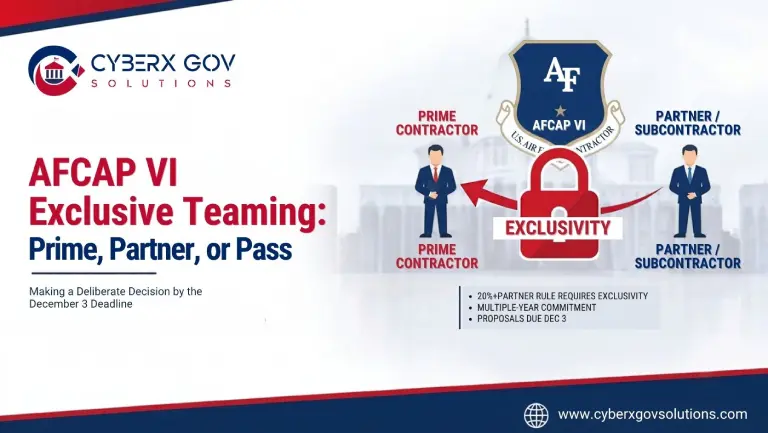
Here is the provision that changes the whole calculation. Per GovCon Wire, prime offerors must execute exclusive teaming arrangements with any partner expected to perform at least 20 percent of the anticipated contract value.
That is not a standard teaming agreement. An exclusive arrangement means a partner commits to one prime and, as reported, cannot team with a competing AFCAP VI prime. On a vehicle whose ordering period runs into 2036, that commitment is measured in years, not months.
Consider a niche construction firm courted by three competing primes. On a normal vehicle, it could sign with all three and ride whichever one wins. Under the reported AFCAP VI rule, it has to pick one. If that prime loses its bid, the firm may have sat out the other two teams for nothing.
The exact scope of the lock-in is the single most important thing to confirm in the RFP text. How long the exclusivity lasts, whether it survives a prime losing its bid, and which partners it binds will decide whether signing is smart or costly. Do not rely on a summary for this clause. Read it, and have counsel read it, before anyone signs.
Option 1: Bid as Prime
Priming means assembling a team that can credibly cover worldwide contingency work, with partners performing 20 percent or more of the value, while meeting the solicitation’s clearance and surge-response expectations.
On a response window of roughly three weeks, that is a stretch for most small businesses. A vehicle this size will likely draw experienced contingency contractors, so the bar for a credible prime bid is high.
Priming makes sense only if you already have the pieces: established partner relationships, relevant past performance in contingency or emergency construction, and the capacity to staff and price a global response. If any of those is missing, priming in this window is a long shot.
Option 2: Become an Exclusive Partner
Serving as a 20 percent-plus partner can deliver meaningful workshare on a long-running vehicle. The catch is that you are betting on a single prime, and the reported exclusivity means you cannot hedge afterward.
So choose that prime carefully. Compare each one’s past performance, price competitiveness, and contingency capacity before you sign. Our guide to small business teaming covers how to vet a prime partner the right way.
Ask one more question before you commit: how much work would you realistically receive? A seat on a vehicle is a hunting license, not a guaranteed paycheck. Task order volume is never promised, so weigh the exclusivity against the work you can actually count on.
Option 3: Pass
Passing is a legitimate and often smart decision. If the exclusivity would box you out of other pursuits you value more, or you cannot meet the clearance or surge requirements, a clean no-bid protects your resources.
Redirect that effort toward later task-order or subcontract opportunities, or toward vehicles that fit your profile better. Our framework for a disciplined bid or no-bid decision helps you make the call without regret.
A thoughtful pass beats a rushed proposal and a multi-year lock-in you never fully priced.
Due Diligence Before You Sign
Exclusivity rewards the contractor who reads the fine print. Before you sign anything, work through this list.
- Read exactly how the RFP defines a partner that could perform 20 percent or more, and how that share is measured.
- Ask what happens to the exclusivity if your prime does not win a seat on the vehicle.
- Look for termination rights, carve-outs for existing customers, and conflicts with teaming agreements you have already signed.
- Check whether subcontractors below the 20 percent threshold are bound by the same restriction, since the reporting does not address this.
- Have counsel review any exclusivity language before signature, not after.
These are the questions that separate a sound commitment from a trap you discover a year into the vehicle.
A Short Window to Decide
Whatever you choose, the hard part is the calendar. The proposal deadline is close, so a slow decision is effectively a decision to pass.
Start the work now. Build your compliance matrix from the solicitation’s Sections L and M, confirm your clearance and past performance eligibility, and get any partner commitments in writing. And verify the exact deadline and time on the official solicitation on SAM.gov rather than trusting any summary, this one included.
For the bigger picture on how large vehicles like this fit a pipeline, see our guide to contract vehicles.
How CyberX Gov Solutions Can Help
A compressed deadline and a binding teaming choice are exactly the moments when outside help pays for itself. There is no time to redo a rushed decision.
CyberX Gov Solutions supports small contractors with teaming strategy, bid or no-bid analysis, compliance matrices, and full proposal development. We help you decide prime, partner, or pass with clear eyes, then build the proposal and the team behind it.
The goal is simple: make a deliberate call, not a deadline-driven one, and back it with a plan you can execute.
Conclusion
AFCAP VI is not a vehicle to team on by reflex. The reported exclusivity rule turns a routine teaming choice into a multi-year commitment, and the short deadline leaves no room for a lazy decision.
Read the real solicitation, price the lock-in, and choose prime, partner, or pass on purpose. A deliberate decision, even a no-bid, will serve you better than a scramble you regret in 2027.
Racing the December 3 deadline? Talk to the CyberX Gov Solutions team or schedule a consultation at cyberxgovsolutions.com/schedule-a-meeting/.
Frequently Asked Questions
What is AFCAP VI?
AFCAP VI is the Air Force Contract Augmentation Program’s sixth iteration, a multiple-award IDIQ for worldwide contingency planning, logistics, and emergency construction. Per trade reporting, the solicitation was released on November 9, 2026, with proposals due December 3, 2026. Confirm details on SAM.gov.
What is the AFCAP VI exclusive teaming rule?
Per GovCon Wire, prime offerors must sign exclusive teaming arrangements with any partner expected to perform at least 20 percent of the contract value. Verify the exact scope and duration in the official solicitation before signing.
Is AFCAP VI a small business set-aside?
Early coverage described it as full and open or unrestricted, which would mean it is not reserved for small businesses. Small firms would compete as primes or as teaming partners. Confirm the set-aside status in the final RFP.
What is the AFCAP VI contract value?
Govly reports a $15 billion maximum single-order limit. Whether that is a per-order cap or the overall ceiling should be confirmed in the solicitation, since trade sources describe the figure differently.
When can I perform work under AFCAP VI?
Govly reports an ordering period from June 1, 2028, through May 31, 2036, with deliveries permitted through May 2039. These dates are from secondary reporting, so verify them on SAM.gov.
Should my small business prime or partner on AFCAP VI?
It depends on your past performance, your capacity for worldwide response, and whether you can accept an exclusive, multi-year commitment. If neither prime nor partner fits cleanly, a disciplined no-bid is a valid choice.