
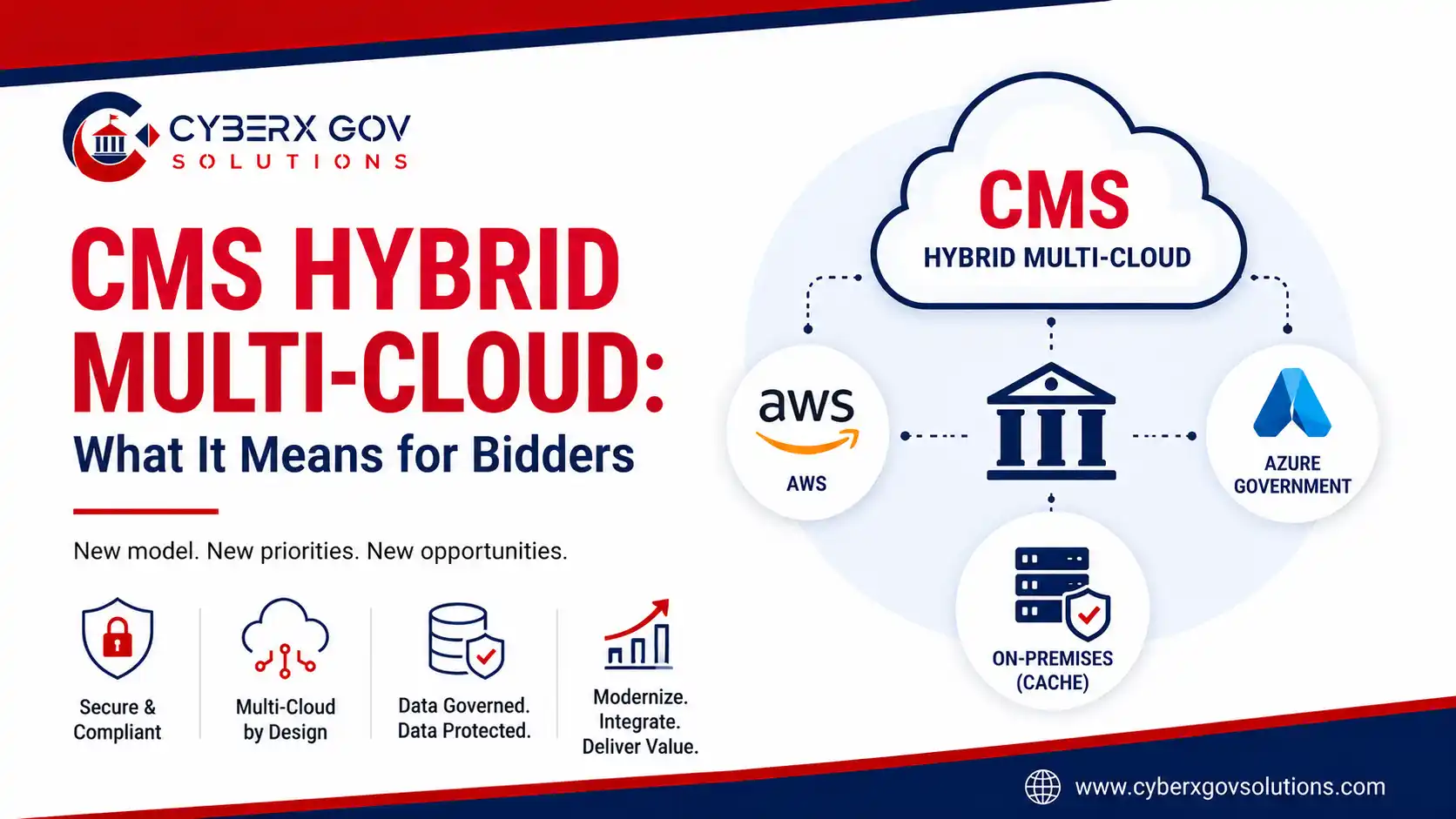
The Centers for Medicare & Medicaid Services (CMS) has advanced its technology modernization by adopting a hybrid, multi-cloud approach, marking a strategic shift in how it manages its infrastructure and signaling new opportunities for contractors.
The CMS hybrid multi-cloud approach emphasizes security and governance as core priorities, reassuring contractors that these areas are central to success.
For cloud, data, AI, and IT modernization providers, understanding CMS’s multi-cloud approach is key to identifying future contracting opportunities, starting with how CMS achieved this and where the real work now lies.
Key Takeaways
• CMS operates a hybrid, multi-cloud model that combines managed AWS and Microsoft Azure Government with its on-premises CACHE platform.
• CMS treats security, data governance, and enterprise standards as core parts of its architecture, not add-ons.
• Demand is shifting from single-cloud migration toward cross-cloud integration, data engineering, and AI governance.
• CMS requires most data to stay inside its authorization boundaries, which raises the bar on how contractors handle data.
• The strongest bidders position themselves around operating and governing a complex environment, not just moving workloads.
What Is CMS Hybrid Multi-Cloud?
CMS hybrid multi-cloud is an operating model that combines more than one public cloud with the agency’s own hosting environment, all managed under common architecture, security, and governance standards. It lets CMS match each workload to the environment that fits it best, instead of forcing every application onto a single platform.
CMS’s own Technical Reference Architecture (TRA) shows how this fits together. The TRA names CMS Hybrid Cloud as the strongly preferred hosting platform for CMS-developed applications. Its architecture includes managed Infrastructure-as-a-Service environments for both AWS and Microsoft Azure Government, plus the Continuously Available CMS Hosting Environment (CACHE), which serves as the primary on-premises hosting platform.
Definition: A hybrid, multi-cloud model blends public cloud and on-premises infrastructure (hybrid) while using more than one cloud provider (multi-cloud). CMS does both at once.
Why CMS Hybrid Multi-Cloud Matters for Contractors
Flexibility comes with complexity. When teams can pick AWS, Azure Government, or on-premises hosting per workload, the number of environments, access paths, and policies to manage goes up fast.
CMS’s TRA is clear that this environment still has to behave like one enterprise. The architecture emphasizes common security, data stewardship, and shared enterprise services across every processing environment. CMS policy also states that all CMS data must remain within CMS authorization boundaries, except for public data the agency releases.
CMS needs partners who excel in connecting and managing these environments, focusing on operational excellence and governance, which presents a real opportunity for capable contractors.
How the Model Actually Works
CMS’s approach follows a simple logic, even if the execution is hard.
- Match the workload to the environment: Teams choose AWS, Azure Government, or CACHE based on factors such as FISMA boundaries, data usage, and hosting needs.
- Apply common standards everywhere: The TRA sets shared expectations for architecture, security, and data across all environments.
- Keep data inside the boundary: CMS data stays within CMS authorization boundaries, with limited, reviewed exceptions.
- Integrate, then operate: The environments must connect and run together, not sit in separate silos.
For a contractor, step four is the payment for the work. Standing up a cloud is now table stakes. Making clouds and on-premises systems operate as one governed platform is the differentiator.
Cloud, Data, and AI Are Converging
CMS’s cloud strategy is developing alongside a stronger focus on data and artificial intelligence. These three areas are starting to move as one.
CMS calls data a strategic asset and has set Data Principles covering integration, analytics, accessibility, quality, security, ownership, and reuse. The agency also states that code, data, and systems built under CMS contracts must stay accessible to CMS and be returned or transferred to the agency or a successor when appropriate.
Artificial intelligence follows the same pattern. CMS’s TRA AI guidance says the agency is building policies and processes so AI systems are developed and used responsibly. Sensitive data, including Protected Health Information (PHI), may only be used with AI tools that meet HHS and CMS cybersecurity standards. CMS also requires high-impact AI use cases to apply minimum risk-management practices, with a CMS AI Governance risk assessment deciding whether a use case counts as high-impact.
Put together, the direction is easy to read. Cloud provides the foundation. Data provides the value. AI provides new capability. Security and governance hold it all together.
Where the CMS Contracting Opportunities Are
For companies chasing CMS work, the hybrid multi-cloud shift opens several areas worth watching. Each maps to a real capability gap, not a buzzword.
Hybrid and multi-cloud engineering: CMS needs teams that can design, integrate, operate, and optimize workloads across AWS, Azure Government, and on-premises systems. Relevant skills include cloud architecture, migration, platform engineering, automation, DevSecOps (development, security, and operations combined), and cloud operations.
Data engineering and governance: More environments make enterprise data harder to manage. That drives demand for data integration, data quality, metadata management, data standards, analytics, and secure data exchange, all aligned to CMS’s data principles.
Cloud security and identity: More integration points mean more access paths and policies to protect. Contractors strong in identity and access management (IAM), cloud security, authorization, continuous monitoring, and compliance fit this need well.
AI implementation and governance: The opportunity reaches past building models. CMS’s rules create demand for AI governance, risk assessment, model oversight, and responsible deployment inside a regulated data environment.
Application modernization: Hybrid environments invite work to modernize legacy systems and connect them to newer platforms through APIs, microservices, cloud-native development, and integration.
CMS’s direction rewards a focus on enterprise architecture and cross-cloud integration, encouraging contractors to lead with how they enable environments to work together seamlessly.
Single-Cloud vs. Hybrid Multi-Cloud Positioning
The way you frame your capabilities matters as much as the capabilities themselves. This is how the two mindsets compare.
| Single-cloud positioning | Hybrid multi-cloud positioning |
| “We migrate applications to the cloud.” | “We integrate and operate workloads across clouds and on-premises.” |
| Deep in one platform only | Cross-platform architecture and integration |
| Migration as the finish line | Operations, security, and governance as ongoing value |
| Data handled per project | Data governed to CMS enterprise standards and boundaries |
| AI as a standalone build | AI delivered with governance and risk management built in |
Common Mistakes Bidders Make
A market signal is not a solicitation. Reading CMS’s shift correctly means avoiding a few traps.
- Treating the announcement as a guaranteed contract: CMS’s multi-cloud direction points to demand. It does not promise a specific award.
- Over-indexing on one cloud: Single-platform-only messaging can work against you when the agency values integration.
- Separating data and security from delivery: CMS builds governance into its architecture. Bidders who bolt it on look out of step.
- Ignoring the data boundary rules: Proposing an approach that moves CMS data outside its authorization boundary is a fast way to lose credibility.
When to Seek Professional Support
Some teams have the technical skill but not the federal positioning. If your commercial cloud, data, or AI work is strong, the real question is whether it maps to CMS’s architecture, security, governance, and mission. That translation is where many capable firms stumble.
Professional GovCon support helps most when you are entering CMS for the first time, repositioning existing capabilities for a federal buyer, or preparing for a specific opportunity. An outside review can test whether your capability statement, past performance, and win themes actually speak to how CMS buys.
How CyberX Gov Solutions Can Help
CyberX Gov Solutions helps technology firms line up their capabilities with where CMS is headed. Through the Get Fed Ready™ program, CyberX supports federal readiness, opportunity identification, and fit analysis, so you can see where CMS hybrid multi-cloud priorities match what you already do.
When a solicitation appears, CyberX’s proposal development support covers compliance mapping, win themes, and the technical, management, and past performance sections that decide awards. The goal is simple: help you show CMS not just that you can build in the cloud, but that you can operate, secure, and govern a complex cloud and data environment.
Conclusion
CMS hybrid multi-cloud is best understood as the latest stage of a longer modernization effort, not a one-time announcement. The agency is not just adding cloud providers. It is building an environment where cloud, data, applications, security, and AI must run together under shared standards.
For contractors, that changes the opportunity and the message. The strongest positioning is not “we can move CMS to the cloud.” It is “we can help CMS securely operate, integrate, govern, and get value from an increasingly complex environment.” Firms that make that shift in how they describe their work will be better placed as CMS’s cloud and data requirements take shape.
Ready to see where these priorities line up with your capabilities?
CyberX Gov Solutions can help you assess your CMS fit through Get Fed Ready™ and build a competitive response through its proposal development support.
Schedule a free consultation at cyberxgovsolutions.com/schedule-a-meeting/ and start positioning for CMS’s cloud and data work.
Frequently Asked Questions
What is the difference between hybrid cloud and multi-cloud at CMS?
Hybrid cloud mixes public cloud with on-premises infrastructure, while multi-cloud uses more than one cloud provider. CMS does both. Its model combines AWS and Microsoft Azure Government with the on-premises CACHE platform, all managed under one architecture, so workloads can run wherever they fit best.
Which cloud platforms does CMS use?
CMS Hybrid Cloud includes managed Infrastructure-as-a-Service environments for Amazon Web Services and Microsoft Azure Government, plus the Continuously Available CMS Hosting Environment (CACHE) for on-premises hosting. According to CMS’s Technical Reference Architecture, CMS Hybrid Cloud is the strongly preferred hosting platform for CMS-developed applications.
Does CMS require data to stay within its authorization boundaries?
Yes. CMS policy states that all CMS data must remain within CMS authorization boundaries, except for public data the agency releases, with limited exceptions subject to review. Contractors proposing cloud or data solutions should design approaches that respect these boundaries from the start.
What skills do CMS multi-cloud contracts call for?
CMS hybrid multi-cloud work rewards cross-cloud integration, enterprise architecture, DevSecOps, data engineering and governance, cloud security, identity and access management, AI governance, and application modernization. Great single-platform skill still helps, but the ability to make environments operate together as one enterprise sets bidders apart.
How should a small business position for CMS cloud opportunities?
Focus your capability statement and past performance on integration, security, and governance, not just migration. Show how your work maps to CMS’s architecture and data rules. If you are new to the agency, a federal readiness review can confirm your positioning speaks to how CMS buys before you invest in a bid.
Does CMS have rules for using AI on its contracts?
Yes. CMS’s AI guidance requires responsible, secure AI use. Sensitive data such as Protected Health Information may only be used with AI tools that meet HHS and CMS cybersecurity standards. High-impact AI use cases must apply minimum risk-management practices, and a CMS AI Governance risk assessment decides whether a use case is high-impact.
Is CMS’s multi-cloud announcement a signal that new contracts are coming?
It is a market signal, not a guarantee of a specific award. It points to likely demand across cloud engineering, data, security, and AI governance. Companies should monitor CMS procurement activity in these areas and review whether their capabilities genuinely align before committing to a bid.
Where can contractors track CMS opportunities and requirements?
Start with official sources. CMS publishes its Technical Reference Architecture and security guidance on cms.gov and security.cms.gov, and federal opportunities appear on SAM.gov. Reviewing these together helps you understand both the technical direction and the specific solicitations tied to CMS’s cloud and data priorities.


