A small IT firm finds the perfect federal opportunity on SAM.gov. The work fits. The price is right. Then the team opens the solicitation and sees 90 pages of instructions, evaluation factors, and clauses, with a due date 18 days away. That gap between “we can do this work” and “we can win this contract” is exactly what government proposal support exists to close.
Government proposal support is the mix of people, process, and services that helps a company plan, write, and submit a compliant, competitive response to a public solicitation. It covers far more than writing. It includes strategy, compliance, pricing, review, and everything needed to hand evaluators a proposal they can score in your favor.
This guide breaks down what that support includes, how the proposal process works, what it costs, and when hiring help makes sense. If you sell to the federal government, or plan to, the details below will save you time and losing bids.
What Is Government Proposal Support?
Government proposal support is professional help that turns a solicitation into a winning submission. It combines proposal management, compliance checks, technical writing, pricing input, and quality reviews. The goal is simple: submit a bid that follows every rule and scores higher than the competition.
The federal government is the largest buyer of goods and services in the world. According to the U.S. Small Business Administration (SBA), federal agencies must aim to award at least 23% of prime contract dollars to small businesses each year. In fiscal year 2024, the SBA reported that small firms won a record total of roughly $183.5 billion in prime contracts. The money is real. The competition is real too.
Expert tip: Support is not only for companies that cannot write. Many capable firms lose because they run out of time, miss a hidden requirement, or answer the wrong question. Good support prevents those errors.
Who Relies on Proposal Support?
- First-time bidders who have never responded to a Request for Proposal (RFP) and need a guide.
- Growing small businesses that win occasionally but want a repeatable process.
- Prime contractors who need extra hands during a busy bid season.
- Subcontractors and teaming partners who must supply strong, compliant sections to a prime.
Federal, State, and Local Work
Most people picture federal RFPs, and this guide focuses there. The same discipline applies to state and local (SLED) bids and to grants. Federal work usually carries the heaviest compliance load because of the Federal Acquisition Regulation (FAR), the rulebook for federal buying. Always read the actual solicitation, because the rules shift by agency and program.
What Services Does Government Proposal Support Include?
Strong support is modular. You can buy the full package or just the piece you lack. Here are the core services and when each one matters.
| Service | What it does | When you need it |
| Opportunity identification | Finds bids that fit your capability and vehicles | Before a solicitation drops |
| Capture and win strategy | Builds win themes and a plan to beat rivals | Weeks or months before RFP release |
| Bid/no-bid analysis | Scores whether an opportunity is worth pursuing | Right after the RFP posts |
| Compliance matrix | Maps every requirement to a place in your proposal | Day one of the response |
| Proposal management | Runs the schedule, roles, and reviews | Throughout the effort |
| Technical and management writing | Turns your solution into evaluator-ready text | Core drafting phase |
| Pricing and price-to-win | Aligns cost with strategy and evaluation | Alongside the technical volume |
| Color team reviews | Independent checks on compliance and quality | At draft milestones |
| Orals coaching | Prepares your team to present and defend the bid | When the RFP requires a presentation |
| Production and submission | Formats, checks, and delivers on time | Final hours before the deadline |
A quick note on two terms people mix up. Capture management is the pre-proposal work: research, positioning, and strategy before the solicitation arrives. Proposal management is the execution: running the response once the RFP is out. You often need both.
The Government Proposal Process, Step by Step
Every solicitation is different, but strong teams follow a clear sequence. Here is the process most federal contractors use.
- Capture and positioning. Learn the customer, the incumbent, and the likely requirements. Win probability is highest here, before the RFP is even released.
- Read and “shred” the RFP. Break the solicitation into parts. In the traditional Uniform Contract Format under FAR 15.204-1, Section C is the Statement of Work, Section L holds the instructions for preparing your bid, and Section M lists the evaluation factors that decide your score.
- Build the compliance matrix. List every requirement, then assign each one to a proposal section, an owner, and a review status. Nothing gets missed.
- Draft the volumes. Write the technical, management, staffing, past performance, and pricing sections. Answer Section L instructions in the order the evaluators will read them.
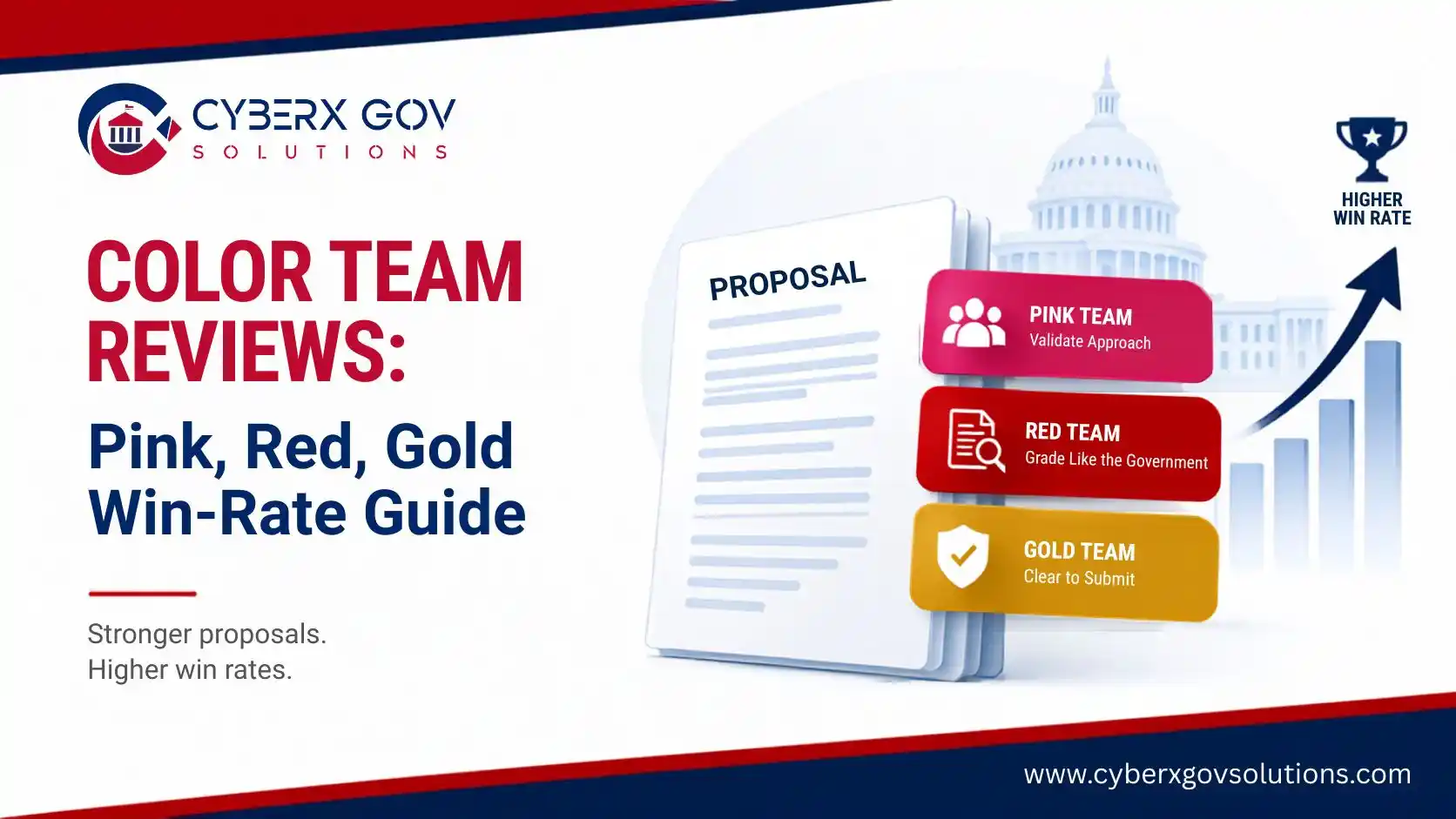
- Run color team reviews. Independent reviewers grade the draft against Section M. See the table below.
- Produce and submit. Format to spec, run a final compliance pass, and deliver before the clock runs out. Late means disqualified.
- Debrief after award. Win or lose, request a debrief. The feedback improves your next bid.
Color team reviews come from the Shipley method, the capture-and-proposal approach that has guided the industry for over 50 years. Each review answers one question.
| Review | The question it answers |
| Blue Team | Is the win strategy sound? |
| Black Hat | What will competitors likely propose? |
| Pink Team | Does the early draft comply and follow strategy? |
| Red Team | How will evaluators score the near-final draft? |
| Green Team | Is the price competitive and defensible? |
| Gold Team | Are all fixes in, and is it ready to submit? |
| White Hat | What did we learn for next time? |
How the Government Scores Your Proposal
Understanding the scorecard changes how you write. Under FAR Part 15, agencies buy on a “best value” basis. There are two main paths.
- The agency can pay more for a stronger proposal. The extra value must justify the extra cost.
- Lowest Price Technically Acceptable (LPTA). The agency picks the cheapest bid that meets the minimum bar. No credit for going beyond it.
The solicitation always states the factors and their relative importance. Read Section M first, then write to it. Many contractors write to Section C and forget how points are actually awarded.
Why do good companies lose? The Government Accountability Office (GAO) publishes protest data every year. In its report for fiscal year 2024, the most common reasons GAO sustained protests were unreasonable technical evaluations, flawed source-selection decisions, and unreasonable price evaluations. In plain terms: the details of scoring decide contracts. A compliant, well-organized proposal gives evaluators fewer reasons to mark you down.
Expert tip: Write so a busy evaluator can find your answer in seconds. Mirror the RFP language. Use the same section labels they expect. Do not make them hunt.
What’s Changing in Federal Procurement Right Now
Federal buying rules are in the middle of a major update. The Revolutionary FAR Overhaul began with Executive Order 14275, “Restoring Common Sense to Federal Procurement,” signed in April 2025. The effort rewrites the FAR in plainer language and moves some rules into companion guides.
For proposal teams, the practical message is steady: do not rely on habit. Some provisions have moved or changed, and agency systems may lag the new policy. Read each solicitation as written, and confirm current rules on official sources like acquisition.gov. This is one more reason experienced support pays off during a transition period.
Benefits of Professional Government Proposal Support
Here is what strong support actually delivers.
- Fewer compliance errors. A clean compliance matrix keeps you from getting cut before scoring even starts.
- Higher win probability. Sharper win themes and clearer writing earn more points against the evaluation factors.
- Time back for your team. Your engineers keep serving clients while specialists run the response.
- Better pricing discipline. Price-to-win support aligns your cost with the strategy and the budget.
- Senior expertise on demand. You get proposal managers and reviewers without a full-time hire.
- A process you can repeat. Good support leaves you with templates and habits for the next bid.
A Next Step
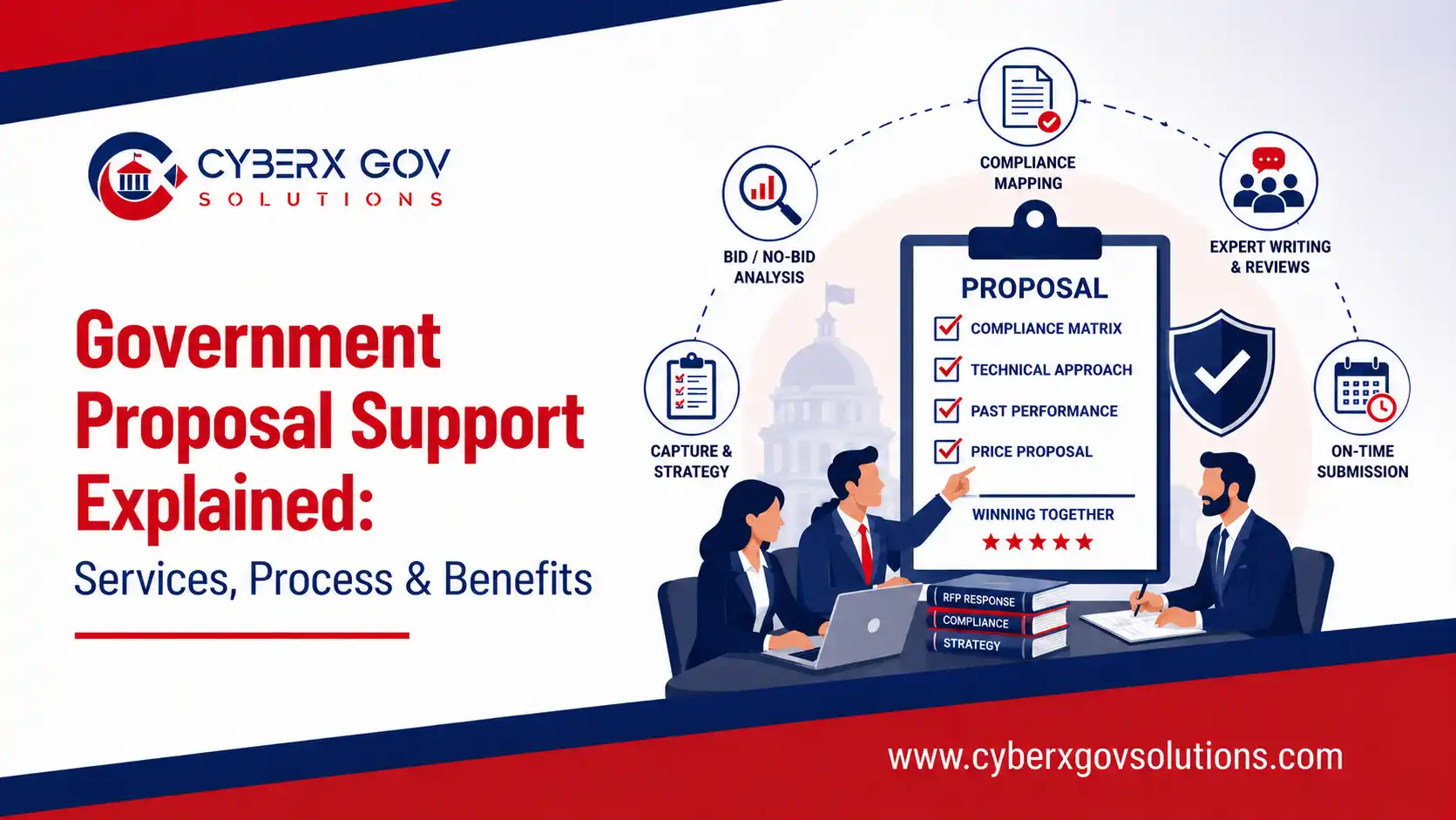
Knowing the benefits is one thing. Putting them to work on your next bid is another. CyberX Gov Solutions supports contractors across the full response, including compliance mapping, win strategy, color team reviews, and on-time submission. If your recent proposals scored well on price but fell short on technical factors, expert guidance can close that gap.
Learn how the team can strengthen your next submission at cyberxgovsolutions.com/government-proposal-writing-services/.
In-House vs. Outsourced Support
Both models work. The right choice depends on your bid volume and your bench.
| Factor | In-house team | Outsourced support |
| Best for | Steady, high bid volume | Occasional or surge bids |
| Cost model | Salaries and overhead | Per-project or retainer |
| Ramp-up speed | Slow to hire and train | Fast, often within days |
| Depth of expertise | Limited to your staff | Access to specialists |
| Control | Full internal control | Shared, needs coordination |
Many small firms start outsourced, then build an internal team as their pipeline grows.
How Much Does Government Proposal Support Cost?
Prices vary by scope, complexity, and turnaround. Industry estimates give a useful range.
- Hourly: roughly $75 to $200 per hour for experienced federal proposal help.
- Per proposal: often $3,000 to $15,000 for a standard response.
- Complex bids: $20,000 or more for multi-volume federal proposals with heavy compliance.
Remember the hidden cost of doing it alone. A single response can consume 40 to 80 hours of staff time across your company. That time has a price too, even when no invoice shows it.
Common Mistakes to Avoid
Use this checklist before you submit.
- Started too late, with no capture work before the RFP dropped.
- Skipped or froze the compliance matrix after kickoff.
- Wrote to the Statement of Work but ignored the Section M scorecard.
- Missed hidden requirements buried in the clauses and special sections.
- Used vague claims with no proof or past performance to back them.
- Left pricing to the last minute, disconnected from the strategy.
- Ran out of time for production and formatting checks.
- Chose the cheapest writer, then paid again to fix a non-compliant draft.
Simplify the Process
A tight deadline and a 90-page solicitation should not decide your bid. CyberX Gov Solutions helps contractors turn complex RFPs into clear, compliant responses through its Government Proposal Writing Services. From the first compliance matrix to final submission, the team handles the heavy lifting so your experts can stay focused on the work.
When Should You Seek Professional Support?
Consider expert help when any of these are true.
- This is your first federal RFP, and you are unsure where to start.
- The deadline is tight, and your team is already stretched thin.
- The opportunity is large enough that one loss hurts.
- Your recent bids scored well on price but lost on technical factors.
- You keep winning small work but struggle with multi-volume proposals.
If two or more apply, support usually pays for itself.
How CyberX Gov Solutions Helps
CyberX Gov Solutions provides end-to-end government proposal support through its Proposal Development service. The team works with small businesses, primes, and subcontractors on RFPs, Requests for Quotation (RFQs), and task orders.
Support includes a proposal readiness assessment, a compliance matrix and requirements mapping, win theme and strategy development, and writing across the technical, management, staffing, and past performance sections. It also covers proposal reviews, pricing narrative support, teaming coordination, and final submission help.
For companies not yet active in the federal market, the Get Fed Ready™ program covers the groundwork, including SAM.gov registration support, capability statement development, and opportunity fit analysis. When a bid calls for security-cleared staff, CyberX can also support cleared recruitment planning. The point is to remove the guesswork so your proposal reflects your real strengths.
The Bottom Line
Winning federal work is less about writing talent and more about discipline. The companies that win read the solicitation closely, map every requirement, write to the scorecard, and submit clean and on time. Government proposal support brings that discipline to your bid, especially when time is short or the stakes are high.
You do not have to build all of this alone. Start with one strong proposal, learn from the debrief, and improve from there.
Talk Through Your Next Bid
Every opportunity is different, and your proposal support should be too. CyberX Gov Solutions builds customized government proposal support around your solicitation, your capabilities, and your timeline. Whether you are bidding for the first time or scaling a busy pipeline, the team is ready to help you compete with confidence.
Schedule a free consultation at cyberxgovsolutions.com/schedule-a-meeting/
Frequently Asked Questions
What is the difference between a proposal writer and a proposal manager?
A proposal writer drafts the content of specific sections. A proposal manager runs the whole effort, including the schedule, the compliance matrix, and the reviews. Larger bids usually need both roles.
How long does it take to respond to a federal RFP?
Most agencies give 15 to 45 days, though complex bids can allow more. Strong teams do capture work for weeks before the RFP even posts, so writing time is not the whole story.
Do I need a compliance matrix if the RFP is short?
Yes. Even short solicitations bury requirements across several sections. A matrix takes an hour to start and stops you from missing a rule that could disqualify your bid.
Can a first-time contractor win a federal contract?
Yes. New firms win regularly, often through small business set-asides and by teaming with an experienced prime. Solid past performance from commercial or subcontract work helps a lot.
Is proposal support only for large defense contracts?
No. Small businesses across every industry use it for civilian and defense work, task orders, and state and local bids. The service scales to the size of your opportunity.
What happens if I submit my proposal late?
Late federal proposals are almost always rejected without review, no matter how strong they are. Building time for production and final checks is a core part of any proposal plan.