A contracting officer is reading two bids for the same medical product. One vendor writes that its device is “FDA Approved.” The device is actually FDA Cleared. That single word is now a factual error in an official federal submission.
Small slip, real risk. In government contracting, the words you use to describe your regulatory status are part of your credibility. Ensuring accuracy helps you build trust and confidence with federal buyers.
Here is the core answer up front. FDA Cleared vs Approved refers to two separate routes a product takes to reach the U.S. market. Clearance and approval are not interchangeable, and the difference changes what you can claim, what you can sell, and how an agency evaluates your bid. This guide breaks down both terms in plain English, then shows why they matter when you sell to the federal government.
Key Takeaways
- FDA Cleared most often means a medical device cleared the 510(k) pathway by proving it is “substantially equivalent” to a product already legally on the market.
- FDA Approved means the FDA reviewed independent scientific evidence and confirmed a product is safe and effective; this is the bar for the highest-risk devices, plus drugs and biologics.
- The FDA uses a third term, granted, for novel low-to-moderate-risk devices that clear the De Novo pathway.
- Federal buyers generally require valid FDA market authorization before a regulated device can be sold through channels like the VA Federal Supply Schedule.
Misstating your FDA status in a proposal can raise compliance and credibility problems, even when the mistake is honest. Accurate terminology demonstrates your commitment to integrity and professionalism.
What Does FDA Cleared Mean?
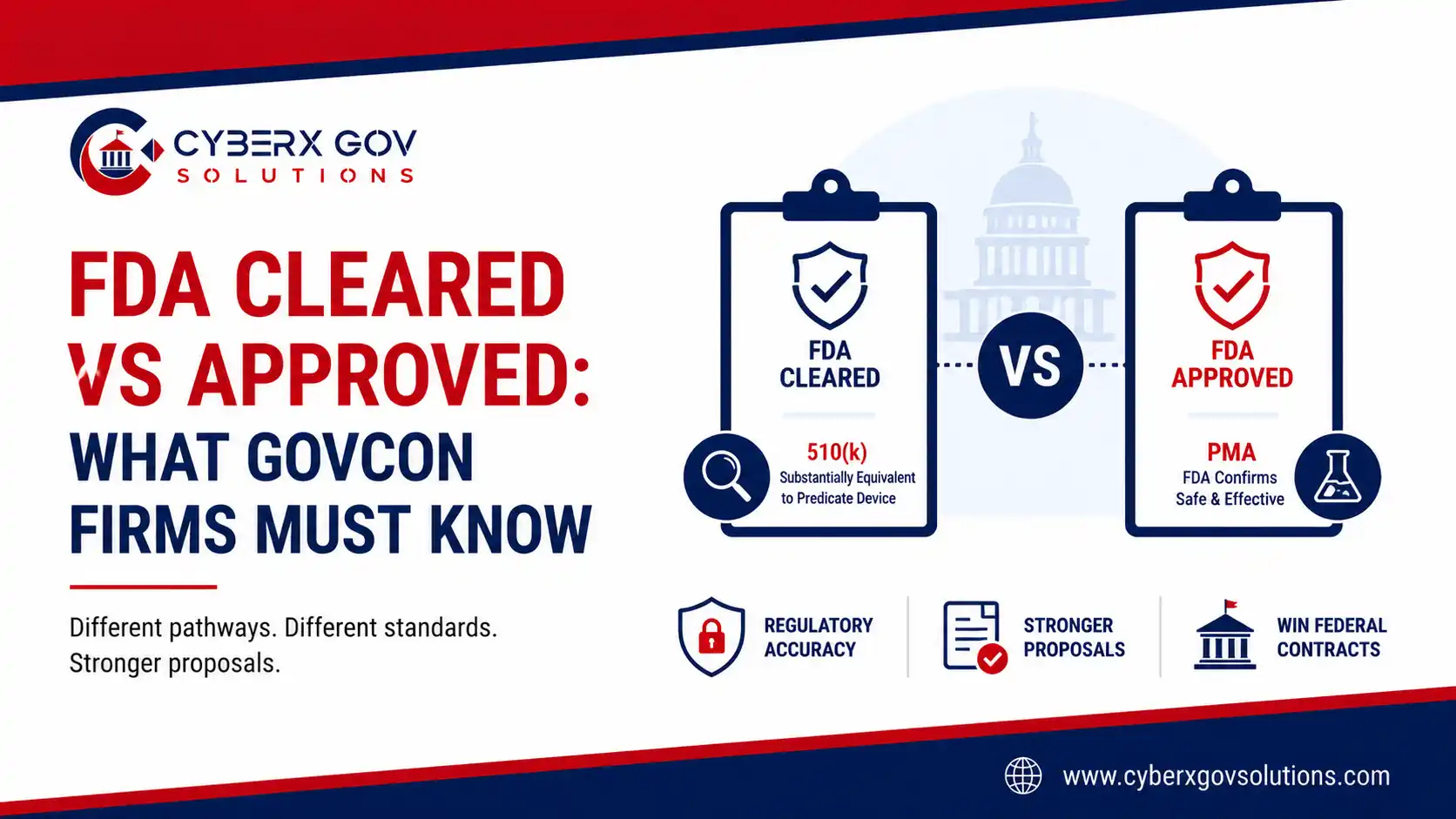
FDA cleared means a product went through the FDA’s 510(k) premarket notification process. In that process, a company shows its device is “substantially equivalent” to a device already legally sold in the United States, called a predicate device.
Clearance is common for moderate-risk products. Think blood pressure monitors, many surgical instruments, and a wide range of diagnostic tools. The FDA describes a 510(k) as a submission made “to demonstrate that the device…is substantially equivalent” to a legally marketed device that is not subject to premarket approval.
The key idea: Clearance compares your product to something already trusted. It does not always require brand-new clinical trials proving the device works on its own.
Expert tip: “Cleared” is not a weaker version of “approved.” It is a different legal pathway for a different risk level. Describing a cleared device as “approved” is not an upgrade in wording. It is an inaccuracy. For example, avoid stating “FDA approved “when your device only has 510(k) clearance, and instead specify “FDA cleared via 510(k).” This precision helps maintain compliance and build trust with evaluators.
What Does FDA Approved Mean?
FDA approved means the FDA reviewed original scientific evidence and confirmed that a product is safe and effective for its intended use. This is the FDA’s most demanding review.
For medical devices, approval comes through Premarket Approval (PMA). The FDA calls the PMA “the most stringent type of device marketing application,” and it requires “sufficient valid scientific evidence” that gives reasonable assurance the device is safe and effective. High-risk devices such as implantable pacemakers and heart valves follow this route.
The word “approved” also applies to devices:
- Drugs are approved through a New Drug Application (NDA).
- Biologics are approved through a Biologics License Application (BLA).
So a pharmaceutical or a vaccine is approved, never “cleared.” That distinction matters if your company sells across product types on federal contracts.
FDA Cleared vs FDA Approved: Key Differences
The fastest way to keep FDA cleared vs approved straight is to compare them side by side.
Feature |
FDA Cleared (510(k)) |
FDA Approved (PMA) |
| Review standard | Substantially equivalent to an existing device | Safe and effective, proven by original evidence |
| Typical risk level | Moderate risk (often Class II) | Highest risk (Class III), plus drugs and biologics |
| Evidence required | Comparison to a predicate device | Independent clinical and scientific data |
| Common examples | Blood pressure cuffs, many diagnostic tools | Pacemakers, heart valves, prescription drugs |
| FDA workload | Less intensive review | The most stringent FDA review |
There is also a third term worth knowing. When a product is new and does not fit the older categories, the FDA may use the De Novo pathway for low-to-moderate-risk devices. The FDA “grants” these requests, which is why you sometimes see “FDA granted.” A granted device can then serve as a predicate for future 510(k) submissions.
How Device Class Decides the Pathway
The FDA sorts medical devices into three classes based on risk.
- Class I (low risk): General controls apply. The FDA notes that most Class I devices are exempt from premarket notification.
- Class II (moderate risk): General and special controls apply. These devices usually need 510(k) clearance.
- Class III (highest risk): These devices support or sustain life or carry a serious risk. They generally require PMA approval.
The class depends on the device’s intended use and its indications for use. Higher risk means a tougher pathway, which is the root of the FDA cleared vs approved split.
Why the Difference Matters for Federal Contractors
For most consumers, the gap between cleared and approved is a footnote. For a federal contractor, it can affect a bid.
Here is why. A federal proposal is an official document. When you describe a product’s regulatory status, that statement becomes part of your representation to the government. If you write “FDA approved” for a cleared device, you have put an inaccurate claim into a federal record. Evaluators who know the difference will notice, and it can chip away at the trust your bid depends on. Misrepresentation can also lead to legal or contractual penalties, so accuracy is critical for compliance and credibility.
Accuracy also protects you after the award. Marketing a cleared device as “approved” has drawn legal challenges in the commercial world under false-advertising rules. Inside a government contract, the same overstatement can turn into a compliance question.
The safe habit is simple. Use the exact term the FDA used for your product, every time, in every volume of your proposal. This empowers you to present your product confidently and accurately.
FDA Compliance in Government Contracting
Selling a regulated medical product to the federal government usually starts with one gate: proper FDA market authorization.
Agencies buy products that can legally reach the U.S. market. For a medical device, that means the correct FDA pathway is complete, whether that is 510(k) clearance, De Novo grant, or PMA approval. Major federal buying channels reflect this. The VA runs a Federal Supply Schedule for medical products, and regulated devices sold through it are expected to carry valid FDA authorization.
FDA status rarely travels alone. Federal medical procurement often layers in other requirements, which can include:
- Unique Device Identification (UDI) labeling for the product.
- Quality system compliance under the FDA’s Quality System Regulation (21 CFR Part 820), now transitioning to the Quality Management System Regulation.
- Standard federal steps such as SAM.gov registration and the right NAICS codes for your business.
Expert tip: Treat FDA authorization as a foundation, not a finish line. Winning a federal medical contract also depends on how clearly you present that status inside a compliant, well-structured proposal.
How FDA Status Can Affect Proposals and Contract Opportunities
Your FDA status can shape a bid in three practical ways.
1. Eligibility. Some solicitations require FDA authorization before a product qualifies at all; no valid clearance or approval, no seat at the table for that line item.
2. Technical evaluation. When evaluators score your technical volume, an accurate, well-documented regulatory status supports your case. Vague or incorrect wording invites questions you do not want during review.
3. Past performance and credibility. Regulated buyers value vendors who describe their products precisely. A clean record of accurate FDA claims strengthens your capability statement and your past-performance story over time.
None of this requires legal jargon in your proposal. It requires precision. The FDA cleared vs approved distinction is one of the easiest places to show an agency you know your own product and your own compliance position.
When to Seek Professional Support
Handle the FDA pathway itself with your regulatory team or a specialized regulatory consultant. That is their domain.
Bring in federal contracting support when the challenge shifts to the bid: turning your verified FDA status into a compliant, persuasive proposal, mapping requirements in a solicitation, or preparing your business to enter the federal marketplace for the first time. Many capable health-tech and medical device companies hold the right FDA authorization yet still lose bids on proposal structure, compliance gaps, or unclear positioning.
That is the seam where GovCon expertise earns its keep.
How CyberX Gov Solutions Helps Federal Contractors
CyberX Gov Solutions helps medical device, health-technology, and other regulated companies present themselves well in the federal marketplace. CyberX does not perform FDA submissions or regulatory clearance work. Instead, it supports the contracting side of your effort.
Two services fit this topic directly:
- Proposal Development. CyberX builds compliant, evaluation-ready federal proposals, including compliance matrices, win themes, and technical and past-performance sections, so your verified FDA status is presented accurately and persuasively.
- Get Fed Ready™. For companies entering federal contracting, CyberX supports federal readiness, SAM.gov registration, capability statement development, and opportunity fit analysis, so a regulated product reaches the right agencies the right way.
The goal is straightforward. You confirm the FDA facts. CyberX helps you carry those facts into a winning bid.
Selling a regulated product to the federal government starts with accurate FDA status and ends with a proposal that shows it clearly. CyberX Gov Solutions helps medical device and health-tech companies present their FDA-cleared or approved products the right way through Proposal Development and the Get Fed Ready™ program.
Schedule a free consultation at cyberxgovsolutions.com/schedule-a-meeting/ to talk through your next federal opportunity.
Frequently Asked Questions
Is FDA cleared the same as FDA approved?
No. FDA Cleared usually means a device passed the 510(k) process by proving it is similar to a product already on the market. FDA approved means the FDA reviewed the original evidence and confirmed the product is safe and effective. They are different standards for different risk levels, not two names for the same result.
What does FDA cleared mean for a medical device?
FDA Cleared means the device went through the 510(k) pathway and was found “substantially equivalent” to a legally marketed predicate device. It is common for moderate-risk products, like many diagnostic and monitoring tools. Clearance lets the device be sold, but it is not the same as full premarket approval.
Do federal contracts require FDA approval to sell a device?
Federal buyers generally require valid FDA market authorization before a regulated device can be sold, which may be a 510(k) clearance, a De Novo grant, or a PMA approval depending on the product. Channels like the VA Federal Supply Schedule expect proper FDA authorization, so confirm your exact status before bidding.
What is the difference between FDA registered and FDA approved?
FDA registered means a company has listed its facility with the FDA. It does not mean the FDA reviewed or authorized any product. FDA approved means the agency has confirmed that a product is safe and effective. Calling a “registered” product “approved” is a serious and common wording error.
Why does FDA cleared vs approved matter in a proposal?
Because a federal proposal is an official record. Writing “approved” for a cleared device puts an inaccurate claim into your bid, which can raise compliance and credibility concerns during evaluation. Using the FDA’s exact term shows agencies you understand your product and your obligations.
What does FDA granted mean?
FDA granted refers to the De Novo pathway, used for novel devices of low to moderate risk that have no existing predicate. The FDA “grants” the request, and that device can later serve as a predicate for future 510(k) submissions. It is a third term alongside cleared and approved.