Winning a government contract is only the beginning. To deliver on that contract, you need qualified professionals who meet technical requirements, satisfy applicable clearance requirements, and can support your project timeline.
For small and mid-sized IT contractors, finding these professionals can be challenging. Delayed hiring can affect contract delivery, increase recruitment costs, and create staffing gaps that put project timelines at risk.
Choosing the right cleared recruitment partner can help you address these challenges. While job boards and traditional staffing firms offer recruitment support, they may not provide the ongoing capacity and structured processes that growing government contractors need.
This is where Recruitment Process Outsourcing (RPO) offers a strategic advantage.
Rather than focusing only on individual vacancies, RPO provides ongoing recruiting support that can align hiring activities with your contract requirements, staffing plans, and business development goals.
In this guide, we compare job boards, staffing firms, and RPO to explain why RPO can be the preferred solution for government contractors managing recurring cleared hiring needs.
Who Should Read This Guide?
It is particularly useful for:
- Business Development leaders preparing for new contract opportunities.
- HR and talent acquisition managers are responsible for cleared hiring.
- Program managers manage staffing requirements and delivery timelines.
- IT contractors are hiring cybersecurity, cloud, software, systems engineering, networking, and data professionals.
- Companies recruiting candidates for Secret, Top Secret, TS/SCI-related, or polygraph-required positions.
- Contractors managing multiple vacancies or preparing for post-award staffing requirements.
If your company regularly competes for federal contracts or needs to build a reliable cleared talent pipeline, choosing the right recruitment model can make a significant difference.
Why Cleared Recruitment Requires a Strategic Approach
Cleared recruitment is not ordinary IT recruiting with a security clearance filter added. Candidates must possess the required technical skills and meet the applicable security eligibility and access requirements for their positions.
For example, Top Secret eligibility does not automatically provide access to Sensitive Compartmented Information (SCI). Additional eligibility and program-specific access requirements may apply.
Several factors make cleared hiring particularly challenging:
- Limited talent availability: The pool of professionals who meet both technical and clearance requirements is smaller than the general IT workforce.
- Specialized requirements: Some positions require SCI eligibility, polygraph examinations, or program-specific access.
- Passive candidates: Experienced cleared professionals may not actively search for new opportunities.
- Tight contract timelines: New awards and contract transitions can create immediate staffing needs.
- Security coordination: Authorized security personnel may need to verify relevant eligibility and access information.
- Changing workforce demands: Contractors may need to recruit across multiple roles as contracts and task orders evolve.
A reactive approach to recruitment can make these challenges harder to manage. For example, relying on job postings each time a vacancy appears may not provide the candidate pipeline needed for a major contract ramp-up.
Similarly, using a staffing firm for every individual vacancy may create fragmented recruitment processes when hiring continues across several contracts.
A structured RPO model can help contractors build a more consistent recruitment process, maintain visibility into candidate pipelines, and plan for future staffing needs.
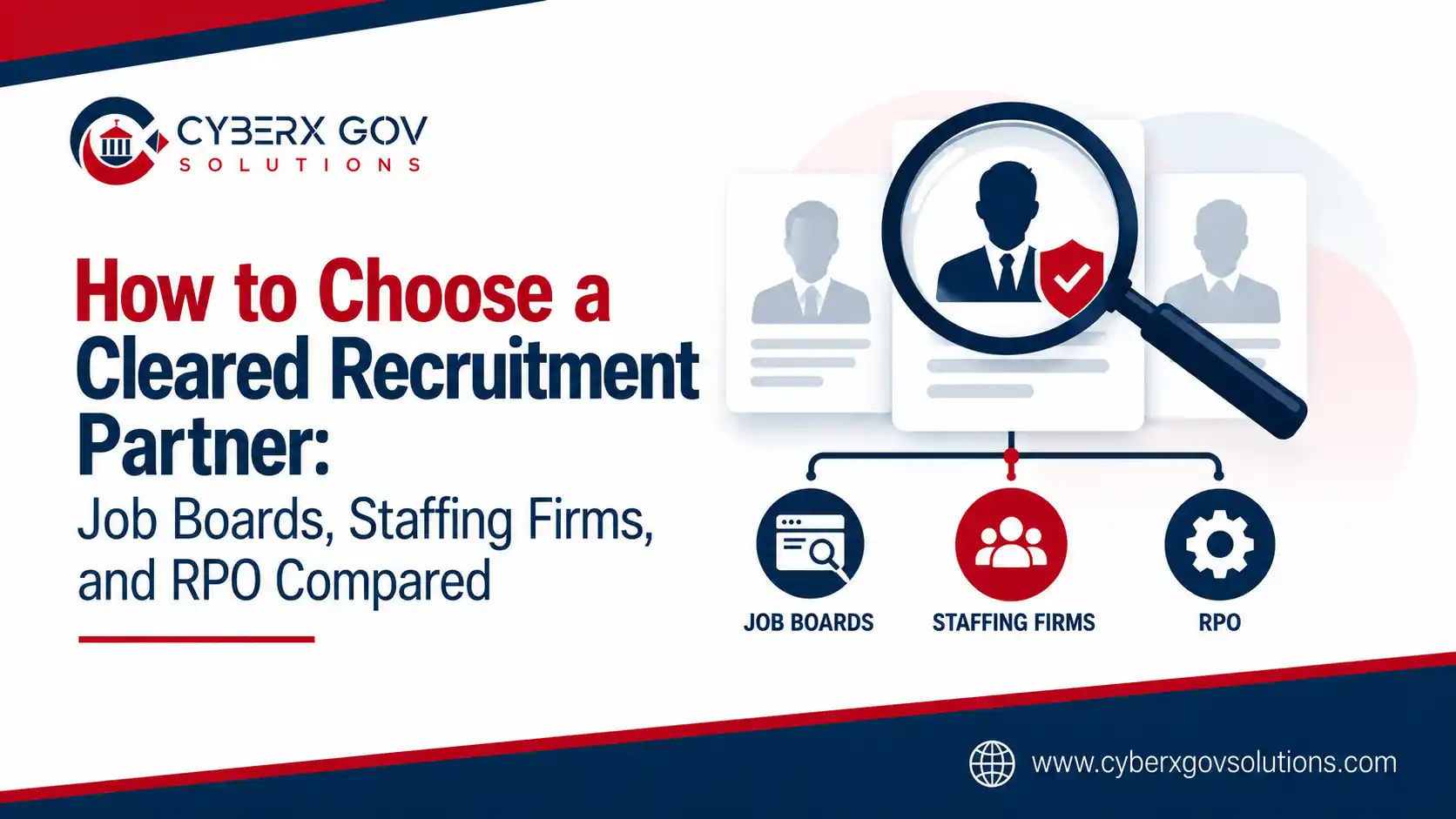
Job Board vs. Staffing Firm vs. RPO: Which Model Is Better?
All three recruitment models have a place in the market. However, their value depends on your hiring requirements and internal resources.
For contractors with ongoing cleared recruitment needs, RPO offers a more comprehensive approach because it can support the recruiting process beyond individual vacancies.
| Recruitment Model | What It Provides | Main Advantage | Main Limitation |
| Cleared job board | Job postings, search tools, and candidate access | Useful for internal recruiting teams | Requires your team to manage sourcing, screening, and follow-ups |
| Cleared staffing firm | Candidate sourcing, screening, and submissions for specific roles | Additional support for individual or urgent searches | May focus on individual vacancies rather than an ongoing recruitment strategy |
| Recruitment Process Outsourcing (RPO) | Ongoing recruiting capacity, structured workflows, and candidate pipeline management | Supports recurring hiring and longer-term workforce planning | Requires clear scope, collaboration, and an appropriate hiring volume |
A job board helps you reach candidates. A staffing firm helps you fill specific vacancies. RPO can help you establish a repeatable recruitment process that supports both current and future hiring needs.
For government contractors managing recurring cleared hiring requirements, this broader approach can provide greater consistency and visibility.
Why RPO Can Be the Better Choice for Cleared Recruitment
It Supports Ongoing Hiring Needs
Federal contractors do not always hire one person at a time. A new award, contract transition, or task order can create demand for several professionals with different technical and clearance requirements. (federal contracting opportunities)
RPO can provide ongoing recruiting capacity to support these changing needs.
Instead of starting from scratch for every vacancy, your company can work with a recruitment partner that understands your requirements and established hiring process. This can be particularly useful for contractors managing multiple programs or anticipating continued growth.
It Creates a More Consistent Recruitment Process
Recruitment becomes harder to manage when every vacancy follows a different process. RPO can establish consistent workflows for sourcing, screening, candidate communication, shortlisting, and recruitment reporting.
This gives your team a clearer view of the hiring pipeline and helps identify problems before they affect staffing plans. Consistency is especially valuable when several hiring managers are recruiting for similar technical positions.
It Aligns Recruitment With Contract Requirements
For GovCon businesses, hiring is closely connected to contract performance. You may need specific technical skills, clearance eligibility, geographic availability, and staffing timelines to support a program. An RPO partner can work with your team to understand these requirements and align recruitment activities with anticipated demand.
For example, a contractor preparing for a contract transition may need to plan for multiple cleared IT positions rather than waiting until every vacancy becomes urgent.
RPO can help organize that process, although actual hiring outcomes depend on candidate availability, eligibility, and other factors.
It Provides Greater Visibility Into the Hiring Pipeline
When recruitment is managed across different providers or internal teams, it can become difficult to track candidate progress and identify recurring bottlenecks.
An RPO arrangement can establish agreed reporting processes and performance measures.
These may include:
- Time to the first qualified candidate slate.
- Time to fill.
- Cost per qualified submission.
- Candidate-to-interview conversion.
- Interview-to-hire conversion.
- Recruitment progress by role or contract.
These measures help your company evaluate recruitment performance and identify opportunities for improvement.
It Can Support Long-Term Recruitment Efficiency
Using a different process for every vacancy can create repeated administrative work and inconsistent candidate experiences.
An established RPO process can reduce duplication by maintaining clear workflows, defined responsibilities, and consistent reporting.
The financial benefit depends on hiring volume, the agreement, and implementation costs. RPO is not automatically cheaper than every alternative.
However, for contractors with recurring recruitment requirements, the opportunity to improve process consistency and resource allocation makes it worth serious consideration.
When Should You Choose RPO Over a Job Board or Staffing Firm?
RPO is particularly worth considering when recruitment is an ongoing business requirement rather than an occasional activity.
Use this framework to evaluate your situation.
Do You Have Recurring Cleared Hiring Needs?
If your company regularly recruits across multiple contracts, RPO can provide ongoing recruiting support.
If you only need to advertise an occasional vacancy and have an experienced internal recruiter, a job board may be sufficient.
Are You Hiring Across Multiple Roles?
When several vacancies require different technical skills and clearance levels, a structured recruitment process can help coordinate sourcing and screening.
RPO can be useful when you need consistent recruiting capacity across these requirements.
Do You Need More Than Candidate Submissions?
A staffing firm may be appropriate when you need help filling one or two specialized positions.
If you also need pipeline management, recurring recruitment support, reporting, and coordination across multiple hiring requirements, RPO may offer a better fit.
Are Contract Deadlines Creating Staffing Pressure?
If a new award or contract transition creates several hiring requirements, recruitment needs to be planned around the delivery schedule.
RPO can help organize the process and establish agreed milestones.
However, no recruitment model can guarantee that every candidate will be available, eligible, and ready by a specific date.
Do You Want to Build a Repeatable Hiring Process?
If your company expects continued federal contracting work, consider how your recruitment approach will support future opportunities.
RPO can help establish a consistent process that evolves with your staffing requirements.
The key consideration is hiring volume. RPO is often the stronger strategic option for recurring cleared recruitment, while job boards and staffing firms can remain useful for specific situations.
What to Look for in a Cleared RPO Partner
Choosing RPO is only the first step. You also need to evaluate the provider’s ability to support your requirements.
Clearance and Technical Expertise
Ask about experience recruiting professionals for your required clearance levels, technical disciplines, and program environments. Understand how the provider coordinates clearance-related verification through authorized channels. A candidate’s stated clearance level alone does not establish eligibility or access for every position.
Recruitment Process and Accountability
Establish who will manage your recruitment activities, how responsibilities will be divided, and how progress will be reported. Ask about recruiter allocation, screening procedures, communication frequency, and the process for handling changing requirements.
Scalability
Your staffing requirements may increase after a new award or decrease when a project reaches a different phase. Ask how the provider can adjust recruiting capacity and whether the commercial agreement supports changes in hiring volume.
Performance Measurement
Agree on realistic performance indicators before the engagement begins. These may include time to first qualified slate, candidate quality, interview conversion, and cost per hire. Make sure the metrics reflect your actual requirements and distinguish recruiting activity from final hiring outcomes.
Pricing Transparency
Understand the full commercial arrangement, including the monthly retainer, included recruiting capacity, additional fees, minimum term, and exit conditions. A clear agreement helps you assess whether RPO is financially appropriate for your business.
12 Questions to Ask Before Signing an RPO Agreement
Before choosing a cleared recruitment partner, ask these questions in writing.
Clearance and Eligibility
- Which clearance levels and specialized hiring requirements do you support?
- How do you coordinate verification of clearance eligibility?
- What experience do you have with SCI-related and program-specific access requirements?
- Which polygraph-related roles have you supported?
- Can you describe comparable recruitment engagements without disclosing confidential information?
Delivery and Candidate Quality
- Who will manage our recruitment activities?
- How many active searches will each assigned recruiter handle?
- What is your expected time to the first qualified candidate slate?
- What technical screening occurs before candidates are submitted?
- How do you track candidate progress and report recruitment performance?
Commercial Terms
- What is included in the RPO fee, and which services cost extra?
- What are the agreement’s minimum term, capacity adjustments, and termination conditions?
Clear answers will help you determine whether the provider can support your hiring requirements.
A Scorecard for Comparing Cleared Recruitment Partners
Use this scorecard to compare potential RPO providers and other recruitment partners.
| Criterion | Weight | What Strong Performance Looks Like |
| Clearance and technical fit | 25% | Relevant experience with your requirements |
| Candidate quality | 20% | Effective screening and relevant submissions |
| Delivery accountability | 15% | Clear ownership, workflows, and reporting |
| Pricing transparency | 15% | Defined fees and understandable contract terms |
| Recruitment performance | 10% | Realistic, measurable delivery expectations |
| Scalability | 10% | Capacity aligned with changing hiring needs |
| Compliance support | 5% | Understanding of security coordination and hiring requirements |
Score each provider from 1 to 5 for every criterion. Multiply the score by the assigned weight and compare the totals. Use the results alongside reference checks and agreement reviews. A scorecard supports your decision, but it should not replace a detailed evaluation of the provider’s capabilities.
Why Consider CyberX Gov Solutions for Cleared Recruitment?
CyberX Gov Solutions supports government contractors seeking qualified professionals for cleared IT and related technical roles.
Its cleared recruitment service is designed to help businesses align candidate sourcing and screening with their technical, clearance-related, and contract requirements.
Cyberx may be worth evaluating if your company:
- Supports federal contracting work.
- Needs cybersecurity, cloud, software, systems engineering, data, networking, or IT support professionals.
- Has recurring cleared hiring requirements.
- Needs additional recruiting capacity without relying entirely on internal resources.
- Wants to align recruitment activities with contract staffing needs.
- Requires support for contract or permanent recruitment.
For contractors managing ongoing hiring requirements, an RPO-oriented approach can help connect recruitment planning with workforce needs and future contract opportunities. Before selecting a provider, discuss your hiring volume, required skills, clearance requirements, and timeline to determine whether its services fit your business.
Need help building a more consistent, cleared recruitment process? Schedule a free consultation at cyberxgovsolutions.com/schedule-a-meeting/
You can also read our guide to cleared RPO vs. in-house recruiting to understand how outsourced recruitment compares with building an internal team.
Frequently Asked Questions
What is the difference between a cleared recruitment partner and an RPO provider?
A cleared recruitment partner is a broad term for a provider supporting cleared hiring. An RPO provider manages part or all of an organization’s recruitment process, often through an ongoing arrangement.
Why is RPO useful for government contractors?
RPO can provide consistent recruiting capacity, structured workflows, and recruitment reporting. It is particularly useful for contractors managing recurring vacancies or hiring across multiple contracts.
Is RPO better than a cleared staffing firm?
RPO can be a better fit for ongoing recruitment and multiple vacancies. A staffing firm may be more appropriate for an isolated or urgent hiring requirement.
Is RPO suitable for small government contractors?
Yes, if the contractor has sufficient recurring hiring needs to justify the arrangement. Companies with occasional vacancies may find a job board or staffing firm more cost-effective.
Does RPO guarantee faster hiring?
No. RPO can improve recruitment coordination and process consistency, but actual hiring timelines depend on candidate availability, technical requirements, clearance eligibility, compensation, and other factors.
What should I consider before choosing a cleared RPO provider?
Evaluate clearance-related experience, candidate quality, recruitment capacity, reporting, pricing, scalability, and contract terms.