A grant officer asks for your UEI. You dig out an old nine-digit DUNS Number and wonder if that is the same thing. It is not, and that one mix-up stalls more registrations than it should.
If you have ever frozen on which number you actually need, you are in good company. The federal government changed how it identifies businesses a while back, and plenty of guidance online still points at the old system.
This guide clears up UEI vs DUNS in plain terms. You will learn what changed, why it changed, and the exact steps to find your UEI in SAM.gov.
What Is the UEI, and What Happened to DUNS?
The Unique Entity Identifier, or UEI, is the number the federal government now uses to identify your business. It is a 12-character mix of letters and numbers, and it is issued and managed in SAM.gov, the System for Award Management.
For years, that role belonged to the DUNS Number, a nine-digit code assigned by a private company, Dun & Bradstreet. If you registered before the change, that is the number you used to track awards and payments.
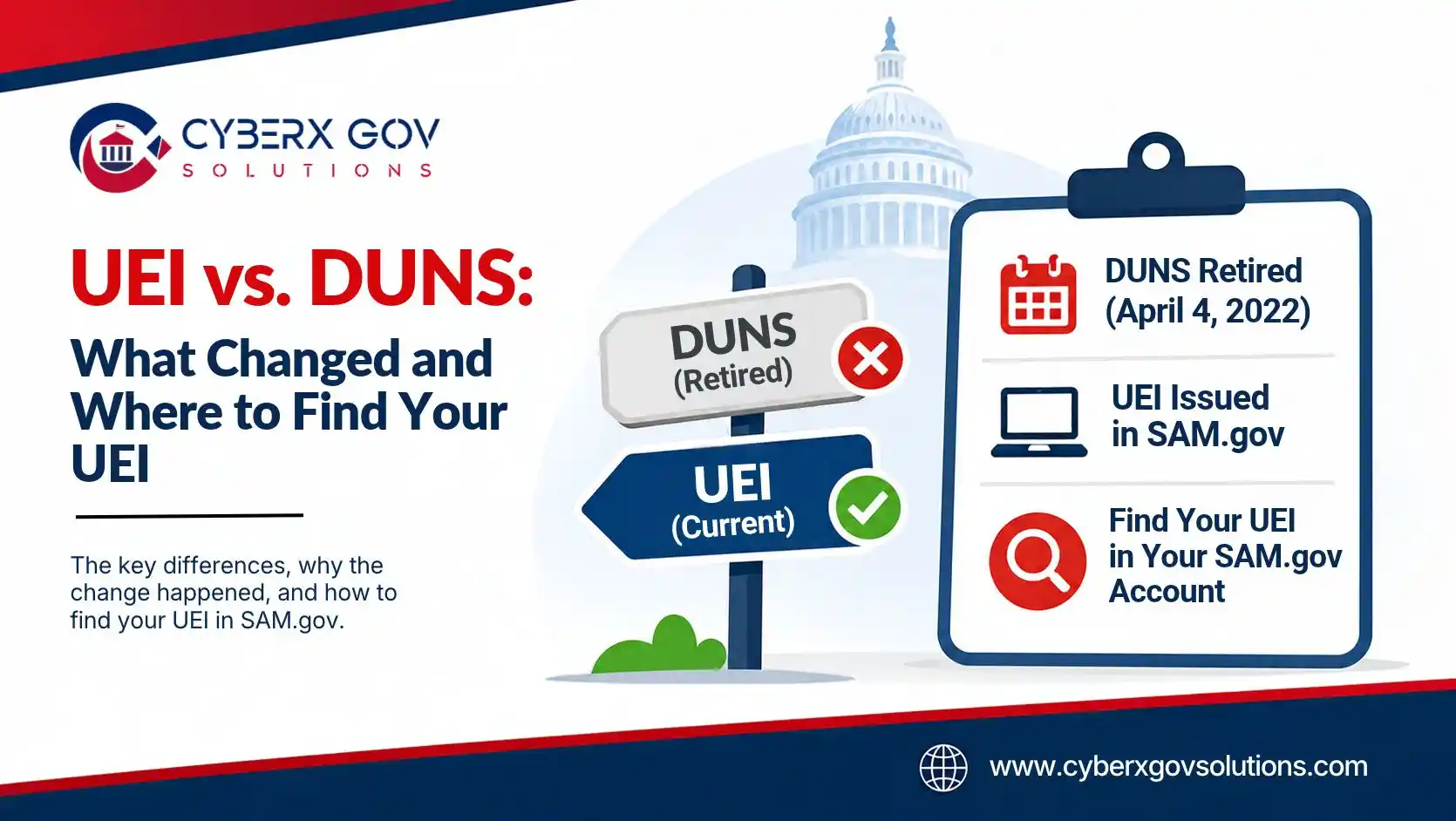
On April 4, 2022, the federal government stopped using the DUNS Number as its official identifier. The UEI, generated directly in SAM.gov, took its place.
The short version: the DUNS Number is retired for federal purposes, and the UEI is the number you need today.
UEI vs. DUNS: The Key Differences
The two identifiers do the same job, but almost everything around them changed. This table sums it up.
| Feature | DUNS Number (old) | UEI (current) |
| Format | 9 digits | 12 characters, letters and numbers |
| Issued by | Dun & Bradstreet, a private company | SAM.gov, run by GSA |
| Where you get it | A third-party website | SAM.gov |
| Cost | Free, but through an outside vendor | Free, directly from the government |
| Status | Retired for federal use | Required for federal awards |
The headline difference is control. The government now hands out your identifier itself, inside the same system where you register and manage your awards.
Why the Government Made the Switch
The move was about owning the process end to end. When a private company controlled the identifier, every contractor had to get a number from an outside source before the government could even recognize them.
By building the UEI into SAM.gov, the government removed that extra step. You now request, receive, and manage your identifier in one official place, at no cost.
For contractors, the practical win is simplicity. One site handles your identifier and your registration, instead of bouncing between a vendor and a federal system.
Do You Already Have a UEI?
Here is the part that catches people off guard. If your business was registered in SAM.gov before April 4, 2022, you already have a UEI. The system assigned it to you.
You do not need to request a new one, and you do not need your old DUNS Number to use it. Your UEI has quietly replaced it on your entity record.
If your business is new to SAM.gov, you get a UEI as part of setting up your entity. You can request a UEI on its own, or get one while completing a full registration to bid on contracts or receive awards.
Either way, the number lives in SAM.gov. That is also where you go to find it.
Here is a common scenario. A small business won a subcontract years ago, registered once, and never logged back in. The owner still has the old DUNS Number written down and assumes that is the identifier a prime is asking for. In reality, SAM.gov assigned the company a UEI back in 2022, and it has been sitting on the entity record the whole time. One login settles it.
Where to Find Your UEI in SAM.gov
Most people asking about UEI vs DUNS really just need to locate their number. Here is how to find it.
- Go to SAM.gov and sign in to your account.
- Open your Workspace and go to your entity registrations.
- Select your active entity to open its record.
- Your Unique Entity ID appears near the top of the registration details. Copy it from there.
SAM.gov updates its menus from time to time, so the exact labels may shift. The rule that holds: your UEI sits on your entity record once you are signed in.
If you only need to confirm another organization’s UEI, and its registration is public, you can search the entity by its legal business name on SAM.gov and read the UEI from its record. No login is required for public entity information.
Common UEI Confusions to Clear Up
A few mix-ups come up again and again. Sorting them out saves time.
The UEI is not your CAGE Code. The Commercial and Government Entity, or CAGE, Code is a separate identifier that still exists alongside your UEI. You can hold both. They are not interchangeable.
The UEI is not your EIN. Your Employer Identification Number comes from the IRS for tax purposes. The UEI is for federal awards. Different agencies, different jobs.
You should not pay for a UEI. Getting a UEI in SAM.gov is free. Some third-party sites charge a fee to do it for you, but the official process costs nothing.
A UEI alone is not a full registration. You can hold a UEI and still not be registered to bid. To pursue contracts or receive awards, you need a complete SAM.gov registration, not just the identifier.
You generally do not need a DUNS Number for federal work anymore. A few private processes, such as some commercial credit checks, may still use one. For federal awards, the UEI is what matters.
What to Do If You Cannot Find or Do Not Have a UEI
If you are stuck, work through it in order.
First, confirm whether your business is registered in SAM.gov at all. If it is, sign in and check your entity record, since your UEI is already there.
Second, if you have never registered, create a SAM.gov account and start your entity setup. The system walks you through getting your UEI, and our guide to SAM.gov registration in 2026 covers what commonly trips up new contractors.
Third, if your entity validation stalls, which is a common holdup, gather documents that prove your legal business name and physical address exactly as they appear on official records. SAM.gov checks these details against outside records before it issues a UEI. A shortened company name, an old address, or a missing suffix can be enough to halt the process. Line up your legal name and address exactly as they read on your formation documents, and most validation problems clear quickly.
Our guide on how to become your SAM.gov entity administrator covers the access side if you are not sure who controls your record.
How CyberX Gov Solutions Can Help
Finding a UEI is simple once you know where to look. Getting a clean SAM.gov registration behind it is where many first-time contractors get stuck.
That is where Get Fed Ready™ fits. CyberX Gov Solutions helps small businesses set up and maintain their SAM.gov registration accurately, from entity validation to keeping your record current.
If a lost login or an outdated record is blocking you, we can help you sort out access and get back in control of your entity.
Conclusion
The DUNS Number had a long run, but the UEI is the identifier federal contractors and grantees use now. It is free, it lives in SAM.gov, and if you registered before April 2022, you already have one.
The next time someone asks for your UEI, you will know exactly what they mean and where to find it. That small bit of clarity keeps your registrations, payments, and awards moving without a hitch.
Need help with your SAM.gov registration or a stuck UEI? Talk to the CyberX Gov Solutions team or schedule a consultation at cyberxgovsolutions.com/schedule-a-meeting/.
Frequently Asked Questions
Is the UEI the same as the old DUNS Number?
No. They serve the same purpose, but the UEI is a 12-character identifier issued in SAM.gov, while the DUNS Number was a 9-digit code from Dun & Bradstreet. The DUNS Number is retired for federal use.
When did the UEI replace the DUNS Number?
The federal government stopped using the DUNS Number as its official entity identifier on April 4, 2022. The UEI, generated in SAM.gov, replaced it.
How much does a UEI cost?
Nothing. Getting a UEI in SAM.gov is free. Avoid third-party sites that charge a fee for something the government provides at no cost.
Do I still need a DUNS Number for federal contracts?
Generally no. Federal awards now use the UEI. A few private processes may still reference a DUNS Number, but it is not required for federal registration.
What does a UEI look like?
It is a 12-character string of letters and numbers. That format is how you can tell it apart from a 9-digit DUNS Number at a glance.
Can I get a UEI without a full SAM.gov registration?
Yes. You can request a UEI on its own. To bid on contracts or receive federal awards, though, you still need a complete SAM.gov registration.