A federal evaluator does not read your proposal looking for reasons to like it. Reviewers score against a fixed checklist, and one missed requirement can knock a strong business out of the running before anyone even opens your pricing volume.
Most companies start out writing proposals in-house, and that works fine for a small, familiar task order. The moment a solicitation gets longer, the deadline tightens, or the compliance requirements stack up, the math changes. That’s usually when businesses start asking whether it’s time to hire a government proposal writer.
This guide walks through the signs that outside help pays off, what a proposal consultant does day-to-day, and how to pick the right partner before your next opportunity closes.
Key Takeaways
- Internal teams can usually handle small, routine solicitations without outside help.
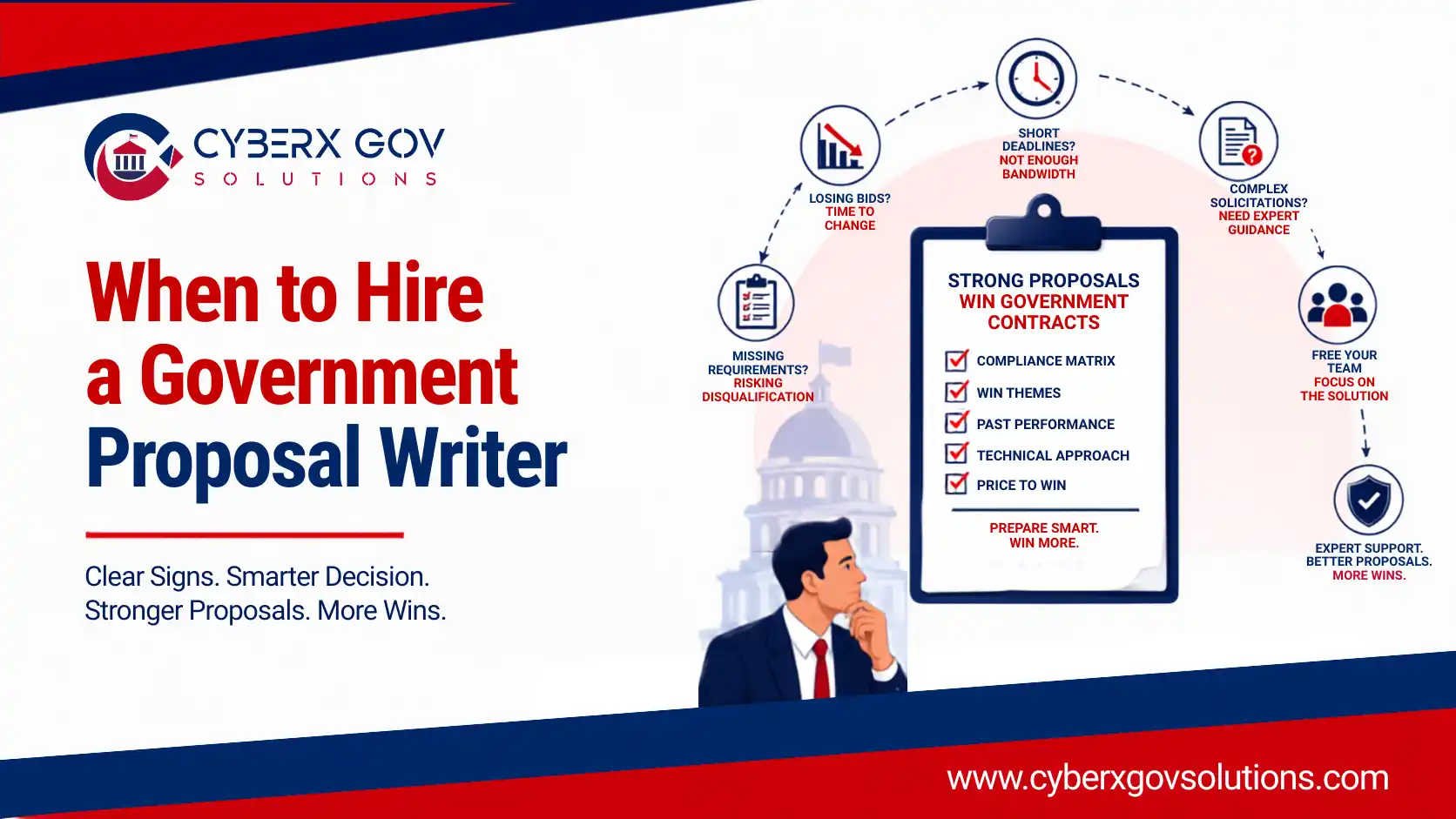
- Repeated losses, thin bandwidth, and missed deadlines are the clearest signs to hire a government proposal writer.
- A compliance matrix, built early from Section L and Section M, is one of the strongest predictors of a proposal surviving evaluation.
- Bringing in a proposal partner does not replace your internal team; it frees them to focus on the technical solution.
- The right time to engage help is during capture planning, not the week before submission.
What Is a Government Proposal Writer?
A government proposal writer is a specialist who turns your company’s technical solution into a document that satisfies every requirement in a federal solicitation. The role covers more than drafting sentences. It includes interpreting dense instructions, organizing content around evaluation factors, and ensuring nothing required is left out.
Federal agencies evaluate bids under the Federal Acquisition Regulation (FAR), a rulebook that governs how the government buys goods and services. Under FAR Part 15, contracting officers score proposals against the factors and sub-factors spelled out in the solicitation’s Section L (instructions to offerors) and Section M (evaluation criteria). A proposal writer’s job is to map your response directly to those sections so evaluators can find what they’re scoring without guessing.
Why Proposal Quality Decides Who Wins
Government evaluation is closer to a checklist than a conversation. If a required element is missing, buried, or hard to locate, reviewers are not required to search for it; many will score it as absent even if the information exists somewhere in the document.
That structure rewards organization as much as it rewards technical strength. A business with a mediocre approach but a tightly compliant proposal will often outscore a stronger business that submitted a proposal an evaluator had to work to understand. This is the core reason proposal quality, not just technical capability, determines who wins.
Signs It’s Time to Hire a Government Proposal Writer
Waiting until a deadline feels unmanageable is the most common mistake businesses make. Watch for these signs earlier:
- You’re preparing your first federal proposal and don’t yet know how Section L and Section M work.
- Your team has lost winnable bids because of formatting, missed requirements, or unclear writing rather than a weak solution.
- Solicitations are landing faster than your internal staff can turn them around.
- Technical experts are pulled off billable work to write proposal sections rather than review them.
- Multiple bids are due around the same time, and something always gets rushed.
- Deadlines routinely arrive before your team finishes internal review.
Any one of these on its own is manageable. Two or three together usually signal that proposal development is starting to cost more than it would to bring in support.
What a Government Proposal Consultant Actually Does
A government proposal consultant works across the full proposal lifecycle, not just the writing stage. Typical support includes:
- Solicitation analysis: breaking down Section L and Section M to identify every mandatory requirement.
- Compliance matrix development: mapping each requirement to a specific location in the proposal so nothing gets missed.
- Strategy and win themes: identifying what makes your business the strongest choice for this specific agency and requirement.
- Writing and content development: drafting technical, management, and past performance sections in coordination with your subject matter experts.
- Structured reviews: running pink team and red team reviews, where a team independent from the drafters evaluates the proposal the way a government reviewer would.
- Final quality checks and submission support: formatting, proofreading, and confirming every submission requirement is met.
A good consultant works alongside your subject matter experts rather than replacing them. Your engineers and technical leads still own the solution; the consultant ensures the solution reads clearly to someone scoring it against a checklist.
In-House vs. Outsourced Proposal Support
| Factor | In-House Team | Outsourced Proposal Writer |
| Best suited for | Small, familiar, low-volume solicitations | Complex, high-value, or first-time bids |
| Compliance risk | Higher without dedicated proposal staff | Lower compliance matrix built from Section L/M |
| Staff impact | Pulls technical experts off billable work | Frees technical staff to focus on the solution |
| Scalability | Limited during multi-bid periods | Flexible for overlapping deadlines |
| Review process | Often informal or skipped under time pressure | Structured pink/red team reviews |
Common Mistakes Businesses Make Without Professional Support
Proposals rarely fail because the underlying solution was weak. They usually fail for process reasons:
- Building the compliance matrix too late, or skipping it entirely.
- Writing persuasive prose that never ties back to a specific evaluation factor.
- Missing page limits, required certifications, or formatting instructions.
- Starting the proposal after the solicitation drops instead of during capture planning.
- Skipping an independent review before submission.
None of these require a technical failure to sink a bid. A contracting officer can find a proposal non-responsive on process grounds alone, before evaluators ever weigh the technical merit.
Best Practices for Choosing a Proposal Partner
Not every proposal professional brings the same level of experience. Before signing on with a partner, ask about their compliance-tracking process, review structure, and how they collaborate with your internal team.
Tip: Ask a prospective proposal partner to walk you through how they build a compliance matrix from Section L and Section M. Their answer tells you more about their process than any client list.
Look for a partner who explains, in plain terms, how they manage deadlines, revisions, and communication; not just one who promises a win.
How CyberX Gov Solutions Can Help
CyberX Gov Solutions supports federal proposal development from readiness assessment through final submission. That includes compliance matrix and requirements mapping, proposal strategy and win theme development, writing and content development for technical, management, staffing, and past performance sections, structured proposal reviews, and coordination with subcontractors and teaming partners. The team works with small businesses, primes, and subcontractors responding to RFPs, RFQs, and task orders, whether it’s a first federal bid or a recurring pipeline of opportunities.
Conclusion
Deciding when to hire a government proposal writer usually comes down to bandwidth and compliance risk, not the strength of your technical solution. If your team is losing time to proposal work that pulls them away from billable projects, or if bids keep coming back non-responsive on process grounds, that’s the signal to bring in support.
The earlier that support comes in, ideally during capture planning rather than the week before submission, the more it improves both compliance and quality. A government proposal writer does not replace your expertise. It makes sure evaluators actually see it.
Get Help With Your Next Federal Proposal
If proposal deadlines are starting to strain your team, you don’t have to sort it out alone. CyberX Gov Solutions helps businesses build compliant, well-organized federal proposals from the first compliance matrix to final submission.
Schedule a free consultation at cyberxgovsolutions.com/schedule-a-meeting/.
Frequently Asked Questions
What is a compliance matrix and why does it matter?
A compliance matrix is a document that maps every requirement in a solicitation to the exact place in your proposal where it’s addressed. It’s built from Sections L and M and helps prevent a proposal from being marked non-responsive for a missed requirement.
How much does it cost to hire a government proposal writer?
Cost depends on the size and complexity of the solicitation, the number of volumes required, and the level of support you need from full development to a single-section review. Most consultants scope pricing per proposal rather than charging a flat rate.
Can a proposal writer help with just one section instead of the whole proposal?
Yes. Many businesses bring in support for a specific section, such as the executive summary or past performance volume, while their internal team handles the rest.
Should I hire a proposal writer before the RFP is released?
When possible, yes. Engaging support during capture planning gives time to build content libraries, assign sections, and develop a win strategy before the clock starts on a formal deadline.
Do government proposal consultants work remotely?
Most do. Proposal teams typically collaborate through secure document-sharing and project management tools, which makes remote support standard rather than an exception.
What’s the difference between a pink team and a red team review?
A pink team review checks an early draft for structure and responsiveness. A red team review comes later, once the proposal is closer to completion, and evaluates it as a government reviewer would.
How do I know if my business is ready to bid on a federal proposal without help?
If your team has successfully managed proposals before, understands Sections L and M, and has the capacity to meet the deadline without pulling technical staff off other work, internal resources may be enough. If any of those are missing, outside support reduces the risk.