The federal government just set a much bigger target for veteran-owned businesses. On November 9, 2026, the first day of National Veterans Small Business Week, the Small Business Administration (SBA) announced its final FY2027 contracting goals. One number jumps off the page.
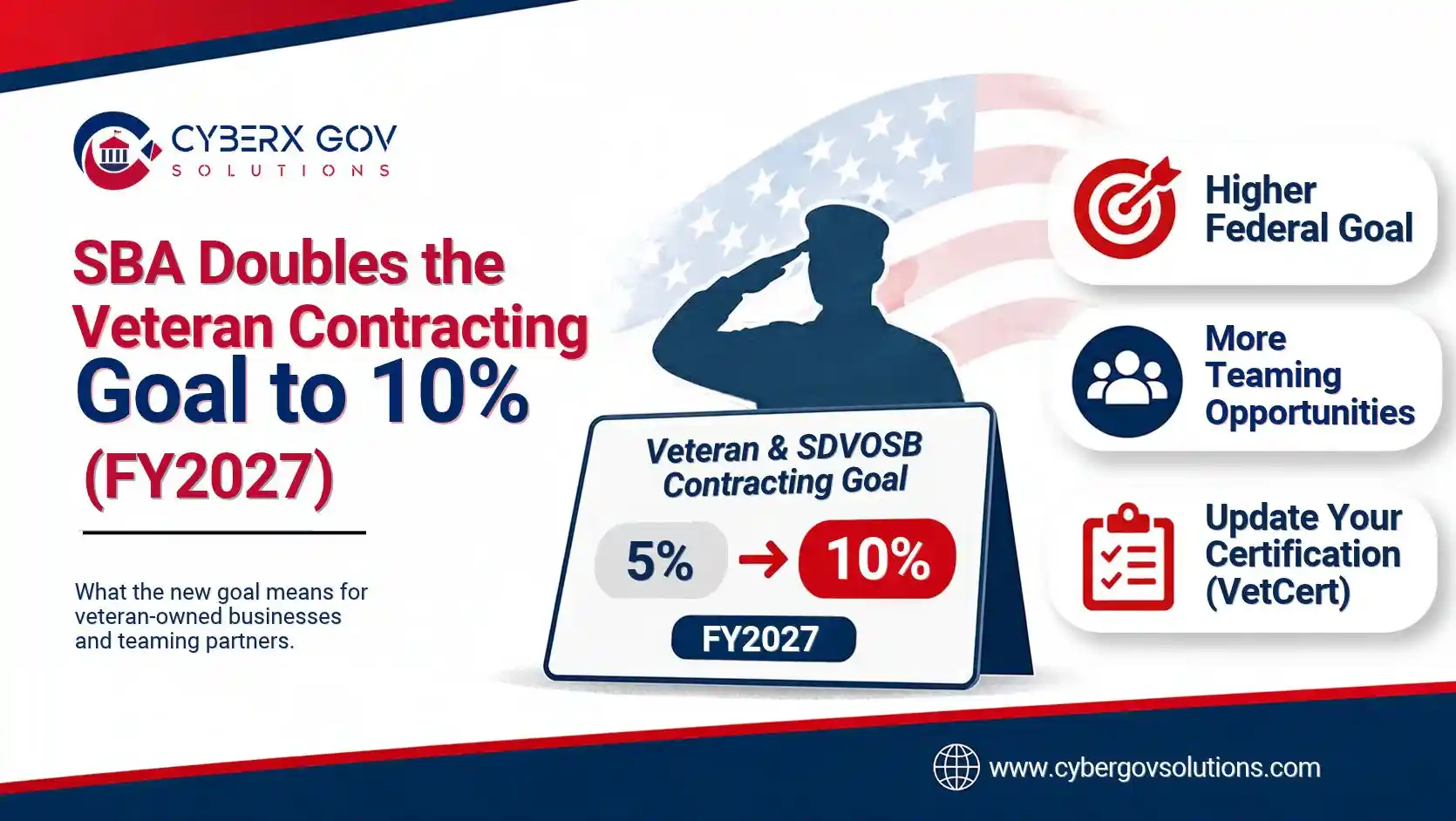
The combined goal for veteran-owned and service-disabled veteran-owned small businesses (SDVOSBs) doubles, from 5% to 10%. That new target applies at both the prime and the subcontracting levels.
If you are a certified veteran-owned firm or a prime that teams with one, this is a signal worth planning around. Here is what the veteran contracting goal change means and what to do next.
What SBA Announced for FY2027
SBA sets small business goals with federal agencies and tracks them through its annual Small Business Procurement Scorecard. For FY2027, the veteran goal is the headline, but it sits in a full table of targets.
| Category | Prime goal | Subcontracting goal |
| Veteran-owned and SDVOSB | 10% | 10% |
| Small Disadvantaged Business | 5% | 5% |
| Women-Owned Small Business | 5% | 5% |
| HUBZone | 3% | 3% |
SBA also noted that the government has exceeded its 23% statutory small business prime target for eleven years running. The veteran goal is the one that changed sharply, and it changed in both directions of the award chain.
Why Doubling to 10% Is a Big Deal
To see why this matters, look at where the goal started. According to a Congressional Research Service (CRS) report, Congress created a 3% government-wide SDVOSB goal in 1999, then raised it to 5% in the FY2024 National Defense Authorization Act.
Agencies have cleared the 5% bar on the prime side recently, surpassing it in FY2023, FY2024, and FY2025. In FY2025, the government awarded $32.5 billion in prime contracts to SDVOSBs, just above 5% of eligible dollars.
The subcontracting side tells a different story. CRS reports that the share of subcontract dollars going to SDVOSBs has stayed below the 3% mark, landing around 2.4% in FY2025. So the jump to 10% is a stretch on both sides, and the widest gap is in subcontracting.
That gap is the opportunity. Agencies and large primes measured on veteran participation now have twice the reason to go find qualified veteran-owned partners.
A Goal Is Not a Set-Aside
One point needs to be clear, because the difference decides how you act on this.
A goal is a target that agencies are measured against. It does not create a set-aside on its own, and it does not guarantee any firm an award. Contracting officers still decide, case by case, whether to limit a competition to SDVOSBs, following the rules and thresholds in the solicitation.
What actually changes is the incentive. When an agency or a prime is scored on veteran participation, a 10% goal pushes them to seek out veteran-owned firms, especially for subcontracts where the shortfall is largest. You still win on merit and compliance. The goal just widens the door.
Picture a large prime bidding a multi-year services contract. Its subcontracting plan is scored, and veteran participation now carries a 10% target instead of 5%. Adding a certified SDVOSB teammate helps that score. Multiply that across agencies and primes, and a number on paper turns into real demand for veteran-owned subcontractors.
Certification Is Your Entry Ticket
To benefit from any of this, your veteran-owned status has to be official. The days of self-certification are over. A government-wide certification process, SBA’s VetCert, is now the only path.
Per CRS, an eligible SDVOSB must be at least 51% owned and controlled by a service-disabled veteran. Certification is not permanent, either. You renew it every three years to stay eligible.
SBA has been working through demand. The agency cleared a backlog of more than 2,700 VetCert applications in 2025, and it approved over 18,000 contracting certifications for veteran-owned and service-disabled veteran-owned firms in FY2026.
If your certification is close to expiring, or you have been meaning to apply, treat this as your prompt. Get your ownership and control documentation in order now, before FY2027 competitions heat up.
What Certified Veteran-Owned Firms Should Do Now
If you already hold your certification, the goal is to be easy to find and fast to engage. A few steps put you in front of the right buyers.
- Refresh your capability statement, and make your certification status obvious on it.
- Review your FY2027 pipeline, and flag the agencies and primes with the most subcontracting need in your space.
- Prepare past performance write-ups you can send on short notice, since primes under goal pressure often look for partners quickly.
- Confirm your VetCert status is current, so a renewal date never costs you a bid.
The firms that win here will be the ones ready to respond the week a prime comes looking, not the ones still gathering documents.
What Primes and Non-Veteran Firms Should Do
The change reaches well beyond veteran-owned firms. If your teaming strategy leans on veteran partners, start those conversations earlier this year.
Verify a partner’s certification and size before you commit to them on a bid. A partner who turns out to be uncertified, or no longer small, can unwind your plan late in the process. Our guide to small business teaming covers how to build those relationships the right way.
If you are not a veteran-owned firm, expect more competition for subcontract slots and know where your own strengths set you apart. Keep an eye on a parallel development too. Industry coverage reports that the comment window on SBA’s proposed size-standards overhaul closes around November 20, 2026, and the outcome could change who counts as small in many industries. Confirm that date on SBA’s site before you rely on it.
What Else SBA Announced for Veterans
The contracting goal came with a wider veteran package during National Veterans Small Business Week.
SBA is launching a national pilot with VetsinTech to deliver training, capital access support, and procurement pathways for veteran founders in the drone and dual-use aerospace sector. On the financing side, SBA is waiving certain equity rules under the 7(a) Loan Program, so a veteran buying a business can meet the 10% equity requirement from any capital source instead of draining personal savings.
SBA also reported more than 2,800 loans to veteran-owned small businesses in FY2026, totaling $1.32 billion in federally backed capital. The theme is consistent: more access, on both the contract and the capital side.
How CyberX Gov Solutions Can Help
A bigger goal only helps if your business is ready to capture the work. That readiness is where many small firms fall behind.
CyberX Gov Solutions helps veteran-owned and other small businesses get positioned through Get Fed Ready™, from capability statements to teaming strategy and federal-market readiness. When an opportunity lands, our proposal development team helps you turn it into a compliant, competitive response.
The goal is simple: make sure that when a prime or an agency goes looking for a veteran-owned partner, your firm is the one they can act on fast.
Conclusion
Doubling the veteran contracting goal to 10% does not hand anyone a contract. It does change where agencies and primes will spend their attention over the next year, and the subcontracting gap is wide enough to create real openings.
Get certified, stay current, and be ready to respond. The firms that prepare now will meet the FY2027 push in a position to win.
Planning your FY2027 pursuits or building a teaming strategy around the new goal? Talk to the CyberX Gov Solutions team or schedule a consultation at cyberxgovsolutions.com/schedule-a-meeting/.
Frequently Asked Questions
What is the new FY2027 veteran contracting goal?
SBA doubled the combined goal for veteran-owned and service-disabled veteran-owned small businesses from 5% to 10%. It applies at both the prime and subcontracting levels, starting in fiscal year 2027.
Does a 10% goal mean more set-aside contracts for SDVOSBs?
Not automatically. A goal is a target agencies are measured against, not a set-aside. It gives agencies and primes a stronger reason to seek veteran-owned partners, but each set-aside decision still rests with the contracting officer.
Do I need SBA certification to count toward the goal?
Yes. Self-certification has ended. A firm must be certified through the SBA’s VetCert process, be at least 51% owned and controlled by a service-disabled veteran, and renew that certification every three years.
Where is the biggest opportunity under the new goal?
Subcontracting. The share of subcontract dollars going to SDVOSBs has stayed below 3%, so the move to a 10% target leaves the most room to grow on the subcontracting side.
How much did SDVOSBs win in federal prime contracts recently?
In FY2025, the government awarded $32.5 billion in prime contracts to SDVOSBs, just above the prior 5% goal. The new 10% target asks agencies to roughly double that share.
I am not a veteran-owned firm. How does this affect me?
Expect more competition for subcontract slots, and more primes looking for certified veteran partners. Verifying a partner’s certification and size early protects your teaming plans.