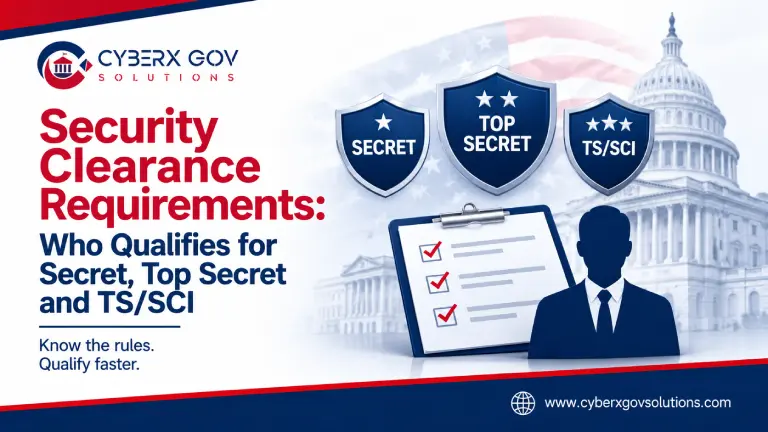
A job post says “Secret clearance required,” and a strong candidate stops cold, unsure if they even qualify. The honest answer is that it depends less on the job title and more on two things: you and whether a role actually needs the access.
Security clearance requirements are not a checklist you complete alone. They are a mix of hard rules, like citizenship, and a judgment call about whether you can be trusted with classified information.
This guide breaks down who qualifies, what every clearance demands, and what changes as you move from Secret to Top Secret to TS/SCI. For a refresher on what the levels themselves mean, pair this with our guide to security clearance levels.
What Does It Take to Qualify for a Security Clearance?
Every clearance, at every level, rests on the same core requirements. Meet these, and you are in the running. Miss one, and the process stops.
- A sponsoring employer or agency with a genuine need for you to access classified information.
- S. citizenship, with only a narrow exception for non-citizens in rare cases.
- A completed SF-86, the Questionnaire for National Security Positions, submitted through the eApp system.
- A background investigation into your history.
- A favorable adjudication under the National Security Adjudicative Guidelines.
- Enrollment in continuous vetting once you are cleared.
The level you need, Secret or higher, mainly changes how deep the investigation goes and what extra steps apply. The foundation stays the same.
One distinction runs through all of it. “Eligibility” is the government’s decision that you can be trusted to hold a clearance. “Access” is being read into classified material for a specific job. You can be eligible without being in access, and a sponsor is what turns that eligibility into active access.
You Cannot Get a Clearance on Your Own
Here is the rule that surprises the most people. You cannot apply for a security clearance as a private individual. There is no form you can file on your own to get one.
A clearance is always tied to a job that requires access to classified information. A federal agency or a cleared contractor with a contract that needs it has to sponsor you. No sponsor, no clearance.
That is why the fastest path into cleared work is a cleared job offer. The employer initiates the process once they hire you for a role that needs access. If you already hold a clearance, it can often follow you to a new employer, which we cover in our guide to security clearance reciprocity.
Consider a software engineer with no clearance who gets an offer on a federal contract. She could not have applied for one in advance. The contractor sponsors her, submits her SF-86, and the role’s need for access is what justifies the clearance in the first place. Without that role, there is nothing to sponsor.
You may not have to wait for the full process to finish, either. When the role allows it, your employer can request interim eligibility, which can let you start work while the full investigation continues. Our post on interim clearances clears up the common myths around that step.
The Citizenship Requirement
U.S. citizenship is the clearest hard line in the process. As a rule, you must be a U.S. citizen to be granted a security clearance.
There is a narrow exception. In rare cases where a non-citizen has a skill the government needs and cannot easily find, an agency may grant a Limited Access Authorization (LAA) for specific, limited access. This is uncommon and tightly controlled, not a general path.
Dual citizenship, on its own, does not automatically disqualify you. What draws scrutiny is conduct tied to a foreign country, such as using a foreign passport, which falls under the adjudicative review covered below.
The Clearance Process, Step by Step
Meeting the requirements is a sequence, not a single event. Each step has to be cleared before the next one counts.
- Get sponsored. A cleared employer or agency hires you for a role that needs access and starts the process. Nothing moves without this.
- Complete the SF-86. You fill out the Questionnaire for National Security Positions in the eApp system, reporting your history in detail.
- Undergo the investigation. Investigators verify what you reported, pulling records and, depending on the level, interviewing people who know you.
- Receive an adjudication. An adjudicator weighs the findings against the National Security Adjudicative Guidelines and decides whether you are eligible.
- Stay in continuous vetting. Once cleared, your record is monitored on an ongoing basis instead of only at a scheduled reinvestigation.
The higher the level, the deeper the investigation at the third step. The sequence itself is the same whether you are after a Secret or a TS/SCI.
Requirements by Level: Secret, Top Secret, and TS/SCI
As the sensitivity of the work rises, the requirements get stricter. The baseline eligibility is the same, but higher levels add depth and steps.
| Level | What it adds to the baseline |
| Secret | A background investigation sized to the Secret level |
| Top Secret | A more extensive background investigation |
| TS/SCI | Top Secret eligibility, plus separate SCI eligibility, a nondisclosure agreement, and sometimes a polygraph |
The higher the level, the deeper the investigation into your background and the more of your history it covers. Our security clearance levels guide breaks down the investigation tiers behind each one.
TS/SCI deserves a closer look, since it causes the most confusion of any clearance term. Sometimes written TSSCI or “top secret / SCI,” it is not a separate, higher clearance on its own. It is a Top Secret clearance plus access to Sensitive Compartmented Information (SCI). That is the real difference between TS and TS/SCI: the added SCI access, not the base clearance. TS/SCI requirements add a separate eligibility review and a signed nondisclosure agreement, and some agencies and programs also require a counterintelligence or full-scope polygraph.
Who Qualifies: The Trustworthiness Bar
Beyond the hard rules, the heart of a clearance decision is trust. An adjudicator asks a single question: can the government rely on you to protect classified information?
That decision follows the National Security Adjudicative Guidelines and the whole-person concept. Instead of judging one fact in isolation, the adjudicator weighs your full record, including how serious any issue was, how recent, and whether you have shown responsibility since.
This is why no single blemish automatically ends your chances. Debt, a foreign relative, or an old mistake is a concern to explain, not an automatic denial. Our post on security clearance disqualifiers walks through how those judgments actually work.
What the Background Investigation Examines
The investigation is not a single yes-or-no check. It looks across your life for anything that could affect your reliability or expose you to pressure.
The adjudicative guidelines sort those concerns into a set of areas. The main ones include:
- Allegiance to the United States, plus any foreign influence or foreign preference from close ties abroad.
- Financial behavior, since heavy or unexplained debt can create pressure to misuse access.
- Personal conduct, including how honest you are during the process itself.
- Criminal history and any pattern of rule-breaking.
- Drug involvement and alcohol use.
- Psychological conditions are judged only by how they affect reliability, not by a diagnosis alone. Seeking counseling is not, by itself, a concern.
- How have you handled protected information and technology in the past?
No single area decides the outcome. The adjudicator weighs them together under the whole-person concept, which is why context and honesty carry so much weight.
What Can Keep You From Qualifying
A few things do carry real weight against you. Knowing them helps you prepare.
Current illegal drug use is a hard barrier, since federal law bars a current unlawful user from holding a clearance. Unresolved financial problems, undisclosed foreign ties, and a pattern of rule-breaking all raise serious concerns.
The single most avoidable problem is dishonesty on the form itself. Leaving something off your SF-86, or shading the truth, damages your case more than most of the issues people try to hide. Our SF-86 checklist explains how to report a clean, complete history.
How to Meet the Requirements
The process rewards preparation. A few steps put you in the strongest position.
- Land a role that requires a clearance, so a sponsor can begin the process.
- Gather your full history before you start the SF-86, so your dates and details are accurate.
- Disclose everything the form asks for, and explain any issue rather than hide it.
- Once cleared, stay reliable, since continuous vetting monitors you on an ongoing basis.
For a realistic picture of how long each stage takes, see our guide to the security clearance timeline.
Keeping a Clearance, Not Just Getting One
Qualifying is the start. Staying eligible is a requirement of its own.
Under continuous vetting, your record is checked on an ongoing basis, so a new issue can surface at any time rather than only at a scheduled reinvestigation. You are also expected to self-report certain changes to your security officer, such as a new close foreign contact, a serious financial problem, or an arrest.
The practical point is simple. The same judgment that earns a clearance is what keeps it. Handle your finances, your foreign contacts, and your conduct the way the guidelines expect, and your eligibility will hold as you move between roles.
Key Takeaways
- A security clearance always requires a sponsor and a role that needs access. You cannot apply on your own.
- S. citizenship is the standard rule, with only a narrow Limited Access Authorization exception for non-citizens.
- Eligibility runs on the SF-86, a background investigation, and a favorable adjudication under the whole-person concept.
- Higher levels mean a deeper investigation. TS/SCI adds SCI access, a nondisclosure agreement, and sometimes a polygraph.
- Honesty on the form matters more than most of the issues people try to hide, and continuous vetting means your eligibility has to be maintained, not just earned.
How CyberX Gov Solutions Can Help
The hardest requirement to meet on your own is the first one: a sponsor. That is where the right connection changes everything.
CyberX Gov Solutions runs a cleared recruitment service that matches security-cleared professionals and candidates ready to be sponsored with federal contractors who need them. If you already hold a clearance, we can help you find your next role. If you are hiring, we help you fill cleared seats with people who meet the requirements.
The goal is simple: connect qualified people with roles where their clearance works for them.
Conclusion
Security clearance requirements come down to a few clear rules and one big judgment. You need citizenship, a sponsor, and a role that requires access, and then you need to show you can be trusted.
Know the rules, meet the baseline, and report your history honestly. Do that, and a clearance stops being a mystery and becomes a step you can plan for.
Looking for a cleared role or trying to fill one? Talk to the CyberX Gov Solutions team or schedule a consultation at cyberxgovsolutions.com/schedule-a-meeting/.
Frequently Asked Questions
Do I need a job offer to get a security clearance?
Effectively, yes. You cannot apply as a private individual. A federal agency or a cleared employer that needs access must sponsor you, and the clearance is tied to that specific role.
Do you have to be a U.S. citizen to get a security clearance?
As a rule, yes. U.S. citizenship is required. A narrow Limited Access Authorization can allow a non-citizen specific access in rare cases, but that is uncommon and tightly controlled.
What is the difference in requirements between Secret and Top Secret?
The baseline eligibility is the same. A Top Secret clearance requires a more extensive background investigation that reaches further into your history than a Secret-level investigation.
What is the difference between a Top Secret and a TS/SCI clearance?
TS/SCI is a Top Secret clearance plus access to Sensitive Compartmented Information (SCI). The base clearance is the same. The difference is the added SCI access, which brings a separate eligibility review, a nondisclosure agreement, and, for some agencies, a polygraph.
A job posting says it requires an active Top Secret clearance. Do I qualify?
It means the employer needs you to already hold, or be eligible for, a current Top Secret clearance for that role. If you hold one, it can often transfer through reciprocity. If you do not, the employer would have to sponsor you, assuming the position justifies the access.
What does a security clearance background check look at?
It reviews areas such as your finances, foreign contacts, criminal history, drug and alcohol use, and personal conduct, weighed together under the whole-person concept. The aim is to judge your reliability and whether you could be pressured.
Can a non-citizen get a security clearance?
As a rule, no. A clearance normally requires U.S. citizenship. In rare cases, a non-citizen with a skill the government needs may receive a Limited Access Authorization for specific, limited access, but that is uncommon.
What automatically disqualifies you from a clearance?
Very little is truly automatic, with current illegal drug use being a firm legal barrier. Most concerns, such as debt or foreign contacts, are weighed in context rather than treated as instant denials.
Does a clearance expire if I change jobs?
Your access ends when the job ends, but your eligibility can stay on record. A new sponsoring employer can often pick it back up through reciprocity, as long as it is current and at the right level.