A late credit card. Relatives overseas. A joint you smoked years ago. Now a cleared job is on the table, and part of you is already convinced you have blown it.
Take a breath. Most of the security clearance disqualifiers people worry about are not automatic denials at all. They are concerns an investigator reviews in context, and plenty of applicants clear them every year.
This guide explains how debt, foreign contacts, and past drug use are really judged, what actually sinks a case, and what you can do to strengthen yours.
The Short Answer: Concerns, Not Automatic Denials
Clearance decisions follow the National Security Adjudicative Guidelines, the standards set by Security Executive Agent Directive 4 (SEAD 4), effective June 8, 2017. Every federal agency uses them.
The guidelines do not list crimes that end your chances on sight. They list thirteen areas of possible concern, each with conditions that raise a flag and conditions that calm it.
One line matters most. Adverse information about a single issue may not be enough to deny you on its own. Adjudicators look at the full picture before they decide.
There are a few true legal bars, and we cover those below. Outside of them, debt, foreign family, and an old mistake are issues to explain, not walls you cannot pass.
How Adjudicators Actually Decide
The core of every clearance decision is the “whole-person concept.” Instead of judging one bad fact, the adjudicator weighs your whole record.
They look at several things about any concern:
- How serious it was and the circumstances around it
- How recent and how frequent it was
- Your age and maturity at the time
- Whether you acted voluntarily
- Signs of rehabilitation or changed behavior
- The chance it happens again
A problem from ten years ago, handled responsibly since, carries far less weight than the same problem last month. Time on your side and proof you have changed are the strongest things you can bring.
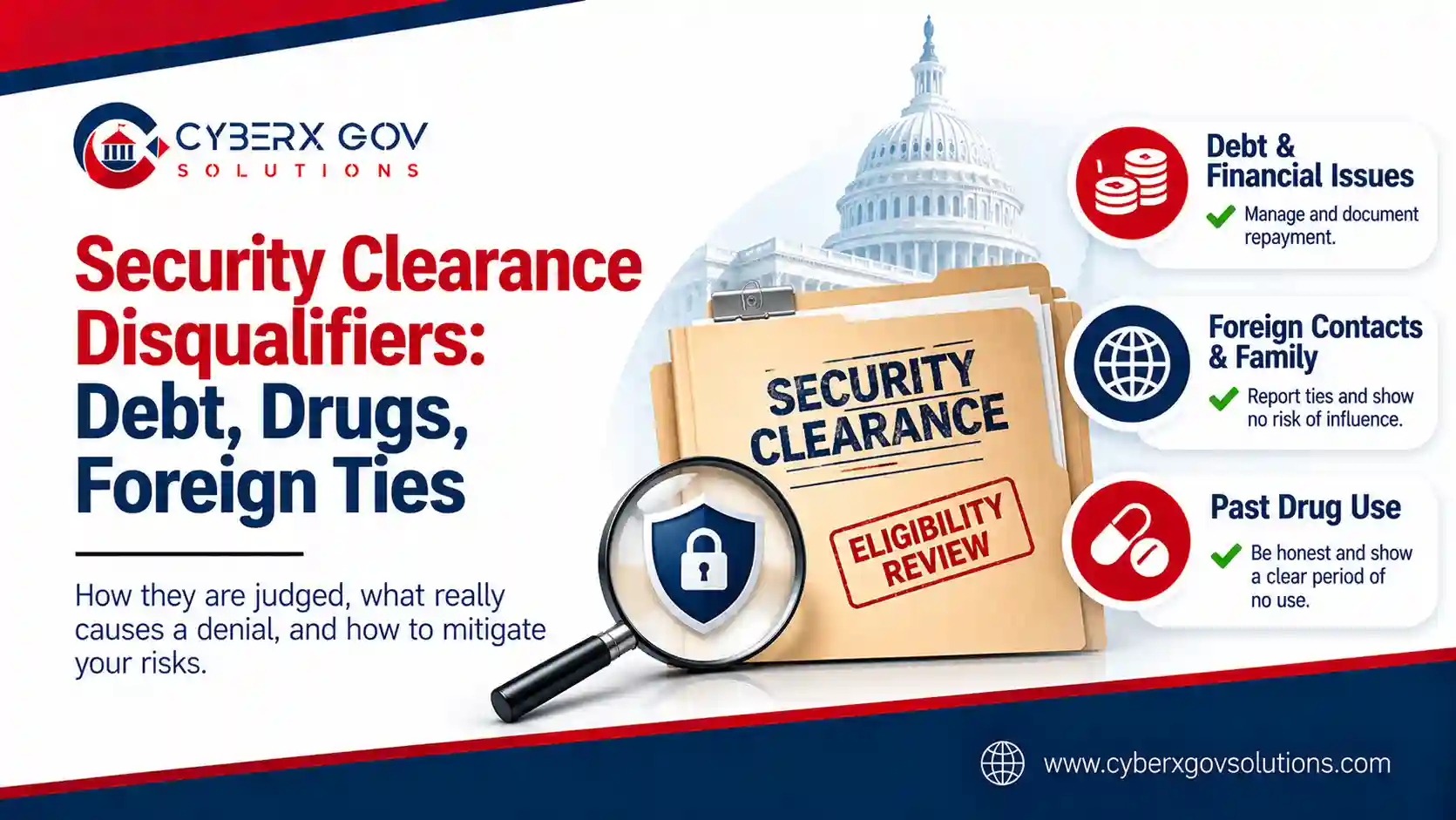
Debt and Financial Problems (Guideline F)
Money is the single most common clearance concern. The worry is simple: someone who is financially overextended could be tempted into illegal acts to get out of the hole.
What raises a flag is a history of not paying debts or an unwillingness to deal with them. What calms it is responsible behavior.
The guidelines spell out mitigation that works in your favor:
- The problem was not recent or a one-time event
- It came from conditions largely beyond your control, such as job loss, a medical emergency, a death, or divorce
- You made a good-faith effort to repay or settle what you owe
- You got financial counseling, and the issue is now under control
Bad credit alone rarely ends a case. Investigators want to see that you faced the debt and built a plan. A payment arrangement you can document beats a perfect score you cannot explain.
If your finances took a hit from something real, say so and show the paperwork. Honesty plus a repayment record is a strong answer.
Foreign Contacts and Family (Guideline B)
Having relatives or friends abroad does not disqualify you. Millions of cleared professionals have family in other countries.
The concern is foreign influence: the risk that a close tie could be used to pressure you, or could pull your loyalty in two directions.
Here again, mitigation is built into the rules:
- Your relatives or contacts are not agents of a foreign power, and cannot be used to force you to choose between them and the United States
- Your contact with foreign citizens is casual and infrequent
- You promptly report foreign contacts when you are required to
The deciding question is pressure. An ordinary relationship with family overseas is very different from a tie that a foreign government could exploit. Report your contacts honestly, and most ordinary connections are fine.
Past Drug Use (Guideline H)
Past drug use worries applicants more than almost anything. The key is the gap between “past” and “current.”
The guidelines treat recent or ongoing involvement harshly. Using drugs after you hold a clearance will almost always end in a denial. Current use is a different category from history.
Older use can be mitigated when:
- It was not recent
- It was isolated or out of character
- You show a clear intent not to use drugs again
- You completed the treatment with a good prognosis
Marijuana deserves its own note. In guidance signed in December 2021, the Director of National Intelligence said past recreational marijuana use should not be determinative on its own. The same guidance is blunt about what comes next: stop all use once you enter the vetting process.
One warning on legality. A state legalizing marijuana does not change federal rules. Under the Bond Amendment (50 U.S.C. 3343), a current unlawful user of a controlled substance cannot be granted or renewed a clearance, at any level, with no waiver written into the law. Where you live does not change that.
Even CBD products carry risks. Officials have cautioned that using cannabis derivatives may still matter to a clearance decision, so read labels and think twice before you buy.
Picture two applicants who used marijuana in college. One stopped years ago and says so plainly on the form. The other kept using right up to the week they signed. Same history, very different outcome, decided by recency and intent.
The Real Security Clearance Disqualifiers
A handful of things genuinely end cases. Knowing them helps you see how much room the rest leave you.
| Issue | How it is treated |
| Lying or leaving facts off your SF-86 | A serious concern on its own, and often worse than the issue hidden |
| Current illegal drug use | Barred by law for any clearance, with no statutory waiver |
| Serious convictions (for the highest access) | For Special Access, Restricted Data, or SCI, a sentence over a year with at least a year served triggers a statutory bar, though a waiver is possible |
| Refusing to address a known problem | Unpaid debts you ignore, or drug use you intend to continue, point the wrong way |
Notice the pattern. The red lines are about current conduct and honesty, not old history. For a deeper look at avoiding form errors, see our SF-86 checklist.
What You Can Do to Strengthen Your Case
You have more control than you think. A few habits move the odds in your favor.
Disclose everything the form asks for, even the uncomfortable parts. The omission almost always does more damage than the fact. Our post on disclosing fully explains why concealment backfires.
Document your mitigation. Gather the payment plans, the completion certificate, the dates that show time has passed. Give the adjudicator reasons to say yes.
Stay consistent. Make sure what you report lines up with what the record shows, so nothing looks like a cover-up.
If you want the bigger picture on how long this takes and which level you need, start with our guides to the security clearance timeline and security clearance levels.
How CyberX Gov Solutions Can Help
CyberX Gov Solutions does not adjudicate clearances, and no one can promise an outcome. What we do is connect security-cleared professionals with federal contractors who need them.
Through our cleared recruitment service, we match cleared talent to the right role and clearance level, from Secret to Top Secret to TS/SCI. If you already hold a clearance, we help you find your next position. If you are hiring, we help you fill cleared seats without losing months.
The goal is simple: keep good people and good contracts moving forward.
Conclusion
The fear that debt, a foreign family, or an old mistake has already cost you a clearance is usually bigger than the reality. The system is built to weigh the whole person, not one bad chapter.
Face your issues head-on, show how you have handled them, and never hide anything on the form. Do that, and the most common concerns become explainable, not fatal.
Looking for your next cleared role, or trying to fill one? Talk to the CyberX Gov Solutions team or schedule a consultation at cyberxgovsolutions.com/schedule-a-meeting/.
Frequently Asked Questions
Does bad credit automatically disqualify me from a security clearance?
No. Debt is a common concern, not an automatic denial. Investigators look for responsible handling, such as a repayment plan or a clear reason the problem was beyond your control.
Will having family in another country deny my clearance?
Not by itself. Many cleared professionals have foreign relatives. The concern is whether a contact could be used to pressure you, so report your foreign contacts honestly.
How long should I wait after past drug use before applying?
There is no single fixed number in the current guidelines, and more time always helps. The safest move is to stop all use the moment you enter the vetting process and show a firm intent not to use again.
Can unpaid taxes affect my clearance?
Yes. Unfiled or unpaid taxes fall under financial concerns and can delay a case. Filing, setting up a payment plan, and documenting it are the steps that help most.
Is one old arrest a dealbreaker?
Usually not. A single old, resolved matter is often mitigated by time and context. Leaving it off your form, however, creates a far more serious honesty problem.
Is legal state marijuana use safe for clearance holders?
No. Federal rules still control, and current use is disqualifying regardless of state law. The Bond Amendment bars a current unlawful drug user from holding a clearance.