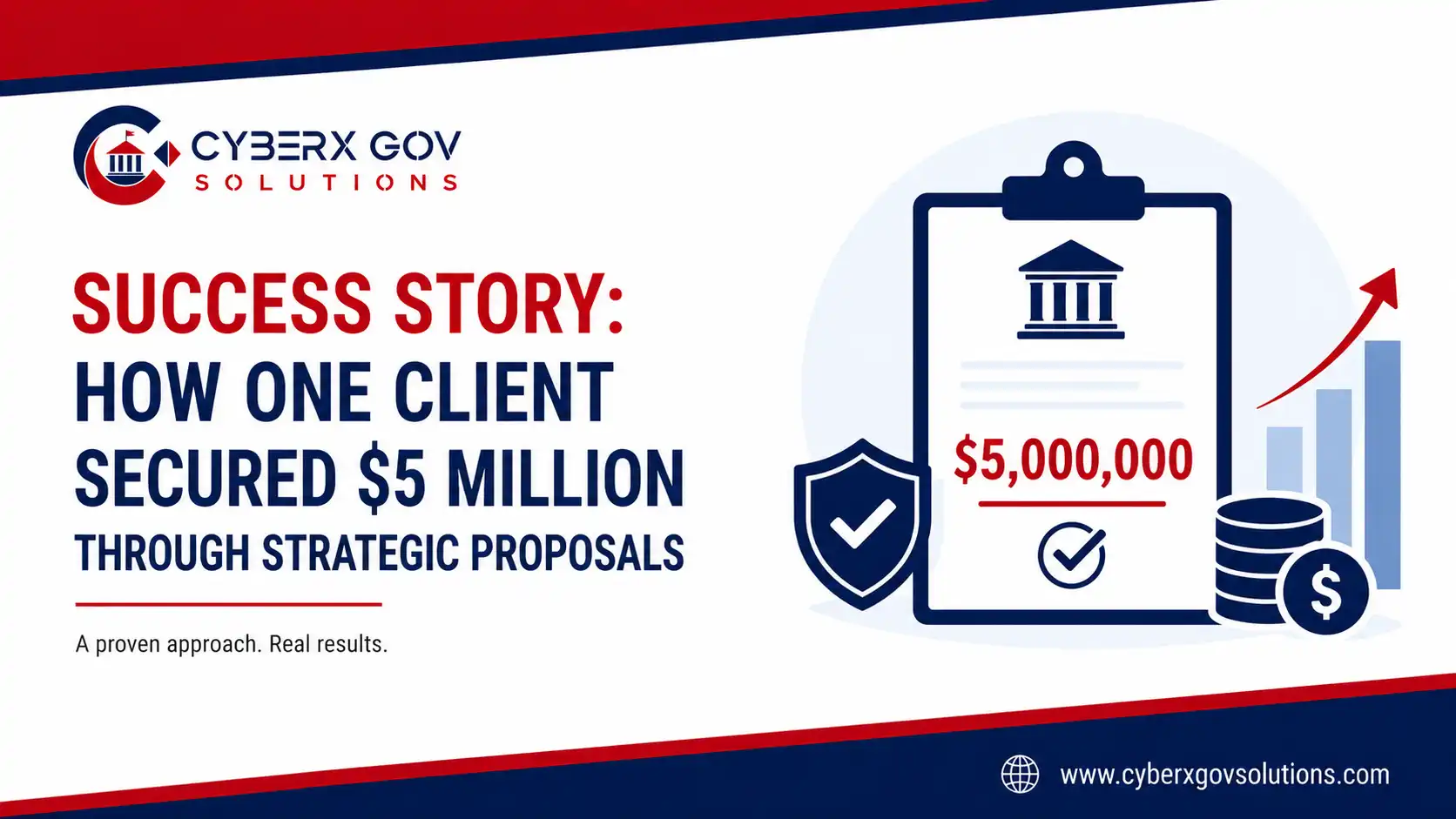
When a client wins a $5 million funding year, it rarely happens by accident. It happens because someone treats proposals as a discipline, not a scramble. At CyberX Gov Solutions, that discipline is our job.
Grant competition is brutal. Industry data compiled by Instrumentl suggests only about 1 in 10 foundation proposals get funded. Federal awards are just as tight. And yet the money is real. U.S. foundations give more than $100 billion to causes each year, according to Giving USA. Roughly 30% of nonprofits that file an IRS Form 990 receive government grants, per Candid, and those grants total more than $303 billion each year.
This is the story of one client we supported through our proposal writing services. Hands-on, strategic help turned a run of near-misses into a $5 million funding year. It shows what professional proposal support can do, and it is the kind of result more organizations are looking for.
Here is the work behind it and what your organization can borrow from the same approach.
Overview of Our Journey
The client came to us in a familiar spot. Strong mission, committed staff, and a growing pile of rejected applications. Funding arrived in small, unpredictable bursts. No one owned the grant process from start to finish.
We changed that first. We made proposals for a system instead of a scramble. Working across several funding cycles, that system turned scattered attempts into a $5 million funding year.
Here is how we did it.
Defining Our Funding Goals Clearly
Our first move cost nothing but focus. We helped the client set clear, specific funding goals to build confidence and direction in their efforts. This clarity ensures they feel in control and motivated to pursue the right opportunities. Our first move cost nothing but focus. We helped the client stop chasing every open grant and define exactly what they needed and how much, illustrating how setting specific, measurable goals can lead to more successful proposals.
Vague goals produce vague proposals, and funders spot them fast. So we broke the funding target into specific, fundable pieces. Each one was tied to a measurable outcome.
This clarity did two jobs. It filtered out poor-fit grants. And it gave every proposal a sharp, honest ask that reviewers could trust.
Building a Dedicated Proposal Team
Grant writing fails when it is nobody’s real job. According to GrantStation data, most grant-seeking organizations lean on just one or two people to carry the load.
We brought structure. Our team handled proposal strategy, writing, and compliance. The client’s program staff supplied the on-the-ground detail that made each submission credible.
The client did not need to hire overnight. They needed clear ownership and a repeatable process. That combination raised both output and quality.
Analyzing Successful Proposal Examples
We reviewed strong past proposals and public abstracts of awarded federal grants, helping the client feel empowered with insights that improve their understanding and confidence in crafting winning proposals.
We looked for patterns. How was the problem framed? Where did the data sit? What made a budget easy to follow?
This step is easy to skip and costly to miss. Studying winners teaches structure faster than any template.
Developing Strong Relationships with Funders
We helped the client open Conversations with funders long before deadlines, fostering trust and making them feel supported and valued in the process. Cold proposals rarely win big. We helped the client open conversations with funders long before any deadline.
That meant short, specific questions to program officers, attendance at funder webinars, and honest requests for feedback on past rejections. Many funders answered.
Relationships do not replace a strong proposal. They earn it a fair reading. A funder who knows the work reads the request with context, not suspicion.
Crafting Compelling Narratives and Data
The biggest gains came in the writing. We moved the client’s proposals from activity lists to clear stories backed by evidence.
Every proposal followed a simple arc: the problem, the people affected, the plan, and the proof it would work. We paired each claim with data. Then we gave it a human face with a short, real example.
We also cut jargon. Reviewers read many applications in one sitting. Plain language and clean formatting help a strong proposal score well.
Implementing Feedback for Proposal Improvement
No proposal left our hands on the first draft. We ran each one through a structured review, similar to the color-team reviews used in federal proposal writing.
One reviewer checked the story and logic; a second checked compliance against every requirement in the guidelines. A third read it cold, the way a stranger would, to catch confusing spots.
We treated every rejection as data. When a proposal was lost, we logged why and fixed that weakness in the next one.
Conducting Targeted Outreach to Funders
With a strong process in place, we went on offense. Instead of waiting for the perfect grant, we mapped funders whose missions matched the client’s work.
We built a simple pipeline. It tracked each funder’s priorities, typical grant sizes, and deadlines. We ranked opportunities by fit, not just by dollar amount. A smaller, well-matched grant often beats a large, unlikely one.
This focus protected everyone’s time. Federal proposals alone can take more than 100 hours each, according to sector estimates. Those hours belong to the right targets.
Celebrating Our $5 Million Success
The $5 million did not arrive in one check. It added up across foundation grants, a federal award, and renewed multi-year commitments.
We celebrated with the client, then captured what worked while it was fresh. Winning language, strong data points, and clean budget templates went into one shared library.
That library became a lasting asset. The client’s next funding cycle started from strength, not from scratch.
Key Takeaways for Clients
You do not need a bigger team to raise more money. You need a better system. The playbook behind this client’s success comes down to a few repeatable moves:
• Set specific funding goals tied to measurable outcomes, then only apply where you fit.
• Give the proposal process clear owners and protected time.
• Study funded proposals before you write your own.
• Build relationships with funders months before you submit.
• Pair every claim with data and a real example.
• Review every draft against the guidelines and learn from every rejection.
None of these steps is complicated. Done together and done consistently, they change outcomes. That is the approach we bring to every client.
Work With CyberX Gov Solutions
Federal grants and contracts follow strict rules, and one missed requirement can sink a strong bid. That is where expert support pays off.
Our proposal development service covers the full process. We map compliance requirements, build win themes, write technical and past-performance sections, and run quality reviews before submission. This is the same disciplined approach behind the client story above.
We support organizations, small businesses, and contractors preparing to bid on federal opportunities. The goal is simple. Protect your team’s time and sharpen your odds.
Conclusion
A $5 million funding year is not luck. It is the result of clear goals, real relationships, honest data, and a proposal process that improves with every draft.
The money is out there; for instance, foundations gave more than $117 billion in 2025, and government grants reach over 100,000 nonprofits each year. The organizations that win are not always the largest. They are the ones who treat proposals as strategy.
Your mission deserves that same discipline, and you do not have to build it alone.
Ready to strengthen your next proposal?
CyberX Gov Solutions helps organizations and small businesses build compliant, competitive proposals from start to finish.
Explore our services at cyberxgovsolutions.com or schedule a free consultation at cyberxgovsolutions.com/schedule-a-meeting/.
Frequently Asked Questions
How long does it take to write a strong grant proposal?
It varies by funder. Foundation proposals often take 15 to 20 hours, while federal proposals can take more than 100 hours, according to sector estimates. A reusable content library cuts down on time for future applications.
What is a color-team review?
It is a structured review process borrowed from federal proposal writing. Different reviewers check the proposal at different stages for strategy, compliance, and clarity. The goal is to catch problems before a funder does.
Do small businesses really win federal grants?
Yes. Federal grant programs fund organizations of many sizes, and Candid reports that smaller businesses do receive government grants, just at lower rates than larger ones; strong compliance and a clear, evidence-based proposal matter more than size.
What does a proposal writing service actually do?
A good service manages the full process: strategy, compliance mapping, writing, and quality review. It works alongside your team, which supplies program knowledge. The result is a cleaner, more competitive submission with less strain on your staff.
Should we hire a professional proposal writer?
It depends on your goals and complexity. Federal proposals, in particular, reward experience with compliance and win-theme development. Professional support can raise quality and free your staff, though no service can guarantee an award.
What is the difference between a grant and a federal contract?
A grant funds a project or program that serves a public purpose. A federal contract pays your organization to deliver specific goods or services to the government. Both use formal proposals, but the rules and evaluation criteria differ.
Note: Client details are kept anonymous to protect confidentiality. The funding approach and result described reflect real proposal work. All external statistics are sourced.