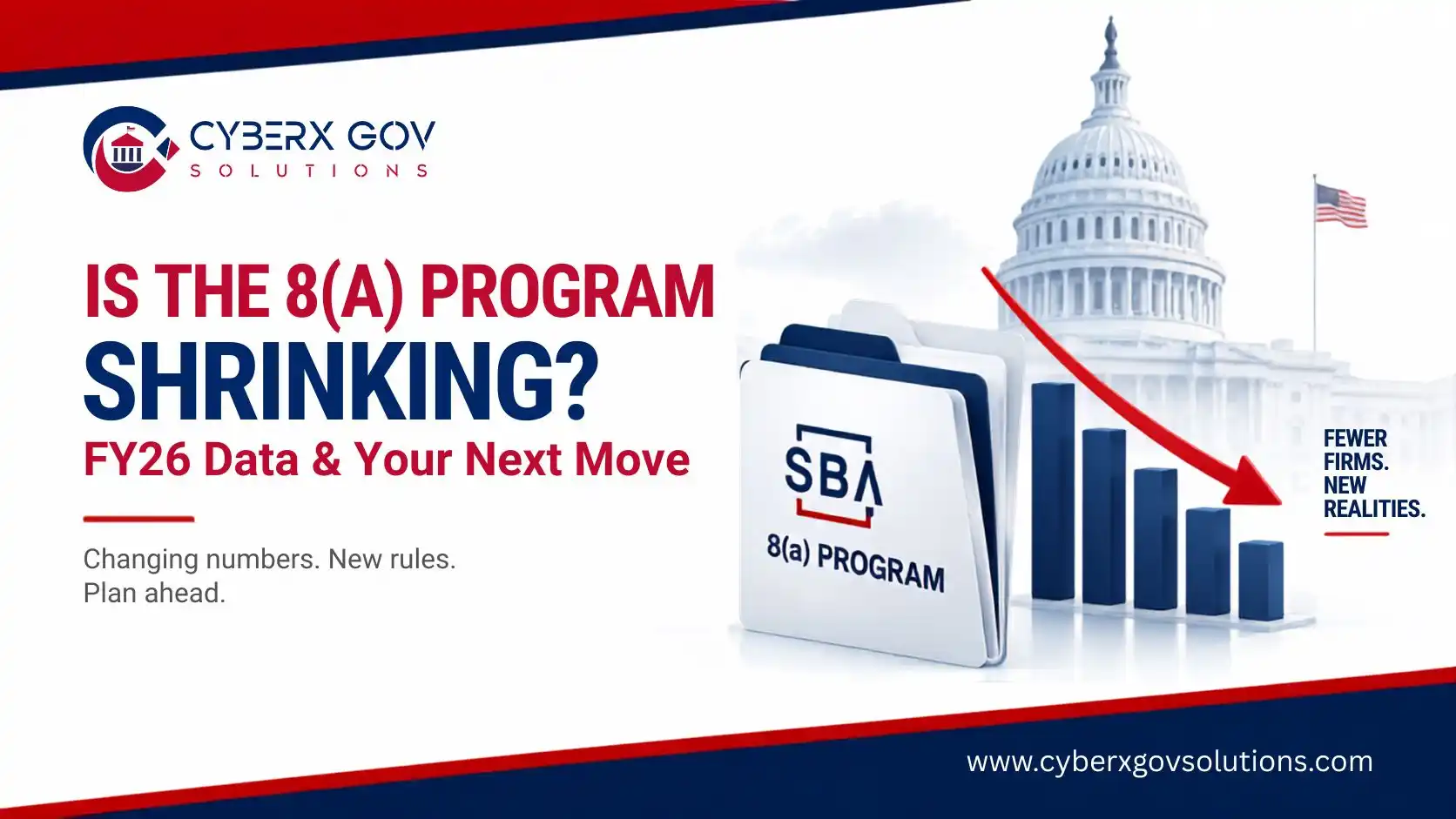
The count says it plainly. In about four months, the 8(a) program shed nearly 900 firms. That is no rounding error. It is the steepest drop the program has posted in years, and it landed at the same moment the rules for getting in were being rewritten.
So take the honest answer first: the 8(a) program is shrinking, yet it is not vanishing. It still runs, still hands out sole-source and set-aside contracts, and still works as an on-ramp for small disadvantaged businesses. What has moved is the eligibility bar, the number of active firms, and the amount of certainty you can lean on. This guide sorts the verified data, tells the real changes apart from the noise, and maps a practical next step whether you already hold the certification, are mid-application, or are still deciding to start.
Key Takeaways
• Participation fell sharply in early 2026, from roughly 4,300 firms to under 3,400, per SBA data.
• The 8(a) program is contracting, not closing. Sole-source and set-aside authority are still in force.
• A new rule reset the eligibility test for individually owned firms on September 10, 2026.
• Entity-owned firms are untouched by that rule, a split most headlines gloss over.
• Opening a second set-aside lane is the cleanest way to cut your exposure.
What Is Happening to the 8(a) Program?
The 8(a) program is experiencing its deepest contraction in years, with active membership dropping by nearly 25% in early 2026, but it remains operational and relevant for small businesses.
The 8(a) Business Development Program is the U.S. Small Business Administration’s on-ramp for small firms owned by socially and economically disadvantaged individuals. It carries a nine-year term, sole-source awards, and set-aside competition. None of that framework changed. The shift is in the conditions around it.
Three pressures hit together: a run of audits and oversight, a court-driven rewrite of the eligibility test, and a freeze on newcomers. Put them side by side, and the drop in the numbers explains itself.
The FY26 Data: How Far the Numbers Fell
Begin with participation, since it reads the clearest.
When 2026 opened, about 4,300 firms held active 8(a) status. By spring, the count slipped under 3,400. One window in April 2026 alone knocked out close to 500 firms, most of them for missing a mandatory data call.
Expert tip: A termination for non-response is avoidable. When SBA asks for records, treat the deadline as firm. The firms that answered held their status. The firms that stayed silent lost it.
The oversight push is documented, not a rumor. In December 2025, SBA told every 8(a) participant to turn in three years of financial records, from bank statements to ledgers to payroll registers, by a January 5, 2026 deadline. SBA Administrator Kelly Loeffler linked the demand to fraud, citing a Department of Justice case built around a $550 million scheme and suspensions covering more than $253 million in awards.
New approvals dried up as well. SBA has cleared no new 8(a) applications since August 2025, so the usual inflow that offsets normal graduation has gone quiet. Exits keep coming, entries stop, and the total falls fast.
What the Set-Aside Dollars Show
Head counts are only half the picture. The dollars show the program’s contracting weight is still heavy.
The newest complete federal scorecard runs through Fiscal Year 2024. It is the most recent full dataset on hand, so read FY26 as the trend in participation, not yet in final award totals.
For FY2024, the government reported the following:
| Set-Aside Category | FY2024 Obligations | Notes |
| All small businesses | $183.5 billion | Over 28% of eligible prime contracts |
| Small business set-asides | $69.6 billion | Reserved competition |
| Small disadvantaged business | $78.3 billion | 12.3% against a 13% goal |
| SDVOSB | $32.8 billion | Service-disabled veteran-owned |
| WOSB | $31.7 billion | Women-owned |
| HUBZone | $17.6 billion | Historically underutilized zones |
One point needs care here. The small disadvantaged business (SDB) number is wider than the 8(a) program. Every 8(a) firm counts as an SDB, but not every SDB dollar passes through 8(a). Blogs that read the $78.3 billion as pure 8(a) spending inflate it. The sound reading: demand for disadvantaged-business work is great and funded, and 8(a) is one lane inside it.
The Rule Change: What Actually Changed on September 10, 2026
Starting September 10, 2026, individually owned firms can no longer lean on a presumption of social disadvantage tied to race or ethnicity. They now have to point to a specific instance of bias and self-certify the harm it caused.
This change primarily affects individually owned firms, requiring them to provide specific evidence of social disadvantage, while entity-owned firms remain unaffected.
For decades, applicants from certain racial and ethnic groups were presumed socially disadvantaged and could qualify on that footing. A 2023 federal court decision, Ultima Services Corp. v. USDA, held that the presumption was unconstitutional. After the ruling, applicants had to submit a personal narrative. The new final rule goes one step further and strikes the presumption from the regulation altogether for individually owned firms.
Under the reset test, an individual applicant has to clear two bars:
- Point to a specific action by a government or private entity that favored other groups or held theirs back.
- Self-certify that they belonged to that group when it happened and took material harm as a result.
SBA puts the reach of the change at roughly 4,190 applicants a year. It also confirmed that current participants mts csx already socially disadvantaged will not have to prove it a second time.
Who Is Not Affected
Here is the split most coverage skips. The rule applies only to individually owned firms. It leaves entity-owned 8(a) participants alone: tribally owned firms, Alaska Native Corporations, Native Hawaiian Organizations, and Community Development Corporations. Those firms qualify on a separate legal footing and keep both their status and their sole-source edge, which for entity-owned firms can climb well past the standard thresholds.
If a headline hints that the entire 8(a) program was struck down, that is the piece to correct. One eligibility path changed. The other held.
Is the 8(a) Program Going Away?
No. Congress has not repealed the program, and its contracting authority stands. But “not going away” is a long way from “business as usual.”
The realistic near-term picture reads like this:
- Fewer active firms, which can mean thinner competition for those who stay eligible.
- A stricter, evidence-based entry test for individually owned applicants.
- A pause on new approvals with no promised date for lifting it.
- Heavier oversight that rewards clean records and penalizes slow answers.
Plan around a smaller, tighter program rather than a disappeared one. That framing produces better calls than either panic or denial.
Your Next Move: A Practical Playbook
What you should do depends on where you stand today. Match your situation to the row that fits.
| Your Situation | Priority Move |
| Current 8(a) participant | Defend your status: answer every data call, keep records clean, and work your remaining term hard |
| Mid-application (individually owned) | Rebuild your social disadvantage narrative around specific, documented instances of harm |
| Entity-owned firm | Hold course: your eligibility path is intact, so pour effort into capture and past performance |
| Shut out or graduating | Stand up a second set-aside lane and compete in full-and-open work |
For most small contractors, the common thread is diversification. Pinning most of your revenue to a single certification was always a gamble. The FY26 data turns that gamble into something you can see.
Build a Second Set-Aside Lane
The upside in the scorecard is that 8(a) is not the only funded route. Depending on your ownership and profile, other set-aside programs move real money:
- Women-Owned Small Business (WOSB) when the firm is majority women-owned.
- Service-Disabled Veteran-Owned Small Business (SDVOSB) for qualifying veteran owners.
- HUBZone is when your principal office and staff sit inside a qualified area.
Each carries its own rules, and each opens up competition that does not ride on your 8(a) standing. Chasing one before you need it beats scrambling after a graduation date by a wide margin.
Expert tip: Do not put off past performance outside the program until your 8(a) term runs out. Win at least one competitive, full-and-open contract while the 8(a) cushion still holds. That track record is what carries you once the term ends.
Common Mistakes to Avoid Right Now
- Ignoring a data call. In 2026, silence is the quickest exit from the 8(a) program.
- Assuming the program ended. It did not, and acting on that belief throws away real work.
- Reading SDB dollars as 8(a) dollars. Size your pipeline on the correct figure.
- Staking everything on one certification. Concentration risk is exactly what the current data punishes.
- Reusing an old social disadvantage narrative. The reset test wants specific instances, not broad statements.
When to Seek Professional Support
Call in help when the stakes or the complexity climb. Rebuilding a social disadvantage narrative under the new standard, choosing which second set-aside to chase, or repositioning a firm aging out of the 8(a) program are all calls where a seasoned GovCon advisor earns the fee. A wrong turn here costs the pipeline, not just hours.
How CyberX Gov Solutions Can Help
Reading the 8(a) program data is one job. Turning it into a plan for your business is another.
CyberX Gov Solutions helps small and growing contractors position themselves for the federal market through its Get Fed Ready™ program, covering federal readiness, opportunity fit analysis, and capability statement development. If the FY26 shift means you need a second lane, that is exactly the strategic work the program backs.
Once you are ready to chase a specific opportunity, our federal proposal development support helps you compete on set-aside and full-and-open work with compliant, competitive submissions. The goal stays simple: keep your pipeline strong no matter how one program’s numbers move.
Conclusion
The FY26 data sends a clear message. The 8(a) program is shrinking, the entry rules for individually owned firms have tightened, and oversight is heavier than it has been in years. At the same time, the program still awards contracts, entity-owned firms stay fully eligible, and billions in set-aside demand still move every year.
The contractors who come through this in good shape will not be the ones who panic, and not the ones who pretend nothing moved. They will be the ones who defend their current standing, read the 8(a) program signals with clear eyes, and build a second path before the need is urgent. Treat this stretch as a cue to diversify, and a smaller program turns into a manageable risk instead of a cliff.
Not sure what the 8(a) changes mean for your pipeline?
CyberX Gov Solutions helps small federal contractors read the shift and set a resilient path forward through Get Fed Ready™ and expert proposal development.
Schedule a free consultation at cyberxgovsolutions.com/schedule-a-meeting and turn the FY26 data into your next move.
Frequently Asked Questions
Is the 8(a) program going away in 2026?
No. The 8(a) program still runs and still awards sole-source and set-aside contracts. It is shrinking, not closing. Active membership fell below 3,400 firms in spring 2026, and new approvals paused, but the program’s contracting authority stays in place for eligible firms.
How many firms left the 8(a) program in 2026?
Active membership dropped from about 4,300 firms at the start of 2026 to under 3,400 by spring, a loss of nearly 900 firms. One window in April 2026 removed close to 500 firms at once, most for missing SBA’s mandatory financial data call.
Can I still get 8(a) certified in 2026?
The program still allows for new participants in principle, but SBA has approved no new 8(a) applications since August 2025, and the eligibility test changed on September 10, 2026. Individually owned applicants must now prove social disadvantage with specific evidence rather than rely on a group-based presumption.
How do I prove social disadvantage under the new 8(a) rule?
You have to point to a specific action by a government or private entity that disadvantaged your group, then self-certify that you belonged to that group at the time and suffered material harm. Broad statements no longer clear the bar. The new standard wants documented, individual instances of bias.
Does the new 8(a) rule affect tribal and Alaska Native firms?
No. The rule changes eligibility only for individually owned firms. Entity-owned participants, including tribally owned firms, Alaska Native Corporations, Native Hawaiian Organizations, and Community Development Corporations, are untouched and keep their status and sole-source advantages.
Are current 8(a) participants required to requalify?
No. SBA confirmed that individuals already found socially disadvantaged do not have to establish that status again. The new evidence test applies to pending and future individually owned applications, not to participants who already hold 8(a) status.
What are alternatives to the 8(a) program?
Other set-aside programs carry real funding, including Women-Owned Small Business (WOSB), Service-Disabled Veteran-Owned Small Business (SDVOSB), and HUBZone. Full-and-open competition is available as well. Building a second set-aside lane trims your dependence on any single certification.
Why is SBA auditing 8(a) firms so aggressively?
SBA points to fraud concerns, including a Department of Justice case built around a $550 million scheme and suspensions covering more than $253 million in awards. In December 2025, it ordered every participant to submit three years of financial records. Firms that responded kept their status.