Most losing bids are not beaten by a better competitor. They are eliminated on a technicality.
A government evaluator opens your proposal, checks it against a scorecard, and looks for specific answers in specific places. Miss one requirement or bury a response, and your bid can be set aside before anyone reads your solution. That is the hard truth behind federal proposal writing services: winning is less about clever words and more about disciplined compliance.
This guide shares seven secrets the best proposal teams use to score higher and win more. Whether you write in-house or hire help, these principles apply to every RFP, RFQ, and task order you touch.
Key Takeaways
- A compliance matrix built from Sections L and M is the single most important step in any winning bid.
- Evaluators score what they can find fast. Answer each requirement exactly where they expect it.
- Proof beats promises. Lead with quantified past performance, not adjectives.
- In fiscal year 2024, federal agencies awarded a record $183.5 billion in prime contracts to small businesses, so the opportunity is real.
- A 30% win rate is considered strong in government contracting, which shows why process matters more than luck.
What Are Federal Proposal Writing Services?
A federal proposal writing service is professional support that helps a business respond to a government solicitation with a compliant, persuasive, and complete bid. It covers strategy, a compliance matrix, section writing, pricing narrative, proposal evaluation prep, and final submission.
Think of it as turning a dense 100-page RFP into a clear response an evaluator can score quickly. The service exists because government contracting follows strict rules. One formatting slip or one unanswered requirement can disqualify an otherwise strong company.
What a Good Proposal Partner Actually Does
Strong providers do not just write. They translate the language of government agencies, map every requirement, and position your strengths where they earn points. That is the difference between a submitted bid and a scored winner.
Secret 1: Build the Compliance Matrix Before You Write a Word
The pros never open a blank page and start writing. They build a compliance matrix first.
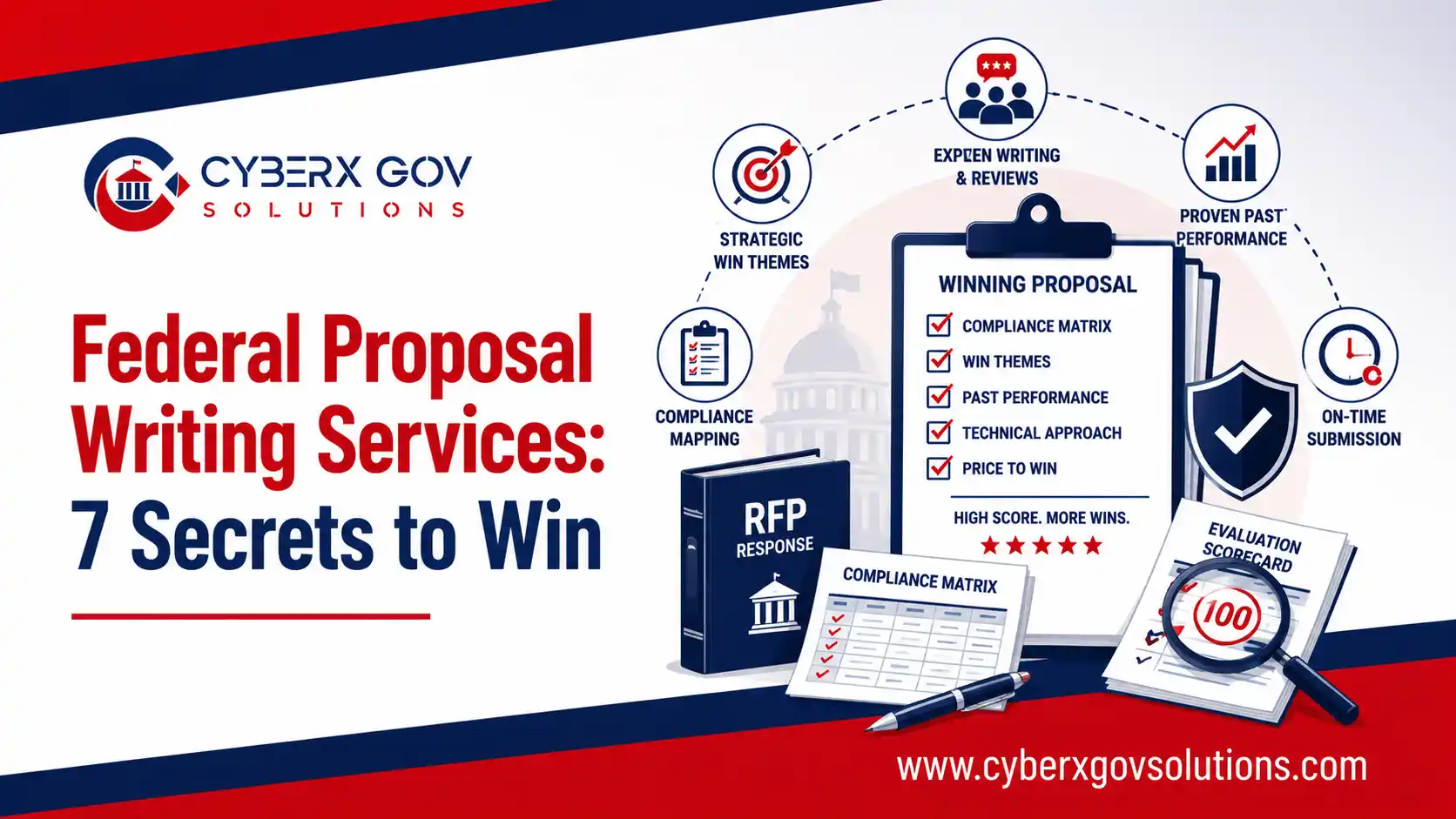
A compliance matrix is a table that ties every requirement in the solicitation to the exact place your proposal answers it. You pull those requirements from Sections L and M of the RFP. Section L tells you how to respond. Section M tells you how you will be scored.
Miss a single item and evaluators may treat your response as if it were never there. Build the matrix first, then write to match it. This one habit separates winning bids from amateur ones.
Expert tip: If a requirement lives in an attachment or a buried clause, add it to your matrix anyway. Evaluators still expect an answer.
Use this quick checklist to build one:
- Pull every “shall,” “must,” and “will” statement from Sections L and M.
- Add requirements hidden in the Statement of Work and attachments.
- Give each requirement a row and a unique ID.
- Note where your proposal answers it (volume, section, page).
- Assign an owner and a status for each row.
- Review the full matrix before you write, and again before you submit.
Want a head start? Grab our free compliance matrix checklist template and drop your requirements straight in.
Secret 2: Answer Every Requirement Exactly Where Evaluators Look
Evaluators do not hunt for your answers. If they have to search, they often score the response as missing.
Mirror the solicitation’s structure and language. When Section M lists an evaluation sub-factor, give it a matching heading. Use the agency’s own terms instead of your internal jargon. This makes scoring effortless and keeps your points from slipping away.
Answer the question first, then explain. Lead each section with a direct statement that satisfies the requirement, followed by your method, staffing, and timeline.
Secret 3: Lead With Proof, Not Adjectives
Saying you are “the best” wins nothing. Numbers do.
Federal evaluators weigh three things heavily: technical competence, compliance, and past performance. Past performance is your record of similar contract work used to judge whether you can deliver. Show it with specifics.
Replace “we have extensive experience” with “we completed 14 similar task orders on schedule with a 98% customer satisfaction rating.” Concrete results build the trust that adjectives cannot.
Secret 4: Write for a Tired Evaluator
Your reader is reviewing dozens of proposals against a checklist. Clarity wins.
Even a strong solution fails when it is hard to follow. Use short sentences, plain words, and clean formatting. Break long blocks into bullet points and tables. Put the answer up front so a rushed reader still catches it.
Simple beats clever every time in federal bids. When your proposal is easy to score, evaluators reward it.
Secret 5: Develop Win Themes During Capture, Not After
Winning starts before the RFP drops. It starts during capture planning.
Capture planning is the pre-proposal work of researching the opportunity, the agency, and the competition so you can position early. Use it to build win themes, which are the two or three reasons your solution is the right choice for this specific customer. Done well, it turns your strengths into a clear competitive advantage.
Weave those themes through every section. A proposal with a clear, repeated theme reads as intentional. One written the night the RFP arrives reads as generic.
Secret 6: Price to Win With a Defensible Basis of Estimate
Lowest price does not always win. Credible price does.
Back your numbers with a basis of estimate that shows your math: labor hours, rates, materials, and assumptions. Evaluators need to see that your price is realistic for the work described. A number with no logic behind it signals risk.
Newcomers to the federal market often underestimate their own proposal and delivery costs. Budget realistically so you can perform the contract profitably after you win it.
Secret 7: Give Yourself Time for Real Reviews
Rushed proposals lose. Reviewed proposals win.
Professional teams use color-team reviews: structured checkpoints where fresh eyes read the draft against the compliance matrix and Section M. A Pink Team checks the early draft. A Red Team scores it as an evaluator would. A Gold Team gives final polish.
Then submit early. Portal glitches and last-minute uploads sink good bids every year. Plan your schedule backward from the deadline and protect the review days.
Common Mistakes That Sink Federal Bids
Even experienced contractors repeat the same errors. Watch for these:
- Skipping the compliance matrix and writing from memory.
- Reusing an old proposal without tailoring it to this solicitation.
- Ignoring page limits, font rules, and file format instructions.
- Making claims with no data or past performance to back them.
- Leaving no time for reviews or a pricing sanity check.
Each mistake is avoidable. A disciplined process, in-house or through professional proposal support, catches them before submission.
When to Seek Professional Support
You do not need help on every bid. But some situations raise the stakes.
Consider professional support when the contract is large or multi-volume, when the deadline is tight, when you are bidding your first federal opportunity, or when your team is stretched thin. The federal opportunity is significant. Agencies awarded more than 28% of eligible prime contracts to small businesses in fiscal 2024, and set-asides reserve many contracts for qualifying small firms.
A skilled partner adds structure, an outside perspective, and review discipline when it matters most.
How Much Does a Federal Proposal Writer Cost?
A proposal writing service usually prices its work one of three ways. The right fit depends on how often you bid and how complex your proposals are.
- Flat fee per proposal. You pay a set price for one bid. This is the most common model for a single RFP or RFQ, because you know the number up front. Price scales with the size and volume count of the solicitation.
- Hourly or day rate. You pay for time spent. This suits smaller tasks, a compliance review, or help on one volume rather than a full proposal.
- Monthly retainer. You pay a recurring fee for ongoing support across several bids. This works for contractors with a steady pipeline.
Two honest notes. First, avoid any provider that charges a percentage of the contract award. Contingency pricing is widely rejected in federal work and raises ethics concerns. Second, budget realistically. Newcomers to the federal market often underestimate proposal costs by a factor of two or more.
Expert tip: Ask for a fixed scope in writing before work starts. A clear deliverables list tied to your solicitation protects both sides and prevents surprise invoices.
How to Choose a Federal Proposal Writing Service
Not every provider is a fit. Use these criteria to compare providers before you sign.
- Federal-specific experience: Confirm they know FAR rules, Sections L and M, and the color-team review process. Commercial proposal experience alone is not enough.
- A defined process: Strong providers scope each opportunity, share a compliance matrix, and give you a schedule. Vague promises are a warning sign.
- Relevant past performance: Ask what agencies and contract types they have supported. Look for work similar to your target.
- Transparent pricing: You should get a clear quote and deliverables list, not a moving target.
- Review discipline: Ask how they run reviews and quality checks. A team without a review step will miss compliance gaps.
Watch for red flags too: guaranteed-win claims, no compliance matrix in their process, contingency pricing, and no interest in your capture or win themes. Good partners educate you and improve your process, not just hand back a document.
How CyberX Gov Solutions Can Help
CyberX Gov Solutions provides end-to-end federal proposal support through its Proposal Development offering. The team supports the full cycle: a proposal readiness assessment, a compliance matrix and requirements mapping, win theme and strategy development, and writing across the proposal technical, management, staffing, and past performance sections.
Support does not stop at the draft. CyberX handles proposal reviews and quality checks, pricing narrative support, subcontractor and teaming coordination, and final submission. The team works with small businesses, prime contractors, and subcontractors on RFPs, RFQs, and task orders.
If you are new to the federal marketplace, the Get Fed Ready™ program helps you build the foundation first, from SAM.gov registration support to a strong capability statement.
Conclusion
Winning federal work is a process, not a gamble. The seven secrets above show what strong federal proposal writing services do differently: they build the compliance matrix first, answer every requirement in place, prove their claims with numbers, and leave real time for reviews.
Apply even a few of these and your next bid will score higher. Apply all seven and you compete like the teams that win consistently. The opportunity is large and the rules are learnable. With the right process behind your proposal, your small business can compete and win.
Ready to strengthen your next bid? CyberX Gov Solutions helps small businesses and contractors build compliant, high-scoring proposals through its federal proposal writing services.
Schedule a free consultation at cyberxgovsolutions.com/schedule-a-meeting/ and put a proven process behind your next submission.
Frequently Asked Questions
How much do federal proposal writing services cost?
Costs vary with the size and complexity of the bid. A short RFQ response costs far less than a large, multi-volume RFP. Newcomers often underestimate the effort involved. Most reputable providers scope each opportunity individually and give a clear price before work begins, so ask for a quote tied to your specific solicitation.
Do I need a proposal writer to win a government contract?
No, but professional help improves your odds on complex or high-value bids. If your team lacks time, federal proposal experience, or review capacity, a writer adds structure and compliance discipline. Many businesses start in-house and bring in support when the stakes rise.
What is a compliance matrix in a federal proposal?
A compliance matrix is a table that links every requirement in the solicitation to the exact place your proposal answers it. You build it from Sections L and M of the RFP. It keeps you from missing requirements that could disqualify your bid before evaluation.
What are Sections L and M in a government RFP?
Section L contains the instructions for how to prepare and submit your proposal. Section M lists the evaluation factors the agency uses to score bids. Reading both first tells you exactly what to write and how points are awarded.
How long does it take to write a federal proposal?
It depends on the solicitation. A simple RFQ might take a few days, while a large RFP can take several weeks. Building the compliance matrix, drafting sections, running color-team reviews, and finalizing pricing all add time, so start as early as the schedule allows.
Can a startup win a federal contract with no past performance?
Yes. New businesses can highlight the relevant experience of key staff, cite commercial or subcontract work, and pursue set-asides designed for small firms. Teaming with an established prime as a subcontractor is another proven path to build a track record.
What is a good win rate for government proposals?
A win rate around 30% is considered strong in federal contracting. Rates vary by market and competition, but a repeatable, compliant process is what pushes your average up over time.