You won the contract. Congratulations. Now you have 30 days to hire staff, buy materials, and start the work, but you will not see a payment for another two to three months.
That gap sinks more small contractors than losing bids ever will. The U.S. Small Business Administration attributes roughly 82% of small business failures to cash flow problems, not to a lack of profit. A company can be profitable on paper and still run out of money before the first check clears.
This is where government contract financing comes in. Done right, it turns that scary gap into a manageable timing issue. Done at the last minute, it costs you far more than it should. Below is how the money actually moves, what your options cost, and how to plan before the award lands.
Why Winning a Contract Does Not Mean Getting Paid
Federal agencies pay on their own schedule, and it is slower than most new contractors expect.
Under the Prompt Payment Act, the government must pay a proper invoice within 30 days of receiving it, or 30 days after it accepts the work, whichever comes later. These rules live in the Federal Acquisition Regulation (FAR), the rulebook for federal buying. For construction, the agency has 14 days to make progress payments and 30 days for final payment, including retainage.
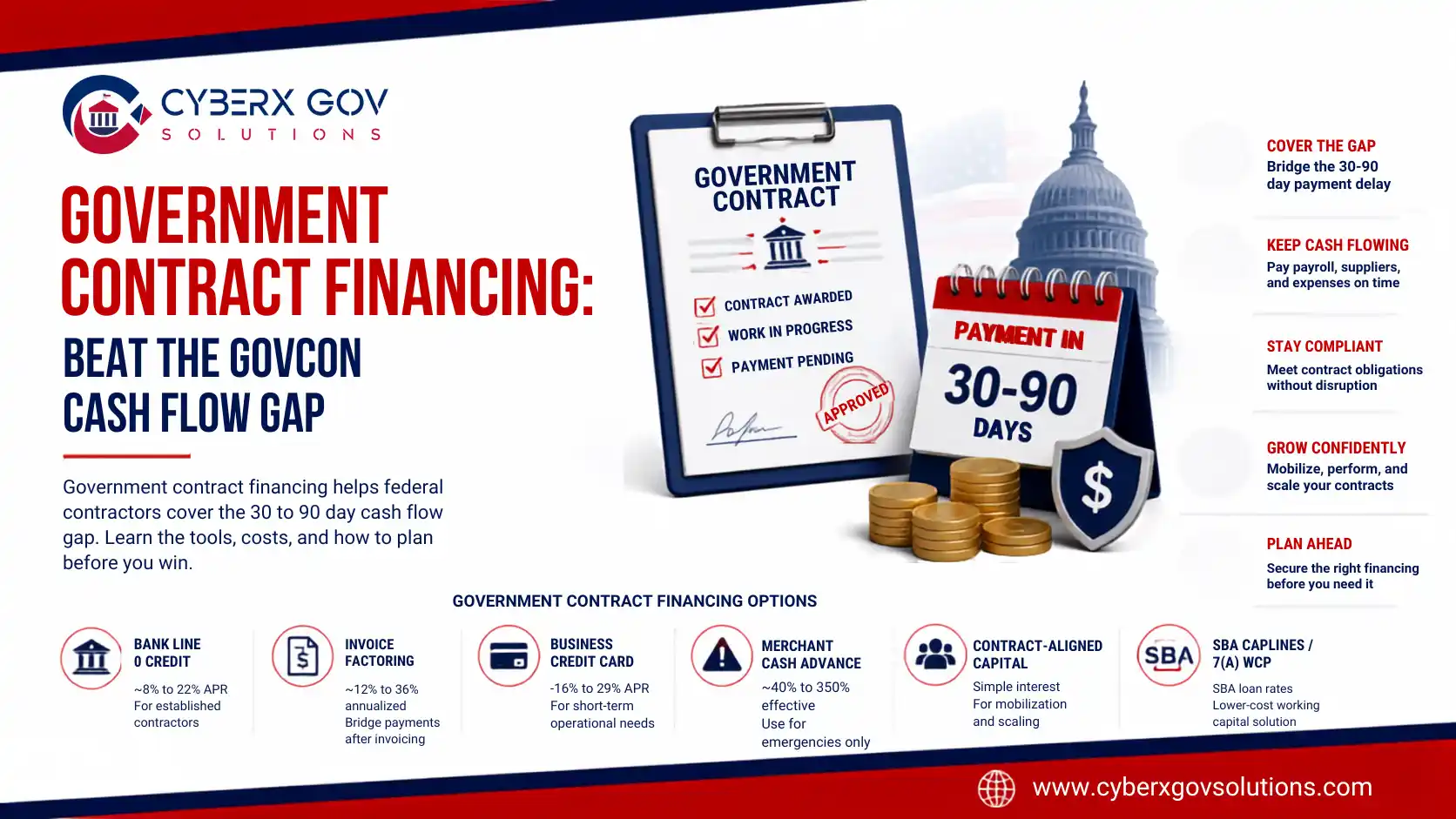
That sounds reasonable until you add up the full timeline. You spend money to mobilize. You perform the work. Then you invoice. Then the clock starts. In practice, the stretch from spending your first dollar to banking the government’s payment often runs 30 to 90 days.
The catch is that payroll, rent, and suppliers do not wait 90 days. Your employees expect to be paid on the normal cycle, usually every two weeks.
The Real Problem Is Timing, Not Profit
Most cash flow trouble is not a sign of a bad business. It is a sign of a normal one that ran out of runway.
The JPMorgan Chase Institute studied 597,000 small businesses in its “Cash is King” report. The median company held just 27 days of cash buffer, meaning it could cover only 27 days of expenses if money stopped coming in. A quarter of businesses held 13 days or fewer.
Now put that next to a 60 or 90 day payment cycle. The math does not work without a plan. This is the core issue government contract financing solves: you incur costs now and get paid later, so you need a bridge across that gap.
Why Waiting Until Award Costs You More
Here is the mistake specialists see again and again. Contractors start looking for money only after they win the work.
By then, it is often too late. Getting financing takes time. You have to compare products, talk to lenders, submit documents, and clear underwriting and approval. If you only have 30 days to mobilize, you cannot rush a good facility into place.
So you take what you can get fast. And fast money is expensive money. A merchant cash advance, one of the quickest options, carries factor rates that translate to an effective annual cost of roughly 40% to 350%. You can absolutely find someone to fund you in 48 hours. You will just pay a painful price for that speed.
The better move is to research your options before you need them. It costs you nothing but time, and it puts you in control when the award email arrives.
The Government Contract Financing Toolkit
No single product is good or bad. Each is a tool with a right time and place. Here is how the main options compare.
| Financing Tool | Typical Cost (2026) | Best For | Main Limitation |
| Bank line of credit | ~8% to 22% APR | Mature contractors smoothing steady operations | Slow to approve; backward-looking underwriting |
| Invoice factoring | ~12% to 36% annualized | Bridging delayed payments after you invoice | Needs an existing invoice; useless for mobilization |
| Business credit card | ~16% to 29% APR | Small bridge costs like travel and software | Dangerous and costly for payroll |
| Merchant cash advance | ~40% to 350% effective | Emergencies only | Extremely expensive; a reactive trap |
| Contract-aligned capital | Varies; simple interest | Mobilizing and scaling with your backlog | Requires awarded contracts to underwrite |
| SBA CAPLines / 7(a) WCP | SBA loan rates | Planned, lower-cost working capital | Full SBA underwriting and lead time |
A few points deserve more detail.
Bank Lines of Credit
A line of credit is great for a mature contractor with steady work. It smooths the normal gap between paying for labor and getting paid for it.
The weakness shows up during growth. If you win a contract that doubles your revenue, the bank cannot always increase your limit fast enough. Banks look backward at your balance sheet, credit score, and often a personal guarantee. That process is slow when you need speed.
Invoice Factoring
Factoring lets you sell an unpaid invoice for an advance of about 80% to 97% of its value, funded in a day or two. Because the government almost never defaults on a valid invoice, factoring federal receivables is cheaper than most commercial factoring.
The limit is built into the name. You need an invoice first. Factoring does nothing for the weeks before you have billed anything, which is exactly when mobilization costs hit.
Contract-Aligned Capital
A newer approach underwrites your contract backlog, the awarded but not-yet-billed dollars, plus your past performance. It looks forward at the work you hold rather than backward at your tax returns.
This structure can fund pre-invoice costs like payroll and materials, and the credit line can grow as your backlog grows. Some facilities are non-recourse and sit behind a surety, which helps bonded construction firms.
Government-Backed Options
Do not overlook the SBA. The Contract CAPLine finances the labor and material costs of specific contracts, up to $5 million. The SBA also runs a 7(a) Working Capital Pilot Program, launched in August 2024, offering flexible lines of credit up to $5 million aimed at small business contractors. These take planning and paperwork, but the cost is lower.
How to Match the Right Financing to the Right Problem
The worst outcome is picking a tool that does not fit the pain. Match the solution to the specific pressure you face.
- Payroll pressure: You cannot ask staff to wait. You need capital that funds labor before you invoice, such as contract-aligned capital or a pre-approved line of credit.
- Materials and technology: Trade credit with net-30 or net-60 terms may cover you. If a vendor wants payment on delivery, you need cash ready.
- Delayed payments: Once the invoice exists, factoring is a legitimate fix. Contract-aligned capital can get you there earlier.
- Growth pressure: If a bigger award would outgrow your current facility, line up something that scales with your backlog before you bid.
Build Your Capital Strategy Before You Win
Treat capital planning the same way you treat capture planning for a bid. Here is a simple three-step framework.
- Step 1: Quantify the gap. Estimate your mobilization and payroll costs, then map the likely delay before your first payment. Different contracts pay on different schedules, so know yours.
- Step 2: Build the playbook. Talk to lenders now. Learn what documents they need, how long approval takes, and which product fits which situation. You are not applying yet. You are preparing.
- Step 3: Execute on award. When the contract lands, you already have your plan. You move with confidence instead of scrambling for whatever money is left.
There is one more reason to sort this out early. Agencies sometimes evaluate whether you have enough financial capacity to perform. A contractor who cannot show access to capital can lose an award over it.
How CyberX Gov Solutions Can Help
CyberX Gov Solutions does not provide loans. What we do is help you get ready to compete and perform, which is where financial readiness fits.
Through our Get Fed Ready™ program, we help small businesses build the operational and financial readiness the federal marketplace expects. That includes federal readiness assessments, SAM.gov registration support, pricing and team readiness guidance, and ongoing advisory as you grow.
Our Proposal Development team also helps you present your capacity to perform. When an agency reviews your bid, it wants to see that you can staff, resource, and deliver. Clear pricing narratives and strong past performance sections help you make that case.
Conclusion
Cash flow is not a side issue in government contracting. It is part of how the strongest contractors run their business.
The contractors who scale treat access to capital as a planned strategy, not a fire drill. They understand the payment gap, they match the right financing to each situation, and they line up their options before the award arrives. The ones who strain wait until the pressure hits and pay for the delay.
You do not have to become a finance expert overnight. You just have to put this on your roadmap and prepare early. Do that, and you will out-execute any competitor stuck in reactive mode.
Want help getting your business ready to win and perform on federal contracts? CyberX Gov Solutions supports small contractors through the Get Fed Ready™ program and full proposal development.
Schedule a free consultation at cyberxgovsolutions.com/schedule-a-meeting/.
Frequently Asked Questions
How long does the government take to pay a contractor?
Under the Prompt Payment Act, agencies must pay a proper invoice within 30 days of receiving it, or 30 days after accepting the work. Construction progress payments are due within 14 days. Counting mobilization and billing, the full cash gap often runs 30 to 90 days.
Can I get financing before I win a government contract?
You usually cannot secure contract-based funding without an award, but you can and should prepare early. Talk to lenders, learn their requirements, and map your options in advance so you can act fast once the contract lands.
What is the cheapest way to finance a federal contract?
Planned options are almost always cheaper than emergency ones. Bank lines of credit and SBA programs like CAPLines tend to cost the least, while last-minute merchant cash advances cost the most. Cost usually drops the earlier you plan.
Is invoice factoring a good option for government contractors?
It can be, once you have submitted an invoice. Factoring federal receivables is often cheaper than commercial factoring because the government rarely defaults. It does not help with costs you face before you can bill.
Does cash flow affect winning a government contract?
Yes. Agencies sometimes assess whether a contractor has enough financial capacity to perform. Being unable to show access to capital can cost you an award, so financial readiness is part of bid readiness.
What is contract backlog in government contracting?
Contract backlog is the value of awarded work you have not yet billed or been paid for. Some lenders use that backlog, rather than your credit score, to size and underwrite working capital.